Chem 20: Unit 3: Solutions
 Call Kai
 Learn
 Practice Test
 Spaced Repetition
 Match
 Flashcards
 Knowt Play
1/98

Earn XP
Description and Tags
gr 11
99 Terms
most chemical reactions occur in a ___ environment, including all chemical reactions necessary for life, therefore it’s vital to understand the physical and chemical properties of _____ solutions.
-water
-aqueous
Solutions
a homogenous mixture that has a uniform composition and the different components making up the mixture are not visible.
what is a solution composed of
at least one solute and solvent
Solute
the substance that is dissolved
Solvent
substance used to dissolve; present in the greatest quantity
usually water (which is the universal solvent)
Aqueous solution
any solution that has water as the solvent. they all have the (aq) symbol.
the solubility of ionic compounds (including bases) can be predicted…
from the solubility chart (in data booklet)
Solubility define
types on the chart explain meaning 2
the amount of solute that can be dissolved in a quantity of solvent. some compounds dissolve better than others.
**
very soluble= high solubility= state of matter (aq)
slightly soluble= low solubility= state of matter (s)
“very soluble” (solubility and state)
-high solubility
-state of matter (aq)
“slightly soluble” (solubility and state)
-low solubility
-state of matter (s)
How to use the solubility chart
Locate the anion at the top of the chart
Decide which row (top or bottom) the cation is located in. Be cautious of transition metals, make sure you’ve located the correct subscript.
Top row will give you high solubility (aq)
bottom row will give you low solubility (s)
what will always be very soluble (aq): trends on solubility chart
-all group one ions (except LiF(s))
-All compounds containing:
NH4
NO3
ClO3
ClO4
what will always have a low solubility (s): trends on solubility chart
-elements
the ____ of a solution is related to the type of compound dissolved
-conductivity
electrolyte
-an aqueous solution that conducts electricity because it has ions, and are:
acids
ionic hydroxides
highly soluble ionic compounds
***must first look at the ionic’s solubility! very soluble will have electrolytes, but slightly soluble (s) WILL NOT
non-electrolyte
-on aqueous solution that does not conduct electricity, and are mostly
molecular compounds (except acids)
elements
non-soluble ionic compounds
diagnostic test for conductivity
conductivity can be tested with a conductivity metre, which will tell us if its an electrolyte (light goes on) or if its a non-electrolyte (light dosen’t turn on)
Litmus Test: Acidic solutions:
tyoes/whats it
blue litmus turns red.
Hydrogen containing compounds: Hydrogen on the left of a chemical formula or COOH is written within the formula
Litmus Test: Basic/Alkaline solutions:
what is it
red litmus turns blue
ionic hydroxides, has OH-
diagnostic test for acidity
is done using litmus paper. red=acid, blue=base, no change on both=neutral
Litmus Test: Neutral solutions:
what will be neutral always
no change in the colour of the litmus paper
ionic compounds
molecular compounds
Diagnostic Tests
-are used to determine properties of a solution or to identify a particular substance:
Conductivity = electrolytes
Litmus = acid/base
flame = elements
solution colour = Ions
Qualitative Analysis
-examines the properties of substances
diagnostic tests does this
Arrhenius’ Theory: Electrolyte
-disperse charged particles throughout the solution
-when a compound dissolves in water, existing ions are separated as individual aqueous ions. Positive ions are surrounded by the negative ends of the polar water molecules, while negative ions are surrounded by the positive ends of polar water molecules.
ionic compounds (soluble)
acids
bases
Arrhenius’ Theory: Non-Electrolyte
-disperse electrically neutral particles throughout the solution.
-when dissolving, molecules of the compound separate from each other and disperse in an aqueous solution as individual molecules are surrounded by water molecules.
molecular compounds
elements
insoluble ionic (Stays at the bottom as a clumped, charged ionic solid crystal lattice. Will form a solid precipitate of the ionic compound and WILL NOT DISPERSE.)
Arrhenius’ theory
He proposed that:
when a substance dissolves, particles of that substance separate from each other and disperse into the solution. This determines whether a solution is an electrolyte or non electrolyte.
Dissociation
-the separation of ions that occurs when an ionic compound dissolves in water
Dissociation equations
balanced equations used to show the separation of ions in a solution:
the formula of the solvent, H2O does not appear as a reactant, and is rather indicated by the (aq).
so you first write the formula, then arrows dividing into its ions as the specific type dictates.
Major Entity:
the chemicals or ions that is mostly present in the solution
Soluble Ionic Compounds:
-define
-equation
-major entities
-dissociate into aqueous ions and can be shown using a dissociation equation.
-will form a dissociation equation
-major entities: cation(aq), anion(aq), H2O(l)

Insoluble Ionic Compounds:
-define
-equation
-major entities
-remain solid compounds and have no dissociation
-NO EQUATION
-major entities: compound(s), H2O(l)

name all dissociation
bases, ionic compounds (soluble and insoluble(no equation))
name all ionization
acids (weak and strong), molecular compounds and elements (no equation)
basic/alkaline compounds:
-define
-equation
-major entities
-are ionic hydroxide compounds that dissociate into individual positive ions and negative hydroxide ions in a solution. treat them just like ionic so make sure you first check their solubility so you know if you have to treat them as soluble or insoluble.
-major entities: cation(aq), OH-(aq), H2O(l), or compound(s) (for insoluble)
-will have dissociation equation if soluble(aq). if insoluble(s) will not have equation.
Ionization
-process by which a neutral atom or molecule is converted into an ion.
acids are molecular compounds that will form ions, as their properties appear only when compounds containing hydrogen dissolve in water
all acids have an ionization equation, but ionize to different degrees
Strong Acids
-define
-equation
-major entities
-have a high degree of ionization (~100%) and are good conductors.
-do have ionization equation, ions will seperate
-major entities: H+(aq), anion, H2O(l)

6 common strong acids
Hydrochloric acid (HCl)
Hydrobromic acid (HBr)
Hydroiodic acid (HI)
Sulfuric acid (H₂SO₄)
Nitric acid (HNO₃)
Perchloric acid (HClO₄)
Weak Acids
-define
-equation
-major entities
-have a low degree of ionization and are poor conductors
-normal ionization equation
-major entities: acid(aq), H2O(l)
major entities will have ENTIE acide not ions.

Molecular Compounds/Elements
-define
-equation
-major entities
-do not dissociate in water and have no dissociation equation.
-will have no ionization equation
-major entities: molecule(aq)/element(s, l, or g), H2O(l)
(for state of molecule: nonpolar=symetrical= own state. then polar=unsymetrical= aq)
It is difficult to predict whether the dissolving of a solute will be ENDOTHERMIC or EXOTHERMIC because we can only observe the effects of the net energy change by using a ….
thermometer.
Remember, dissolving of a substance is a ____ change where the bonds of the solid solute are. _____ to produce molecules or ions. The solute molecules or ions then become attracted to the ____ particles (water).
-physical
-broken
-solvent
** ___ molecules will be attracted to water and will dissolve; ____ molecules WILL NOT be attracted to water and will not dissolve.
-Polar
-Non-polar
so polar molecules (unsymmetrical) will be aq
then non-polar molecules (symmetrical) will remain their state
Breaking bonds REQUIRES energy; energy is _____ (_______)
Ionic bonds in a solid (Intramolecular forces)
Intermolecular forces between molecules
-absorbed
-Endothermic
Forming new bonds RELEASES energy (_______)
- Electrostatic forces between ions and water molecules
-Exothermic
The overall energy in the dissolving process is ____ to the sum of the energy absorbed and released by the dissolving process.
if MORE energy is released than is required, the overall process is
_____
ie. Energy Released > Energy Absorbedif LESS energy is released than is required, the overall process is
_______
ie. Energy Absorbed > Energy Released
-equal
-EXOthermic
-ENDOthermic
IUPAC naming acids
names the acid as though it were an ionic compound, but add aqueous infront of it
Classical Acid naming
- Hydrogen _____ide = hydro____ic acid
- Hydrogen ______ate = _____ic acid
- Hydrogen ______ite = ____ous acid
my ride has hydroulics
sprite is delicious
i ate something icky
how to name bases
just like ionic naming
solution
is made of a solute and solvent. In aqueous solutions, the solvent is water
Concentration
a ratio that compares the amount of solute to the amount of solution
concentration ration
amount of solute / amount of solution
how is dilute used to describe concentration
a solution of a given substance is dilute if it has a small quantity of solute per unit volume of the solution.
how is concentrated used to describe concentration
a solution of a given substance is concentrated if it has a relatively large quantity of solute per unit volume of the solution.
Amount Concentration / Molar Concentration / Molarity
-most common way of expressing the concentration of a solution.
-it is the amount, c, in moles of solute dissolved in 1 litre of solution
-the units (mol/L) directly come from this ratio
c=n/v

Parts Per Million (PPM)
-used for very dilute solutions to give reasonable numbers for very small quantities of solute. often used in environmental chemistry
-ppm is simplified by changing the mass to incorporate a factor of 1 million (106)
c = msolute (mg) / msolution (kg) or (L)
units are ppm or mg/ or mg/kg

molar concentration formula
c = n / v

water equivalent values
1 kg = 1 L
1 g = 1 mL
parts per million formula
c = msolute (mg) / msolution (kg) or (L)

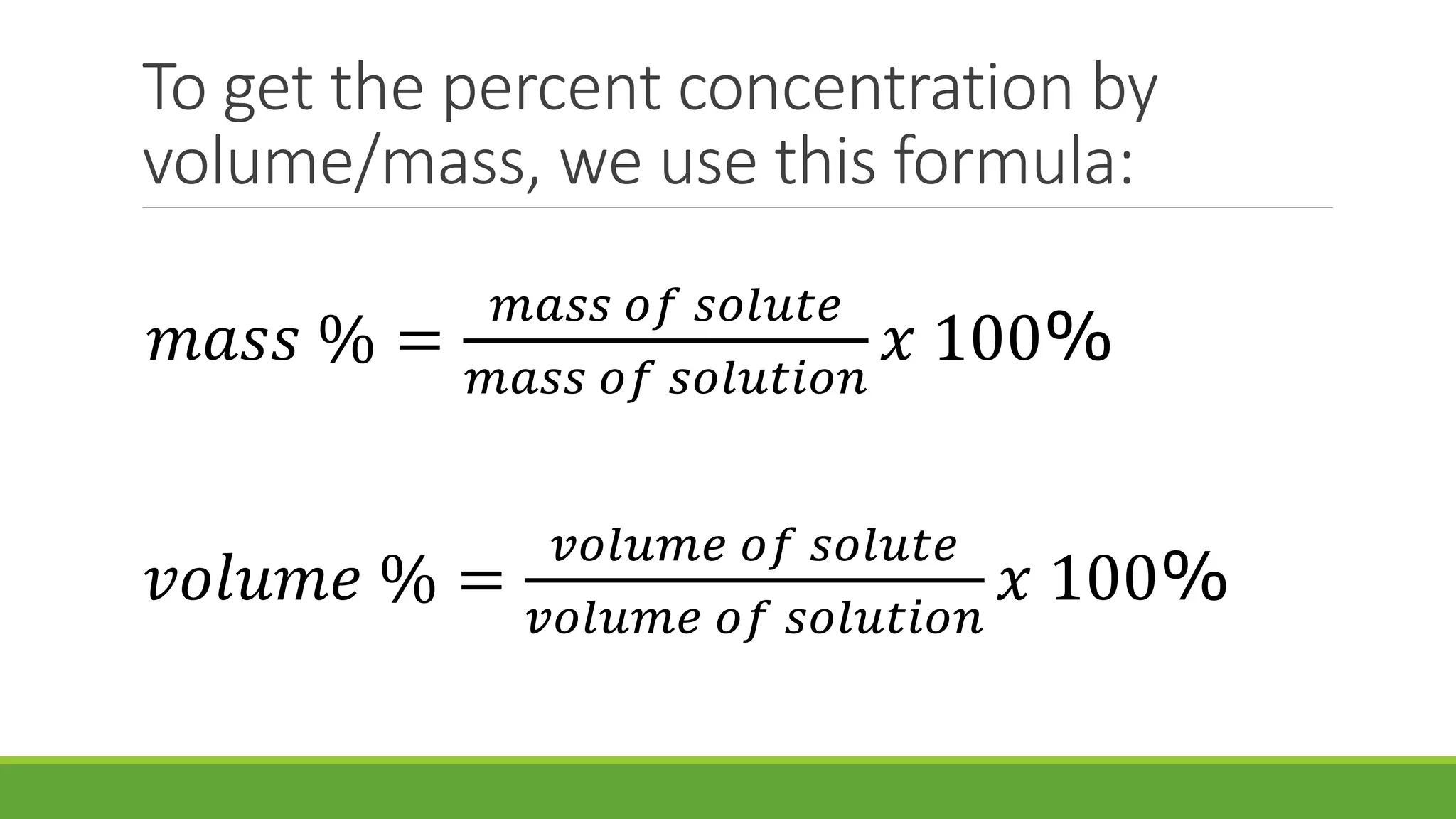
Percent Volume by Volume Concentration (%V/V)
-a volume of solute dissolved in every 100mL of solution
-units are %V/V or (mL/mL) or (L/L)
c = Vsolute/Vsolution x 100%
(units must be the same like ml/ml or L/L)

Percent Volume by Volume Concentration formula
c = Vsolute/Vsolution x 100%
(units must be the same like ml/ml or L/L)
Percent Weight by Volume Concentration (%W/V)
-a mass of solute dissolved in every 100 mL of solution
-Units: %W/V or g/mL or kg/L
c = msolute/Vsolution x 100%

Percent Weight by Weight Concentration (%W/W)
-units: %W/W, or g/g or mg/mg or kg/kg
c = msolute/msolution x 100%

Percent Weight by Volume Concentration formula
c = msolute/Vsolution x 100%
Units: %W/V or g/mL or kg/L

concentration of ions:
solutions of ionic compounds and strong acids are able to conduct electricity, suggesting the presence of ions in the solution.
The molar concentration (mol/L) of the ions in a solution depends on the number of ions making up the compound.
So, you must write out the dissociation or ionization equations to find the molar coefficients in front of the ions.
Steps to calculate lon concentration:
Write a balanced dissociation or ionization equation.
Use a conversion factor to change between chemical units in the balanced chemical equation. this is called the molar ratio or mole ratio because we use the molar coefficients from the equation.)
*NOTE: square brackets around an [ion] or formula indicate the concentration of the substance within the brackets.
standard solution
a solution with on accurately known concentration.
the term 'standard' refers to a set value considered to be true and from which all others will be compared.
° It's the actual concentration value in the question or solution made
•The standard solution must be mixed with extreme accuracy (using Laboratory equipment)
standard solution: most chemicals come in either solid form or in a concentrated solution (liquid). We don't we ____.
gases
reagent:
a chemical, usually relatively pure, used in a chemical reaction.
Preparation of standard Solutions from Solid Reagents:
when given a solid reagent, you must calculate the amount of mass required to form the desired concentration, and then mix that amount carefully with water following these steps:
calculate the mass of solid/solute required (c= n/v and m= Mn)
Weigh the required mass of solution in a clean, dry beaker
Dissolve the solid in distilled water (using around half the final volume)
once dissolved, transfer the solution to a clean volumetric flask. Rinse the beaker and the stir stick, with small amounts of water three times, adding each rinse into the flask
Carefully add water to the volumetric flask until the bottom of the meniscus is on the calibration line. use a medicine dropper when the water is in the neck of the volumetric flask, and make sure you are reading it at eye-level.
6. cover, and invert several times to mix.
Meniscus
is the shape that liquids make when it's in a small tube. It's the result of the cohesion and adhesion of the liquid molecules to the sides of the container and the intermolecular forces within the liquid.
They may form either concave or convex shapes.
→ When taking readings you must take the measurement from the bottom or top of the meniscus.
stock solution:
is an initial, usually concentrated, standard solution from which samples are taken for dilution.
Dilution
to begin with a stock solution and to add solvent to decrease the concentration to the desired level.
so, it's the process of changing the concentration of a solution by adding more solvent (usually water) to an existing solution.
During the process of Dilution, the volume increases while concentration decreases.
Equation for Dilution: C1V1 = C2V2
-this works because the quantity of solute is not charging: ni = nf
the last page in the data booklet will give the molar concentration (mol/L) and mass% concentration of the highest concentrated solution possible for several substances. These are called concentrated solutions.
Preparation of Standard Solutions by Dilution
some chemicals are bought as stock solutions, and must be diluted. With stock solutions, you must calculate the amount of water required for the dilution and mix that amount following these steps:
calculate the volume of solution required (C1V1 = C2V2)
(optional) fill the volumetric flask with around half the volume
Collect requirect amount reageant using a Pipette (volumetric or graduated.)
transfer the solution to the volumetric flask.
carefully add water to the volumetric flask until the bottom of the meniscus is on the calibration line. Use a medicine dropper when the water is in the neck of the volumetric flask and make sure you are reading it at eye level
cover and invert several times to mix.
During the process of Dilution, the volume _____ while concentration ______.
-increases
-decreases
2 types of Pipette: (both used with a pipette bulb)
Graduated pipette: has multiple graduations on it, so to determine how much solution you add, take an initial and final reading. More versatile as you can add any volume.
Volumetric pipette: is designed to transfer a specific amount of solution. generally more accurate, but less versatile. The meniscus must sit on the calibration line before you can transfer.

pipette bulb:
replaced mouth suctioning. Creates a vacuum.
Used to safely draw, control, and dispense liquid samples.

volumetric pipette:
specialised labratory instrument designed to measure and transfer a single exact volume of liquid with very high precision.
1 specific volume.

volumetric flask:
labratory glassware calibrated to hold a precised, exact volume of liquid at a specific temp.
Calibration line / what exact ml it is
beaker
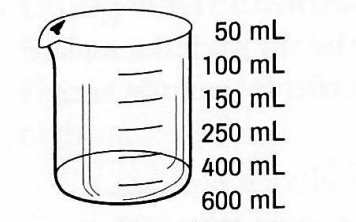
used to mix, stir, heat, and hold liquids. Have rough volume estimates and are not designed for precise measurments.
you collect into a beaker for solid. but u collect into pipette for liquid
using chemicals in solution make it easer to...
•handle chemicals - a solid or gas dissolved in water for ease of use or transportation
• complete reactions - some chemicals don’t react until in a solution where there's increased contact between the reacting entities
• control reactions the rate, extent, and type of reactions are much more easily controlled when one or more of the reactants are in solution. (aq state)
Saturated solution:
-a solution in which no more solute will dissolve at a specified temperature.
-It is a solution that contains the maximum amount of dissolved solute at a given temperature.
-A saturated solution can be recognized if undissolved solids are in the solution
(When you add a small amount of pickling salt (pure sodium chloride) to a jar of water and shake the jar, the salt dissolves and disappears completely. What happens if you continue adding salt and shaking? Eventually, some visible solid salt crystals will remain at the bottom of the jar, despite your efforts to make them dissolve. You have formed a saturated solution—a solution in which no more solute will dissolve at a specified temperature. We say it is at maximum solute concentration. If the container is sealed, and the temperature stays the same, no further changes will ever occur in the concentration of this solution. The quantity (mass) of solute that remains undissolved will also stay the same.

-Solubility:
-describes the concentration of a saturated solution.
-The units are the same as the units for concentration like mol/L or %W/V.
-So, the solubility of a solute is the amount of solute that can dissolve in a given quantity of solvent (usually H20) at a given temperature.
unsaturated solution
is a solution that doesn’t have the maximum amount of solute dissolved in it.
will be clear with no solids
the solubility of solutes can be...
Insoluble:
Slightly Soluble:
Soluble:
Insoluble: less than 0.1g/100mL (very small amount dissolving)
Slightly Soluble: between 0.1g and 1.0g / 100mL.
Soluble: greater than 1.0g/100mL
NOTE: Every substance has its own unique solubility, therefore reference data uses units of grams per 100ml of water to be consistent.
EX Solubility of sodium chloride in water at 2.0°c is 36g/100mL
→ This means...
The maximum amount of NaCl that can dissolve in 100mL of water at 20°C is 36g. (as it's greater than 1.0g /100ml, thus Soluble)
-Range of Solubility:
-define
-what it depends on
-is the degree to which a solute is soluble
depends on the strength of attraction between...
the solute particles (What's holding the solute together)
the solute particles and the solvent particles (how the solute and solvent interact)
also overall how much energy the particles have