BDP: Notation systems
 Call Kai
 Learn
Learn Practice Test
 Spaced Repetition
 Match
Match Flashcards
 Knowt Play
1/5

There's no tags or description
Looks like no tags are added yet.
6 Terms
Humans are diphyodont and heterodont
Human har diphyodont: we develop two sets of teeth:
first the decidous (primary/milk) teeth
followed by the permanent (secondary) teeth.
Humans are heterodont: we have different types of teeth with different shapes and functions.
Human detention division
Wr use the patient´s right and left sides.
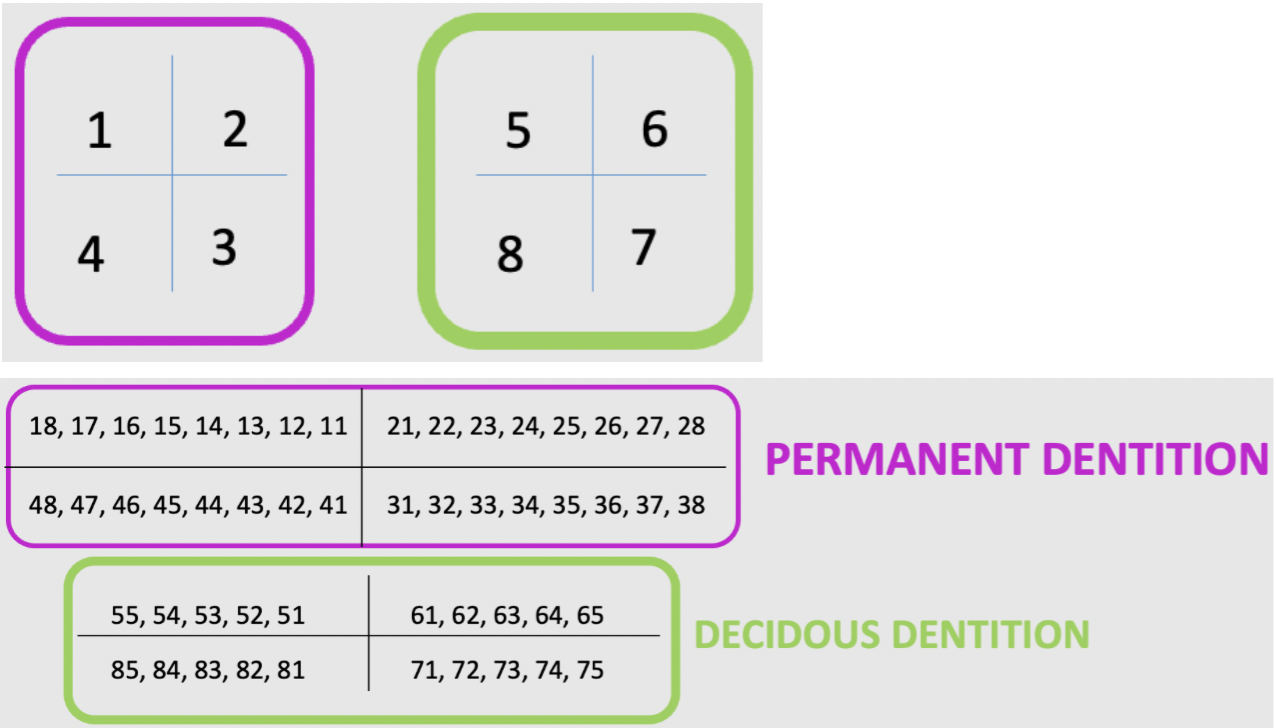
The dentition is divided into 4 quadrants: upper right, upper left, lower right and lower left:
Permanent detention: 8 teeth per quadrant (2-1-2-3 = 32 teeth)
I: 2 Incisors (I1, I2)
C: 1 Canine (C)
P: 2 Premolars (P1, P2)
M: 3 Molars (M1, M2, M3)
Deciduos detention: 5 teeth per quadrant (2-1-2 = 20 teeth)
I: 2 Incisors (I1, I2)
C: 1 Canine (C)
M: 2 Molars
There are no premolars in the deciduous dentention!
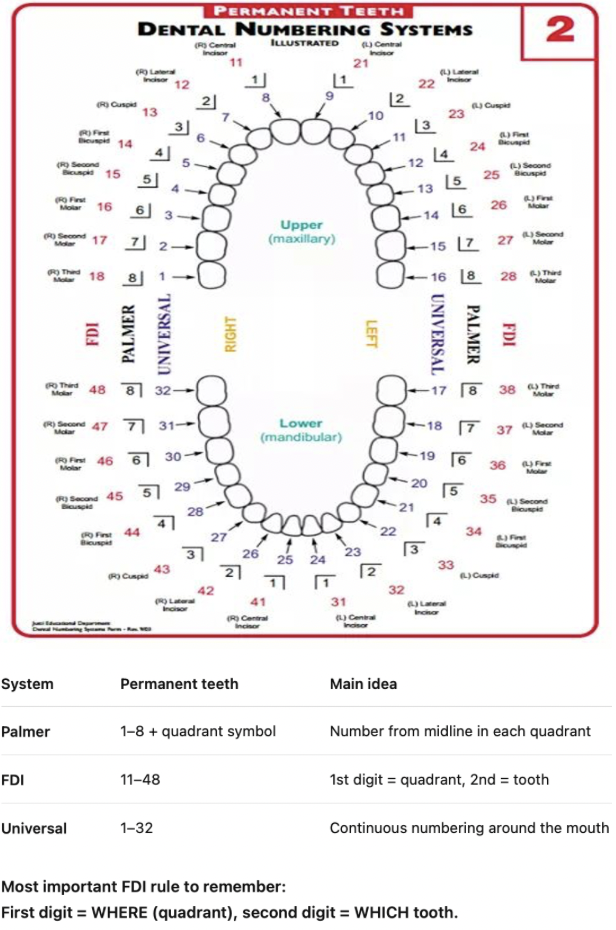
Tooth numbering systems: Zsigmondy-Palmer (military) system
Each quadrant is represented by an L-shaped symbol, and the teeth are numbered from the midline backwards
Permanent teeth: 1-8 in each quadrant
Represented in latin numbers or dark colors
Decidous teeth: 1-5 in each quadrant
Represented in roman numbers, alphabet or red color
The number identifies the tooth, while the L-shaped symbol identifies the quadrant

Tooth numbering systems: FDI system
The FDI (Fédération Dentaire Internationale) system is a widely used two-digit system:
First digit: quadrant
Second digit: tooth position within that quadrant, counted from the midline backwards
For example: 1,13 = upper right canine
Tooth numbering systems: American/Universl system
Instead of numbering each quadrant separately, this system counts continuously around the mouth
Permanent teeth: numbered 1-32, starting at the upper right third molar, continuing across the upper jaw and them around the lower jaw to the lower right third molar
Deciduous teeth: use capital letters A-T, following the same pattern.

Tooth numbering systems: Comparison