Adaptations
 Call Kai
 Learn
 Practice Test
 Spaced Repetition
 Match
 Flashcards
 Knowt Play
1/32

Earn XP
Description and Tags
Noun: Specialized features that enhance features Verb: The process by which features that enhance fitness are fixed in a populations or species.
33 Terms
What mechanism can produce adaptations
Natural selection leads to different adaptations in different environments.
Are adaptations perfect?
They are not because they depend on the environment and many other factors.
Fitness landscapes
A model that shows the relationship between genotypes and an organisms fitness(reproductive success). Significant shifts in phenotype may push organisms ‘off and over’ the adaptive peak.
Genetic Drift
Random change in allele frequencies between generations with no tendency for any specific allele(‘A’ or ‘a’) to be favored.
How is genetic drift different from natural selection?
Genetic drift is completely random, alleles becoming more or less by luck basically. On the other hand, natural selection is driven by non-random environmental pressures. Individuals with better heritable traits for the environment with give them a better chance to survive and reproduce.
How do you calculate heterozygosity
H=1(p2+q2)
H is the change of drawing two different alleles
Relationship between genetic drift and mutation
Both are fundamental mechanisms of evolutions and play distinct complementary roles in changing the genetic makeup of a population.
Genetic drift and heterozygosity
Heterozygosity tends to decrease as random allele sampling continues. Depends heavily on population size with smaller populations loosing heterozygosity faster. This leads to a lower genetic diverisity.
Migration(gene flow) and genetic diversity
Genetic diversity increases as the alleles being moved from one population to another can introduce new alleles and make that population more diverse.
This is not always the case and can make populations more similar which is called homogenization. By continuous sharing of genetic material between separate groups, those populations become more genetically similar.
Adaptive Radiations
Rapid diversification of a single lineage into a large number of species. (Each with adaptions that allow them to exploit different resources and habitats, think about darwins finches)
Eurosociality
A form of social organization where only one or a few individuals are reproductively active and produce offspring, where most individuals in the group do not reproduce and instead help raise the young of the reproducing individuals. (THINK ABOUT BEEEEEEES)
Reciprical Altruism
Evolutionary concept where organism lowers own fitness to help unrelated individual with the expectations favor will be returned. For this to happen there needs to be key conditions.
Kin Selection
An aspect of natural selection based on increasing the fitness of non-offspring kin because they share alleles as relatives so they will continue to pass genes along. Inclusive fitness.
Indirect Fitness
Fitness gained through actions that enhance theproduction of non-offspring kin. This is help from an organisms relatives to raise kin rather than having there own or having there own later in life.
Direct Fitness
Fitness gained through the direct production of offspring. Parents raise their own young.
Monophyletic Group
An ancestor and all of its desendants.

Synapomorphy
A trait that one group has that no other group has. These define monophyletic groups.

Parsimony
A criterion in logic that states that the simplest explanation is the one most likely to be correct
Outgroup
any lineage that is not part of the monophyletic group that is the focus of a phylogenetic tree.
Homoplasy
Similarity in traits that is not due to common ancestor but due to independent evolution.

Homologous Traits
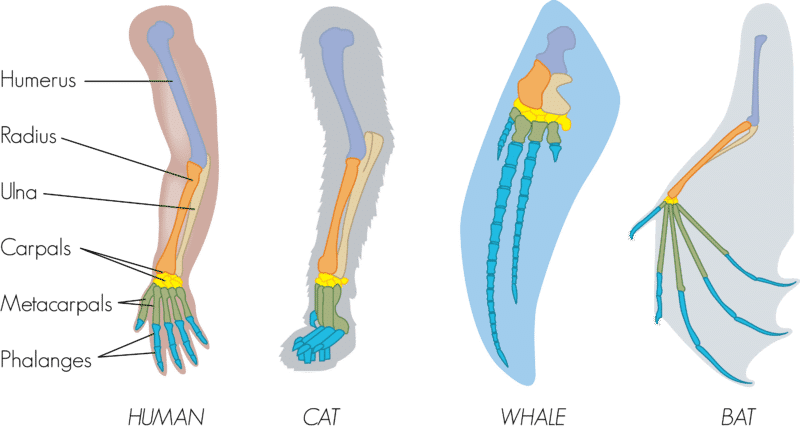
An characteristic, ranging from a single nucleotide in DNA to body parts that is observed in multiple species and inherited from the same common ancestor.
Phylogenetic Species Concept
Identifying species as the smallest monophyletic groups on the tree of life. Uses genetics to determine if the groups have similar traits and DNA to each other to determine relatedness.
Biological Species Concept
Identifying species based on the evidence of reproductive evidence and if they can produce viable offspring.
Morphological Species Concept
Identifying species based on their physical characteristics. Oldest method but can be pretty faulty due to common ancestors and homologous traits.
Population
A group of individuals from the same geographic region that regularly mate together.
Species
An evolutionary independent unit in nature, meaning a population or group of populations that is genetically isolated from other and is thus changing under the effects of natural selection, genetic drift, and mutation independently of others.
Speciation
The process of genetic isolation and genetic divergence that is responsible for the creation of new species.
Genetic Bottlenecks
One of several types of events that can cause genetic drift. They occur when a species undergoes a large and rapid decrease in population size due to a disease outbreak, weather event, or some other change.
Founder Event
When a relatively small number of individuals disperse to a new habitat and found a completely new populations. This means the alleles in this new population will only be the ones that the founders have(at first)
How is reproductive isolation achieved?
Pre and post zygotic barriers, non random mating
Allopatry Speciation
Biological populations or species live in separate, non overlapping geographic locations(Different fatherland)
Sympatry Speciation
Exist in same geographic area and frequently encounter one another.
Parapatry Speciation
Geographic ranges do not significantly overlap but are close and have a narrow area of contact. (Hybrid zone)