A level biology aqa
 Call Kai
 Learn
 Practice Test
 Spaced Repetition
 Match
 Flashcards
 Knowt Play
1/79

There's no tags or description
Looks like no tags are added yet.
80 Terms
What is a monosaccharide
A single sugar unit
What is a disaccharide
2 sugar units
What is a polysaccharide
Many sugar units which create large chain
What is an isomer
A molecule with the same chemical formula but different structure
what type of bond joins monosaccharides together
Glycosidic
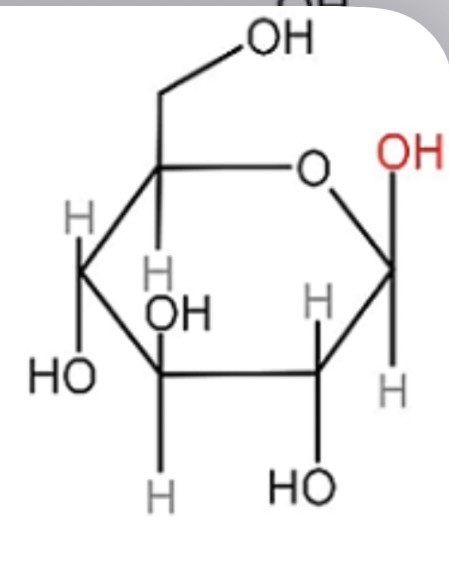
What type of glucose is this
beta glucose

What type of glucose is this
Alpha glucose
What does a condensation reaction release
Water molecule (H2O)
What does a hydrolysis reaction use?
Water molecule (H2O)
What does hydrolysis do?
Breaks bonds using water
Which reaction forms bonds to make polymers?
Condensation reaction
During a condensation reaction, which molecule is used to create water?
Hydroxyl group (OH)
What are the three polysaccharides?
Starch, Glycogen, cellulose
What are the two different forms of starch?
Amylase, Amylopectin
What is the monomer of starch?
Alpha glucose
What is the monomer of glycogen?
Alpha glucose
What is the monomer of cellulose?
Beta glucose
which polysaccharides have a carbon bond of 1-4?
Starch( Amylose) and cellulose
Which polysaccharides have a carbon bond of 1-4 and 1-6?
Starch (Amylopectin) and glycogen
Describe the structure of Amylose
Glycosidic bond (1-4)
Long straight chain
Insoluble
Coils into helix to fit into cell
Hydrogen bonds for strength
Describe the structure of amylopectin
Glycosidic bond (1-4) & (1-6)
Branched so it has more ends
Easily hydrolysed
Coils into helix to fit in cell
Hydrogen bonds hold together shape
What is the general formula for carbohydrates

Describe the structure of glycogen
Insoluble
Glycosidic bond (1-4) and (1-6)
Branched so more ends
Can be rapidly hydrolysed
Coils into helix shape
Hydrogen bonds hold shape
Describe the structure of cellulose
Glycosidic (1-4)
Long straight chain
Every other monomer is inverted
Runs parallel to each other
Hydrogen bonds between adjacent cellulose molecules
Forms micro fibrils which forms into fibres
Which monosaccharides create maltose?
Alpha glucose + Alpha glucose
Which monosaccharides create sucrose?
Alpha glucose + Fructose
Which monosaccharides create lactose?
Alpha glucose + galactose

Name this structure
Galactose

Name this structure
Fructose
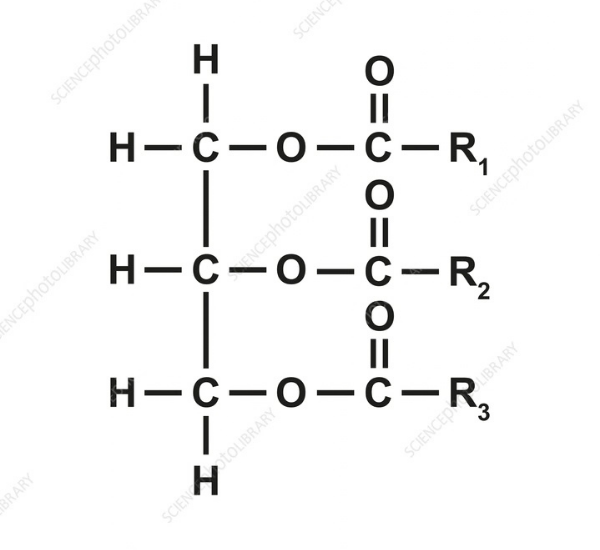
what structure is this?
triglyceride

what structure is this?
phospholypid

what structure is this ?
Amino acid
what bonds are present in lipids?
ester bonds
what bonds are present in proteins?
peptide bonds
what do amino acids form?
Polypeptides
What does DNA stand for?
Deoxyribonucleic
Why is DNA a polynucleotide?
Made up of many nucleotide monomers, joined by phosphodiester bonds
What are the components in a nucleotide molecule?
Phosphate group, deoxyribose sugar, nitrogenous base.
What are the bases of nucleotides?
Adenine, guanine, thymine, cytosine
Which bases are complementary to each other?
Adenine = thymine
Guanine = cytosine
what are purines?
Bases with 2 ring stricture
What are pyrimidines?
Bases with 1 ring structure.
What bonds form in between the bases ?
Hydrogen bonds
How many strands does DNA have?
2 ( double stranded)
Where is the sugar phosphate backbone located?
Outside of the molecule
Where are bases located?
On the Inside of the molecule
Do the DNA strands run parallel or anti parallel?
Anti parallel
What is the structure of DNA?
Strands run anti parallel
Held together by hydrogen bonds in between bases
polynucleotide, made up of nucleotide monomers
Sugar phosphate backbone outside the molecule, bases inside molecule
Nucleotides held together by phosphodiester bonds
Two polynucleotide join to make double helix
Nucleotides compromise off phosphate group, deoxyribose, nitrogenous base
How does the structure off starch relate to its function?
Insoluble molecules do not diffuse out of cells, suitable for energy storage.
it is compact, allowing large amounts of to be stored in a small space.
Amylopectin has branches that allows enzymes to break it down into glucose.
How does glycogens structure relate to its function?
Insoluble, does not affect the water potential of cells
Compact structure allows large amounts glucose to be stored in a relatively small space
Many branches provide numerous sites to enzyme to act on- glucose to be released rapidly
How does cellulose structure relates to its function?
Hydrogen bonds form between monomers- creating strong microfibrils
Cellulose is insoluble- suitable for stable structural role
Straight chains lie parallel to each other
Microfibrils have high tensile strength- helps plants keep rigid structure
What does ATP stand for?
Adenosine triphosphate
What are the components of ATP?
Adenine
Ribose
3 phosphate groups
How is ATP formed?
adenosine diphosphate joins with inorganic phosphate. ATP synthase catalyses reaction.
What type of reaction is ADP —> ATP
Condensation reaction
True or false: ATP can be reversed
True
what reaction brakes down ATP
hydrolysis reaction
What enzyme helps breakdown ATP?
ATP hydrolase
What are some features of ATP?
hydrolysis of atp releases small amount of energy
Broken down in 1 step
Rapidly resynthesised
Bonds between phosphate group unstable (low activation energy)
What is the function of ATP?
Movement (muscles contraction, sperm)
Active transport (moves ions against concentration gradient)
Synthesising large molecules (proteins)
Activating other molecules( can phosphorylate enzyme)
is DNA replication semi conservative or conservative?
Semi conservative
What is the process of DNA replication?
DNA helicase unzips the DNA molecule
This leaves 2 strands to act as the template strands
New Nucleotides pair with their complementary bases on original strand
DNA polymerase forms phosphodiester bonds between nucleotides phosphate group and sugar.
2 new dna molecules are formed with one original strand and one new strand
What does the enzyme DNA helicase do?
Breaks hydrogen bonds, unzips dna
What does DNA polymerase do?
Forms phosphodiester bonds between nucleotides.
What is the primary structure of proteins?
A sequence of amino acids
What is the secondary structure of proteins?
Coiling or folding of a polypeptide chain into a alpha helix shape or beta pleated sheet, stabilised by hydrogen bonds
What is the tertiary structure of protein?
3d shape of a polypeptide formed by further folding and coiling.
Stabilised by interactions between r groups- ionic bonds, disulfide bridges, hydrogen bonds
What is the quaternary structure of proteins?
Proteins consisting of two or more polypeptide chains. Held together by same r group bonds in tertiary structures
Where do hydrogen bonds form?
Between the positive charge of an hydrogen atom and the negative charge of another atom
What are the properties of water?
Is a metabolite - in condensation and hydrolysis
Universal solvent - most things dissolve in it
High surface tension - molecule cling tightly together
High heat capacity - lets water absorb heat without changing state
Cohesion - strong cohesion between water molecules
What is a eukaryotic cell?
A cell which has a membrane bound nucleus and houses a linear protein bound DNA.
What is a prokaryotic cell?
Cell which has no true nucleus and has no membrane bound organelles.
What organelles do animal cells contain?
Mitochondria
Nucleus
Ribosomes (80s)
Cytoplasm
Centrioles
Cell membrane
Smooth + rough endoplasmic
Golgi body/apparatus
Vesicles
Lysosome
Microtubles
Organelles in a plant cell?
Cell wall
Cell membrane
Golgi body/ apparatus
Tono plast( membrane around vacuole)
Mitochondria
Cytoplasm
Vesicles
Ribosomes (80s)
Smooth + rough endoplasmic
Nucleus
Vacuole
Amyloplast
Definition of organelle?
‘Little organs’, discrete structures within cells, all of which have a specific function
Prokaryotic cell structure
Mesosome
Plasmid
Slime capsule
Pili
Flagellum
Ribosomes (70s)
Circular DNA
Cell membrane
Cell wall made of murein
Cytoplasm
How small are prokaryotes
0.5-10nm
How do prokaryotes reproduce?
Binary fission
Why are viruses classed as non living (acellular)?
They cannot make or take in food, so they dont have a metabolism
They do not produce waste products
They cannot replicate independently