TCA Cycle
 Call Kai
 Learn
 Practice Test
 Spaced Repetition
 Match
 Flashcards
 Knowt Play
1/15

There's no tags or description
Looks like no tags are added yet.
16 Terms
TCA Cycle Formula

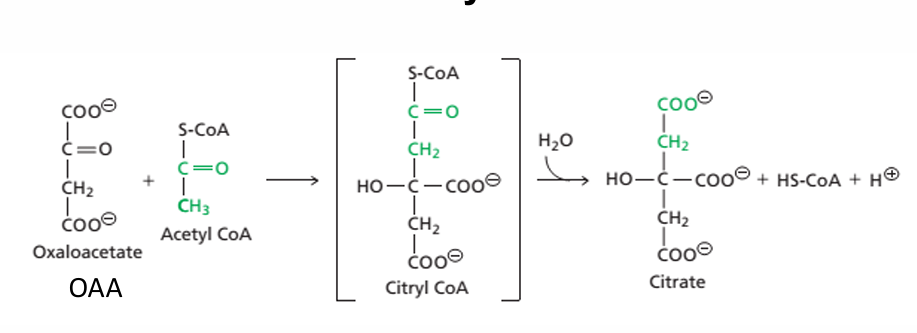
Reaction 1 TCA
Citrate Synthase (transferase)
Condensation of OAA and acetyl-CoA
Low [OAA] in mitochondria
Thioester hydrolysis drives the reaction forward
Reaction 2 TCA
Aconitase (Lyase)
Reversible: At equilibrium: 90% citrate, 4% cis-aconitate, 6% isocitrate
The next reaction is exergonic, pushing this reaction forward

Reaction 3 TCA
isocitrate dehydrogenase (oxidoreductase)
Oxidation to oxalosuccinate.
β-decarboxylation to α-ΚG.
Exergonic. Pushes the aconitase reaction forward.
The B-keto group acts as an electron sink to stabilize the carbanion transition state

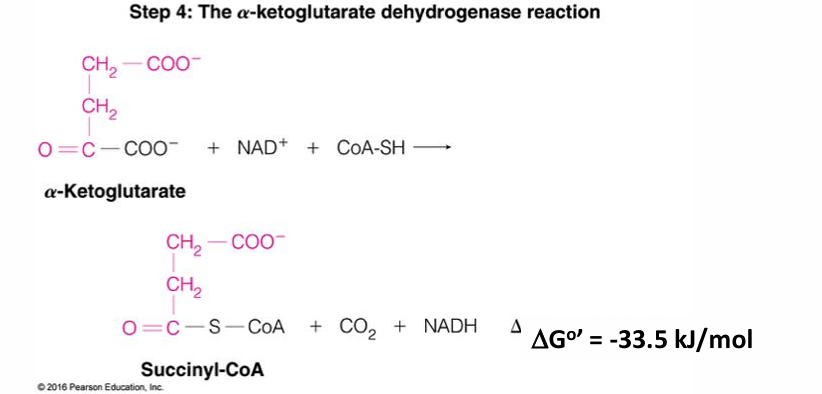
Reaction 4 TCA
α-Ketoglutarate dehydrogenase complex (oxidoreductase)
Decarboxylates to oxidize the carbon and reduce NAD+
α-ketoglutarate is an α-keto acid, so it is difficult to stabilize the carbanion to decarboxylate. Covalent linkage to TPP to stabilize the carbocation
-Uses same 5 cofactors as pyruvate dehydrogenase complex
Reaction 5 TCA
Succinyl-CoA synthetase (ligase)
1) Phosphate displaces CoA, retaining the energy of the high energy thioester
2) The phosphate is transferred to a His on the enzyme
3) The phosphate is transferred to: ADP in brain, muscle for metabolism or - GDP – kidney and liver for biosynthesis

Reaction 6 TCA
Succinate dehydrogenase (oxidoreductase)
Electrons transported to FAD then Q (quinone, another electron acceptor).
FAD is used because it’s a stronger oxidant than NAD+, and it is more difficult to oxidize the C—C bond than a C—O •
The enzyme is in the inner mitochonodrial membrane, and is called Complex II in the Electron Transport Chain.

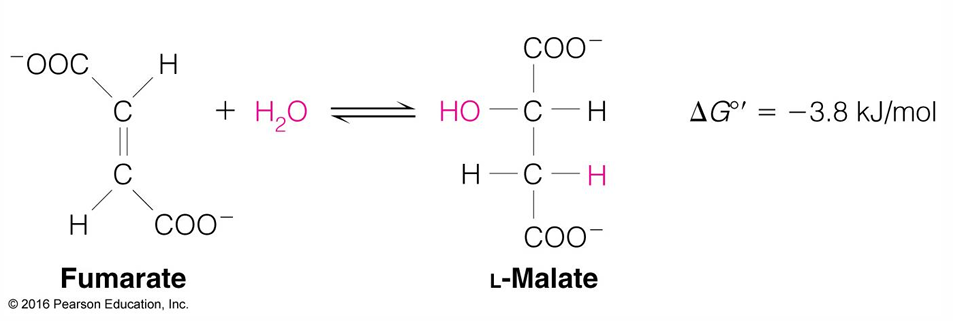
Reaction 7 TCA
Fumarase or Fumarate Dehydratase (lyase)
Fumarate is symmetrical. Trans addition of water stereospecifically generates L-malate
Similar to the second step of Aconitase, adding H2O across the double bond.
Reaction 8 TCA
Malate dehydrogenase (oxidoreductase)
Reaction is very endergonic. It’s pushed forward because step 1 is very exergonic • Oxaloacetate is very low, < 10-6 M

Autotrophs
energy from inorganic compounds
plants - CO2 using the protein RuBisCo
5 other Carbon fixation pathways in bacteria and archaea-
reductive acetyl-CoA pathway – synthesizes acetyl-CoA from 2 CO2
-one of the oldest pathways
Reductive Citric Acid Cycle (rTCA)- reverse of the TCA cycle, is anabolic
3 other cycles
reverse TCA
Anabolic
Uses electrons from reduced NADPH, FADH to reduce oxaloacetate
Photoautotrophs
Sunlight and carbon reduction
Chemoautotrophs
chemical oxidation of inorganic molecules
Heterotrophs
energy from organic compounds
Photoheterotrophs
photosynthetic organisms (typically bacteria) that capture light as energy for organic carbon oxidation (not reducing)
Chemoheterotrophs
Ultimate source of energy is chemical oxidation of organic molecules
-Humans, animals, fungi, most protists, many bacteria