Genetics: Unit 2
 Call Kai
 Learn
 Practice Test
 Spaced Repetition
 Match
 Flashcards
 Knowt Play
1/79

There's no tags or description
Looks like no tags are added yet.
80 Terms
Sugar: Deoxyribose (in DNA)

Sugar: D-Ribose (in RNA)

Purine: Adenine (in RNA)
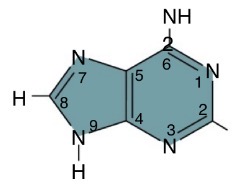
Purine: Guanine (in RNA)

Thymine (in DNA)

Cytosine (in both DNA & RNA)

Uracil (in RNA)

Purine
Nine-member double ring, is a kind of base, examples are Adenine & Guanine
Pyrimidines
Six-member single ring, is a kind of base, examples are Cytosine, Thymine, and Uracil

What is this?
Phosphate group
DNA contains:
deoxyribose
RNA contains:
ribose sugar
DNA and RNA are types of:
Nucleic acids
Nucleotides
building blocks of nucleic acid
DNA A box is:
a DNA sequence that is bound by DNA A protein
Elongation


What is the red?
RNA Primers

What is the purple?
DNA Strands

What is the blue?
New synthesized DNA strands

What is the red?
RNA Primers

What is the blue?
New synthesized DNA strands

What is the pink?
Template DNA strands
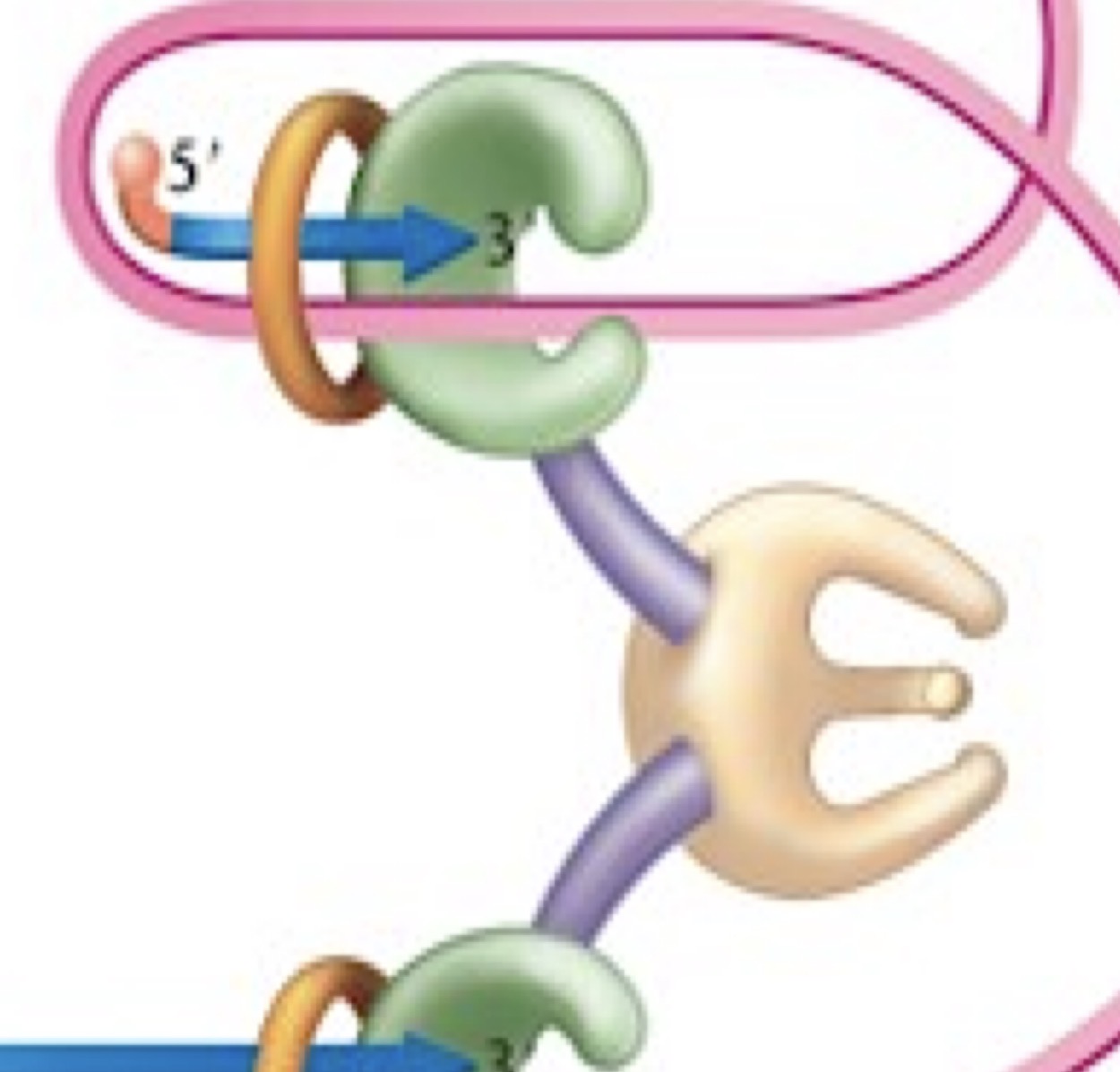
What is beige?
Clamp loader complex

What is the purple?
Subunits/linkers
One difference between eukaryotic and prokaryotic DNA replication is that:
Eukaryotes have multiple ori on each chromosome
Telomere
DNA sequence found at the ends of linear chromosomes
Telomerase adds nucleotides to the:
3' overhang so there is a place for a complementary primer to base pair with this strand
DNA
Bacterial genomes are:
RNA or DNA
Viral genomes are:
Bacterial Chromosomes
Circular, double-stranded D N A compacted into nucleoid. Not surrounded by a
membrane
Naked DNA
The simple double-helix structure with a width of approximately 2 nm.
DNA packaged in nucleosomes
DNA wraps around histone proteins to create a "beads-on-a-string" structure (~11 nm wide)
30nm fiber
The nucleosome chain coils tighter into a more condensed helical filament (~30 nm wide).
Metaphase chromosomes
During cell division (mitosis), the chromatin undergoes maximum compaction and supercoiling to form discrete, highly dense chromosomes (~1,400 nm wide) so they can safely separate.
Polymerase chain reaction (PCR)
Making lots of copies of a DNA sequence
Sequencing DNA
Determining the order of A, G, C, T in a sequence
Denaturation
DNA strands separate
Annealing
Primers bind to DNA
Synthesis or primer extension
Polymerase copies the target sequences
far apart
Crossing over is more likely to occur between genes that are ________ on a chromosome.
linkage group
Another name for a chromosome is a ________, since it contains genes that are often inherited together.
protein
In the Hershey and Chase experiment designed to determine the molecule of heredity, what was radiolabeled with 35S?
23.6% of the offspring exhibit recombination between the two genes.
A map distance of 23.6 between two genes indicates which of the following?
mitotic recombination
In heterozygous individuals, loss of a wild type allele can occur rarely during development by
Hershey and Chase
These individuals determined that DNA was the genetic material in T2 phage.
phosphorus
What radiolabeled substance did Hershey and Chase use to label the DNA component of the bacteriophage in their study to determine whether protein or DNA was necessary for phage production?
The bacteria were in the pellet, many of which contained the radioactive viral DNA.
In the classic experiment conducted by Hershey and Chase, why was the pellet radioactive in the centrifuge tube that contained bacteria with viruses?
Avery, Macleod, and McCarty
The individuals who determined that Griffith's transforming principle was DNA were ________.
antiparallel
The fact that the strands of the DNA helix are arranged in opposite directions gives DNA its ________ characteristics.
Hydrogen
________ bonds are responsible for the chemical affinity between A and T (or G and C) nucleotides.
the five-carbon sugar it uses
DNA differs from RNA in which way?
40%
According to Chargaff's rule, if the DNA of a species contains 10% adenine, what percent of guanine will it contain?
phosphodiester bonds
The backbone of the DNA molecule is formed by ________.
1
How many origins of replication are there in a bacterial chromosome?
conservative
The first generation of replication in the Meselson and Stahl experiment disproved which theory of replication?
semiconservative
DNA replication occurs through a _________process.
After both the first and second generation, they would have observed a band of DNA in between the 15N and 14N bands.
When Meselson and Stahl performed the experiment that showed that replication is a semiconservative process, they utilized E. coli, and various isotopes of nitrogen (15N and 14N). What would have been their results if DNA replicated dispersively?
The amphibian has more repetitive sequences than the mammal.
What is one reason why an amphibian, such as a salamander, might have a larger genome than a mammal, such as a chimpanzee?
unique sequences
The majority of the nonrepetitive genes in an organism are found in which of the following?
Two turns of DNA wrapped around an octet core of histone proteins.
What is a nucleosome composed of?
naked DNA, nucleosome, 30 nm fiber, radial loop, metaphase chromosome.
The correct order of compaction from least compacted to most compacted would be
146
About how many bases of DNA wrap around a histone complex?
to form loop structure, to condense DNA, and to bind to the nuclear matrix
What is the purpose of MARs and SARs?
heterochromatin
Areas of the chromosome that are highly condensed and transcriptionally inactive are called
DNA is negatively charged and histones are positively charged.
Histones and DNA have a strong attraction for each other because
It cannot begin the 5' end of a new strand without a primer, It can only make new DNA in the 5' to 3' direction, and It can add nucleotides to the 3' end of a nucleotide chain
Which of the following is true about DNA polymerase?
phosphodiester
During elongation of a polynucleotide, enzymes join the base's nucleotide to the preceding nucleotide by a(n) __________bond.
To allow DNA to be synthesized in the 5' to 3' direction on the lagging strand
What is the purpose of Okazaki fragments?
topoisomerase
What enzyme relaxes supercoiling ahead of the replication fork?
DNA ligase
Which enzyme attaches adjacent Okazaki fragments, forming a continuous DNA strand?
to the left
In the diagram below, which way does the pictured replication fork proceed?
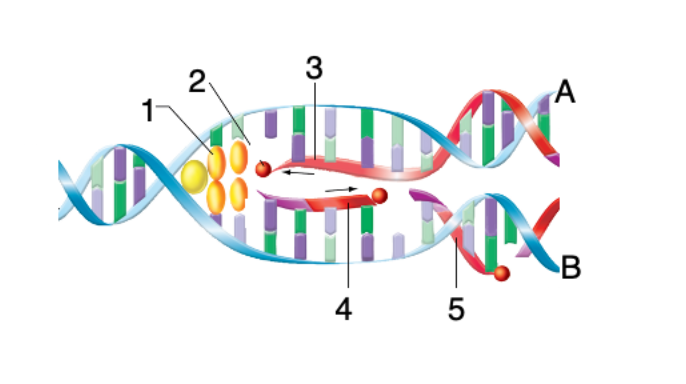
4
In the diagram below, which DNA is being synthesized continuously?

5’
In the diagram below, what end of the DNA is at A?

64
If a single DNA molecule is amplified by PCR, how many DNA molecules will there be after six cycles?
nucleotide triphosphates that lack a 3' hydroxyl
In Sanger sequencing, what causes DNA synthesis to terminate at a specific base?
there is no place for primase to lay down a primer so DNA polymerase cannot replicate that area of the chromosome.
Telomerase exends the 3' ends of chromosomes because
at least some sequence information about the region to be amplified.
PCR cannot be successfully performed without
Short, repetetive DNA sequences found at the end of linear eukaryotic chromosomes.
What is the structure of telomeres?
remove an incorrect nucleotide that was accidentally just added during DNA replication
DNA polymerase III uses its 3' to 5' exonuclease activity to
two
How many replication forks depart from an origin of replication?