10. Cancer Treatment
 Call Kai
 Learn
 Practice Test
 Spaced Repetition
 Match
 Flashcards
 Knowt Play
1/25

There's no tags or description
Looks like no tags are added yet.
26 Terms
TNM classification and staging
The TNM classification is a standardized staging system used to determine the anatomical extent and spread of solid tumors (it is not applied to hematological/blood cancers)
T = Primary Tumor; size and local extent (T1 - T4)
N = Regional lymph nodes; size and extent (N0 - N3)
M = distant metastasis (M0-M1)
Combination of TNM gives stages (stage IV is metastatic disease)
What are the five cancer treatment options?
Targeted therapy (systemic)
Chemotherapy (systemic)
Hormone therapy (systemic)
Surgery (local)
Radiation therapy (local)
Curative versus palliative therapy
Curative treatment: treatment with the intention to cure the patient of cancer
Palliative treatment: treatment with the intention to alleviate symptoms and/or prolong life
Palliative is not terminal
Types of curative treatment
neo-adjuvant treatment = prior to surgery
adjuvant treatment = after surgery
concomitant = together with radiotherapy
How is a radiological reponse assessed?
RECIST criteria: response evaluation criteria in solid tumors
complete resonpse: no metastases or tumor detectable
partial response: decrease of diameter with at least 30%
progressive disease: increase of diameter with at least 20%
stable disease: no partial response nor progressive disease
Kaplan Meier curve
Helps to determine effectiveness of treatment
In these curves you can consider:
Where do the curves separate?
How large is the separation?
Do the curves cross?
Is there a plateau?
What is the median survival?
What is the cohort size?
Are many patients censored?

Mechanism of action in chemotherapy
DNA damage to all dividing cells
Cancer cells are fast dividing cells → sensitive to chemotherapy
Different agents intervene at differetn steps in the cell cycle
Why is chemotherapy given in multiple cycles, and what limits how well it works? (Fractional cell kill)
Fractional cell kill: Each chemo course kills a constant fraction of tumor cells, not a fixed number. Here, ~2 logs (99%) are killed per course, but ~1 log regrows between courses, so the net kill is ~1 log per cycle.
Why multiple cycles: One course can’t eliminate every cell. Repeated cycles are needed to drive the cell count down step by step toward zero (cure).
Detection limit: A 1 cm³ tumor holds about 10⁹ cells, which is the limit of detection. A patient can look “cancer-free” while still carrying many cells, so treatment continues beyond apparent remission.
Adjuvant chemo: Given when the burden is low (e.g., after surgery), so fewer cycles are needed to reach cure.
Resistance: If treatment continues but resistant clones emerge, regrowth outpaces kill and the tumor rebounds.
Dose limit: Dose is capped by the maximum tolerated dose (toxicity to normal tissue), so you can’t simply give more to kill faster.
Side effects of chemotherapy
Are caused by attacking also healthy cells

What defines targeted therapy in oncology, and how do small molecules differ from monoclonal antibodies?
Acts on a specific molecular target controlling cancer cell growth, division, or spread (unlike chemo, which hits all rapidly dividing cells).
Small molecules | Monoclonal antibodies | |
|---|---|---|
Target | Intracellular (e.g., kinases) | Extracellular receptors or ligands |
Why | Small enough to cross the membrane | Too large to cross it |
What does targeted therapy target?
Growth factors (e.g. EGFR)
Angiogenesis (e.g. VEGF)
Specific mutations
What are ways in which a metabolic pathway that is like a ringing doorbell can be stopped?
Have an antibody binding to the ligand (or growth factor) to prevent it from constantly ringing the doorbell
Block the receptor so that no ligand/growth factor can bind to it
Inhibit the pathway somewhere along its pathway.
However resistance can occur and occurs pretty frequently
Dose in targeted therapy
Not maximum but optimal doese: dose that blocks the activated pathway
Does targeted therapy cure?
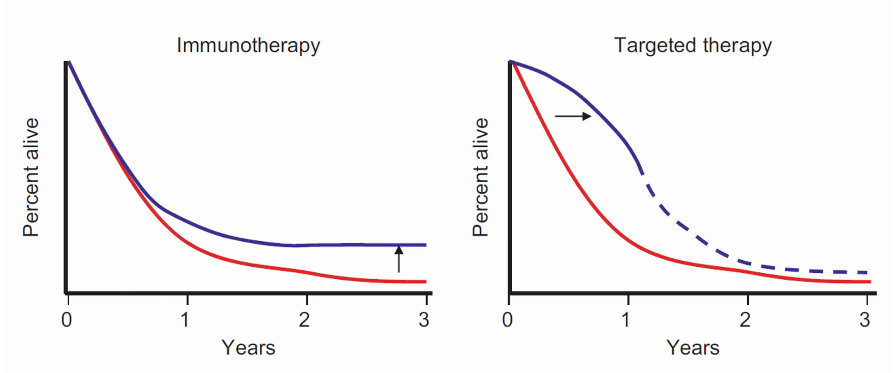
Often not, complete responses are seldom but makes live longer.
Endocrine therapy
Treatment that blocks the production of hormones or interferes with the effect of hormones on cancer cells
Tumor types with hormone-dependent growth: e.g. breast cancer, prostate cancer, endometrial cancer, ovarium cancer
Targeted therapy with hormones as target
Three ways of endocrine therapy
Orchidectomy: removal of the testicles
Ovariectomy: removal of the ovary
Hormonal therapy: blocks hormonal receptors present on tumor cells or blocks hormone production
Hormonal therapy = anti-hormonal therapy
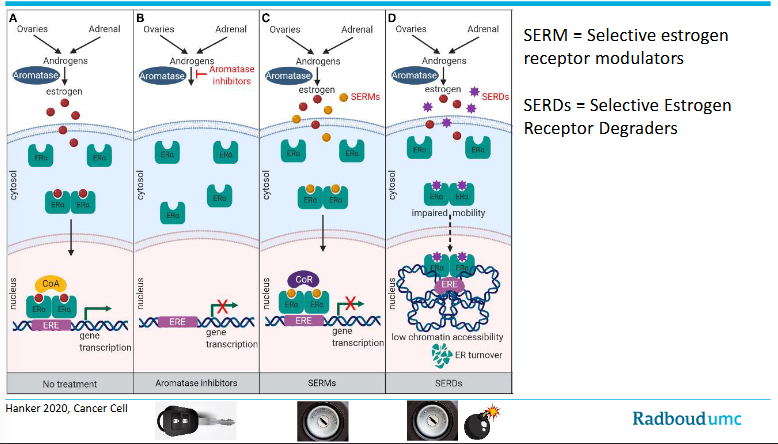
What are aromatase inhibitors, SERMS and SERDS
Aromatase inhibitors specifically inhibit the aromatase enzyme, preventing it from converting androgens into estrogen[1][3]. Deprived of estrogen, the estrogen receptors remain unoccupied, halting receptor-driven gene transcription and stopping tumor cell proliferation[1][3]
SERMs (Selective Estrogen Receptor Modulators; "Jamming the Lock"): Act as decoy ligands that bind to estrogen receptors (ERα), preventing genuine hormones from binding without initiating downstream gene transcription.
SERDs (Selective Estrogen Receptor Degraders; "Breaking the Lock"): Bind to the estrogen receptor, restrict mobility, block chromatin accessibility, and induce receptor degradation and turnover.
What is cancer immunotherapy?
A treatment in which a body uses its own immune cells to kill the tumor cells
Dendritic cells find the cancerous cells and take small parts known as antigens
Via the lymphatics the dendritic cells go to the lymph nodes
During this travel they process the antigen and show it on the outside of their cell
When they reach the lymph nodes, other immune cells will be present
Here a match needs to be found for which immune cell can recognize the antigen that the dendritic cell has presented.
The t-cell and dendritic cell share molecules and the dendritic cell shares cytokines which activates the t-cell
Once t-cell is activated it divides a lot and goes through entire body

Tumor mutational burden
Low mutational burden: are not easily recognized by T-cells as not normal as they look like normal cells
High mutational burden: are more easily recognized by T-cells

Long term benefit of immunotherapy vs targeted therapy
Relation between response of immunotherapy and mutation rate
This is because cells that mutate a lot are more easily recognized by the immune system (high mutational burden) therefore immunotherapy works more efficiently.

How can immunotherapy be activated
Green: Chemotherapy, radiation therapy and targeted therapy may already start an immunological response due to the release of antigens. (Is rare though)
Red: Injecting cyotkines, makes the patients ill for a short period of time. (works a little)
Blue: Immune checkpoint inhibitors. Works by blocking the receptor

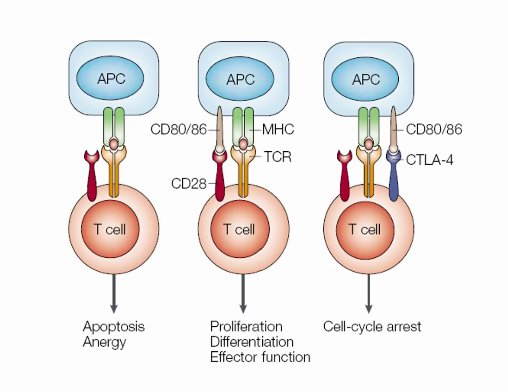
How does blocking CTLA-4 help treat cancer, and what is the main trade-off?
Mechanism: Anti-CTLA-4 antibody (ipilimumab) prevents CTLA-4 from binding CD80/86, so CD28 costimulation wins, boosting T cell proliferation and effector function against the tumor.
Result: Enhanced anti-tumor immunity (first checkpoint inhibitor, approved for melanoma).
Trade-off: Loss of the brake causes immune-related adverse events (colitis, dermatitis, hepatitis, endocrine toxicity).
Side-effects of immunotherapy
Anything can happen!
Often colon is attacked → diarrhea
Lungs → short of breath
Heart → causes death in 50% of patients who experience this
Timing of side effects in immunotherapy
Takes some time for immune system to become active
When it does become active symptoms may occur
Also takes much longer for side effects to go away.
Optimal dose immunotherapy
Dose that activates the immune system activate