CPPS 302 Excitation-Contraction coupling in skeletal muscle
 Call Kai
 Learn
Learn Practice Test
 Spaced Repetition
 Match
Match Flashcards
 Knowt Play
1/14

There's no tags or description
Looks like no tags are added yet.
Name | Mastery | Learn | Test | Matching | Spaced | Call with Kai | Chat |
|---|
No analytics yet
Send a link to your students to track their progress
15 Terms
What are the 4 main events in excitation-contraction coupling
Ach is released form the somatic motor neuron
Ach initiates an action potential in the muscle fiber
Action potential travels along the sarcolemma into the T-tubules and triggers Ca releas from the sarcoplasmic reticulum (SR)
Ca binds with TnC and initiates muscle contraction
Explain how somatic motor neuron initiates depolarization of a skeletal muscle fiber
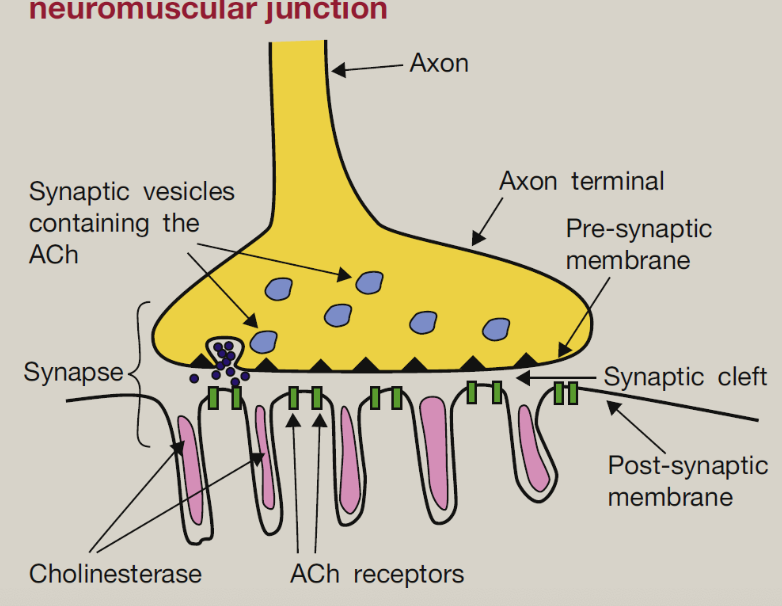
An action potential reaches the motor neuron’s axons terminal
Voltage gated Ca channels open, allowing Ca to enter the neuron
Ca triggers exocytosis of vesicles containing Ach
Ach crosses the synaptic clef and binds to receptors on the muscle’s motor end plate.
These receptors open, allowing mainly Na+ to enter, causing depolarization of the muscle membrane.
How does Ach initiate an action potential in skeletal muscle fiber
Ach binds to receptors on the motor end plate
The receptors open, allowing mainly Na+ to enter, causing depolarization.
If depolarization reaches threshold, voltage-gated Na channels open, generating a muscle action potential
The action potential spreads along the sarcolemma and travels into the T-tubules.
Main concept: Ach converts the nerve chemical signal into an electrical signal in the muscle fibre.
Why does muscle contraciton occur after the muscle action potential rather than immediately
Because excitation-contraction coupling takes time. The action potnetial must trigger Ca release and initiate cross-bridge activity before measurable tension develops.
How deos the duration of a muscle action potential compare to the duration of muscle contraction?
The muscle action potential is a very brief (about 2ms), while the resulting muscle twitch lasts much longer (tens to hundreds of milliseconds)
Action potential is the electric trigger, while the muscle contraciton is the mechanical response that follows

What is the latent period in skeletal muscle contraction?
The short delay between the muscle action potential and the development of measurable tension, during which excitation-contraction coupling occurs

How does an action potential trigger Ca release from the sarcoplasmic reticulum
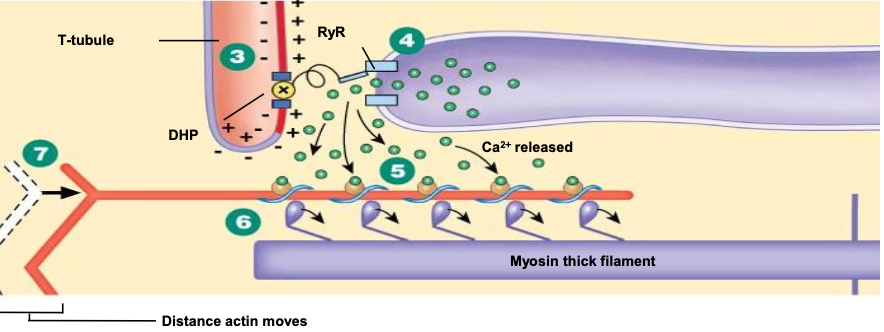
The action potential travels along the sarcolemma and into the T-tubules
Depolarization activates the DHP receptors in the T-tubule membrane
DHP receptors activate the RyR receptors on the SR membrane
Ryr channels open, releasing stored Ca from the SR into the sarcoplasm.
What are the roles of DHP and RyR receptors in skeletal muscle contraction
DHP = detecs changs in membrane voltage in the T tubules and activates the RyR
RyR = A Ca release channel on the SR that opens to release Ca into the muscle cell
How does Ca binding to troponin C initiate skeletal muscle contraction?
Ca released from the SR binds to troponin C (TnC)
This causes a conformational change in the troponin complex
Tropomyosin moves away from the myosin-binding sites on actin
Myosin can now bind to actin, allowing cross-bridge cycling and muscle contraction

What are the roles of the three troponin subunits in muscle contraction?
TnC: binds Ca to initiate contraction
TnL: inhibits actin-myosin interaction when the muscle is relaxed
TnT: Anchors the troponin complex to tropomyosin
How many isoforms does Troponin C have
Two: Low and High affinity
Explain the four main steps in the cross-bridge cycle during skeletal muscle contraction
Detachment: ATP binds to myosin, causing myosin to release actin
Cocking: ATP is hyrodyzed into ADP + Pi, providing energy to cock the myosin head into a high-energy position
Power stroke: myosin binds to actin, and Pi release triggers the power stroke, pulling actin towards the M lin e
ADP release: ADP is released, leaving myosin tightly bound to actin until another ATP binds.
Cycle repeats as long as Ca and ATP are available
Why is ATP necessary for muscle contraciton
ATP has two major functions during the cross-bridge cycle
ATP binding: allows myosin to detach from actin
ATP hydrolysis: provides energy to cock the myosin head, preparing it for the next power stroke
What is the sequence of events during excitation-contraction coupling?
Action potential
Ca release: sarcoplasmic reticulum releases Ca, increasing sarcoplasmic Ca concentration
Muscle tension: Ca binds troponin C, allowing cross-bridge cycling and force generation
Relaxation: Ca is pumped back into the SR, causing the muscle tension
Why does muscle tension peak after sarcoplasmic Ca concentration has aleready started decreasing?
Because force generation takes time. Even after Ca begins decreasing, cross-bridge cycling continues, allowing muscle tension to keep increasing temporarily.