🚗🚗theory
 Call Kai
 Learn
 Practice Test
 Spaced Repetition
 Match
 Flashcards
 Knowt Play
1/112

There's no tags or description
Looks like no tags are added yet.
113 Terms

Beware of bends ahead


Lorry


1.6
Everyone

When the traffic light changes to Amber after he passed the first time

When dry
All crossings
Zebra crossing
Black-and-white stripes on the road.
Flashing amber beacons.
No traffic lights.
You must give way to pedestrians who have moved onto the crossing.
Pelican crossing
Controlled by traffic lights.
The pedestrian presses a button.
The driver gets a flashing amber light after red.
You may proceed on flashing amber only if the crossing is clear.
Puffin crossing
Has sensors that detect pedestrians.
The pedestrian signal is usually on the near side, next to them.
Sensors help control how long the traffic lights stay red.
No flashing amber phase for drivers.
Toucan crossing
For two types of users: pedestrians and cyclists.
Cyclists can ride across instead of dismounting.
Usually traffic-light controlled.
Pegasus crossing
For pedestrians and horse riders.
Has a higher-level button for horse riders.
Usually traffic-light controlled.


Right one
One line cross
At traffic lights what does amber light ALONE mean
What is Amber with red
Alone: stop
With red: stop get ready to go
What's the main hazard you should be aware of when following this cyclist?
Might swerve into the road
(Might be going around an obstacle)
What should u remember anout questions asking about biggest hazard of situations
Don’t pick the things u are already expected to know as a driver
Pick dangerous things that are unexpected on the road
What is the main cause of skidding
The driver
Because the weather creates the risk, but the driver often determines whether the car actually skids.
Too much braking, accelerating or steering for the available grip: the tyres can lose grip, and the car may skid.
You're travelling on a narrow section of road. What should you do if a horse rider ahead is riding in the centre of the lane?
Just wait
Courses are entitled to use the road too
U wait until u can safely overtake
Speed limit end sign vs parking restriction end sign
Speed limit end= shows the numbers
Parking restriction= only sayd zone
You need to use a defibrillator (AED) on a casualty, how will you know how to use it?
Gives spoken imstruction
Which document may the police ask you to produce after you've been involved in a collision?
Driving liscence
You're asked to fetch a defibrillator (AED).
What's the best way to find the nearest AED?
The 999 operator will direct you.
You're at a junction controlled by traffic lights. When should you wait at a green light?
When your exit from the junction is blocked
What does “drinking increases confidence” mean
Some two-way roads are divided into 3 lanes. Why are they particularly dangerous?
Traffic in both directions may be able to use the middle lane to overtake
Which vehicle is most likely to take an unusual course at a roundabout?
Long vehicle
What would you expect to find at a contraflow system on a motorway?
Temporary traffic lights
What to do if overtaking at night
go past slowly so that you can react to unseen hazards or unexpected events on the road ahead.
You're waiting in a traffic queue at night.
How can you avoid dazzling drivers behind you?
Use the parking brake and release the footbrake

50
Why should u park your car in a secure car park
Helps deter thieves
What's the main benefit of driving a four-wheel-drive vehicle?
Improved grip on the road
What's the minimum depth of tread on the tyres of a trailer?
1.6mm
Who can use a public access defibrillator (AED)?
Everyone
What should you do if you cannot see clearly behind when you're reversing?
Ask someone to guide u
When can you wait on yellow grid markings
Going straight ahead or left : You must not enter the yellow box unless your exit is clear. (there's enough space on the road AFTER the yellow box for your car to get through without having to stop inside the box.)
Turning right: You may enter and wait in the box if your exit is clear but you are prevented from turning right by oncoming traffic, or by other vehicles waiting to turn right.
Why might a lorry driver start turning too late
Needs run to turn
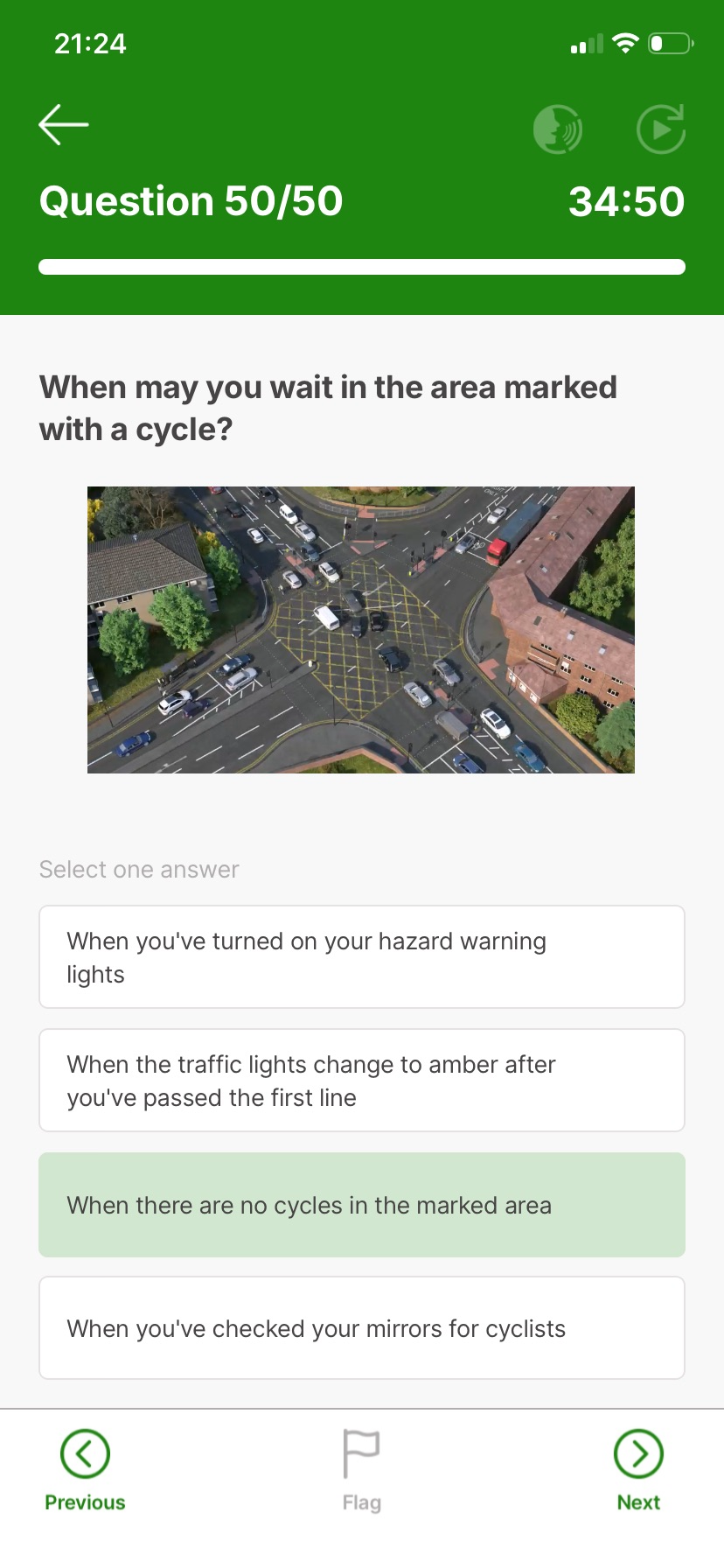
When the lights turn to Amber after already passing it
Who can use toucan crossings
Bikes and pedestrians
Difference between pelican and puffin
🐦 PELICAN
Button box: YES, press it.
Green man: FLASHES.
Signal location: FAR side of the road.
Sensors: No puffin-style pedestrian sensors.
Timing: Fixed signal sequence.
🐧 PUFFIN
Button box: YES, press it.
Green man: DOES NOT FLASH.
Signal location: NEAR side of the road.
Sensors: YES, detect pedestrians.
Timing: Can adjust to help pedestrians finish crossing.

What are they
Red= roundabout
Curcle= mini roundabout
Green= ring riad
How much can stopping distances increase in icy conditions
10x

Large deep cuts in side walls
Road holding meaning
how well a car’s tyres grip the road and keep the car stable while driving.

Which ADAS is turned on
Lane keep assist
Powered vehicles used by disabled people are small and can be hard to see. What colour beacon must they display if they're travelling on a dual carriageway?
Amber flashing beacon
You're looking for somewhere to park at night. When may you park on the right-hand side of the road?
One way street
As you approach the roundabout, there's a sign showing a single white bar on a green background. What does this sign tell you?
100 yards ahead
Difference between blue Countdown Markers green Countdown markers
Blue used on motorways For motorway exit
Green used on primary roots on major a roads to warn you about Things like junctions roundabout
As you approach the roundabout, you want to change lanes. What routine should you follow?
Select one answer
Mirrors, signal, manoeuvre
Signal, mirrors, manoeuvre
Manoeuvre, signal, mirrors
Manoeuvre, mirrors, signal
Mirrors, signal, manoeuvre (MSM). ✅
At an incident, someone is suffering from severe burns. How could you help them?
Select one answer
Remove anything sticking to the burns
Burst any blisters
Douse the burns with clean, cool water
Apply lotions to the injury
Douse the burn with clean cool water
You're driving in a slow-moving queue of traffic. What should you do just before changing lane?
Select one answer
Change down to first gear
Give a 'slowing down' arm signal
Sound the horn and flash your lights
Look for motorcyclists filtering through the traffic
Look for motorcyclists filtering through the traffic
changing gear doesn't tell you whether it's safe to change lanes!
Who's legally responsible for making sure that a vehicle registration certificate (V5C)
is updated?
Select one answer
The registered vehicle keeper
Your insurance company
The vehicle manufacturer
The licensing authority
Registered keeper
You're driving along a motorway and switch on adaptive cruise control. What are you now allowed to do?
Select one answer
Eat and drink
Remove your seatbelt
Use your handheld mobile phone
Check the road signs
check road signs
(You must continue checking road signs because ACC doesn't recognise and respond to every road rule or hazard for you.)
What do solid white lines usually mean
edges of the carriageway. They show you where the road ends and the verge or hard shoulder begins.
When may you cross a double solid white line in the middle of the road?
Select one answer
To pass traffic that's queuing back at a junction
To pass a car signalling to turn left ahead
To pass a vehicle that's towing a trailer
To pass a road maintenance vehicle travelling at 10mph or less
Previous
Flag
To pass a road maintenance vehicle travelling at 10 mph or less.
What are double white lines used for
to stop drivers overtaking when crossing the centre line would be dangerous. They're used where visibility is poor or the road layout makes overtaking risky.
What's the maximum fine for driving or riding without insurance?
Unlimited
How should you load your trailer?
Select one answer
Put heavy items at the front
Put heavy items at the back
Put heavy items in the corners
Put heavy items over the axles
Above axles
How should a load be carried on your roof rack?
Select one answer
Covered with plastic sheeting
Visible in your exterior mirror
Loaded towards the rear of the vehicle
Securely fastened with suitable restraints
Securely fastened with suitable straight

Heavy goods
You're travelling on the motorway. How can you lower the risk of a collision when the vehicle behind is following too closely?
Select one answer
Increase your distance from the vehicle in front
Brake sharply
Move onto the hard shoulder and stop
Switch on your hazard warning lights
Increase distance from vehicle INFORNT
And
Explain all car lights
UK DRIVING THEORY: TYPES OF CAR LIGHTS
1. Dipped headlights: Illuminate the road ahead without dazzling other road users. Used at night and in seriously reduced visibility.
2. Full-beam headlights (main beam): Provide stronger, longer-range illumination on dark, unlit roads. Dip them when approaching oncoming traffic or following another vehicle so you do not dazzle the driver.
3. Sidelights (position lights): Make the vehicle more visible to others. They are not powerful enough to light the road properly. Must be lit between sunset and sunrise, along with rear number plate lights.
4. Daytime running lights (DRLs): Help other road users see your car during daylight. They do not replace headlights at night because rear lights may not come on with them.
(1. Why don't daytime running lights replace headlights?: They're designed mainly to make your car visible to other people during daylight, not to illuminate the road ahead properly at night.They may not switch on your rear lights. That means someone approaching from behind might struggle to see your car in darkness.)
5. Rear lights (tail lights): Red lights at the back of the car that make it visible from behind when the vehicle's lights are switched on. They normally come on with sidelights or headlights.
6. Brake lights (stop lights): Red lights at the rear that become brighter when you press the brake pedal. Warn drivers behind that you are braking or slowing down. They are different from ordinary rear lights.
7. High-level brake light: An additional brake light, usually positioned higher up at the rear window or on the boot. Makes braking easier for drivers behind to notice.
8. Indicators (direction indicators): Flashing amber lights that signal an intention to turn or change position, such as changing lanes. Signal your intention clearly and in good time.
9. Hazard warning lights: Flashing amber indicators on both sides of the vehicle operating together. Warn others of a temporary obstruction or hazard. Use them when stationary and temporarily obstructing traffic. On motorways or unrestricted dual carriageways, they can also warn following drivers of a hazard ahead.
10. Front fog lights: Help you see the road in seriously reduced visibility, such as thick fog. Use only when visibility is seriously reduced and switch them off when visibility improves.
11. Rear fog lights: Very bright red lights that help vehicles behind see you in seriously reduced visibility. Switch them off when visibility improves because they can dazzle drivers and obscure brake lights.
12. Reversing lights (reverse lights): White lights that come on when reverse gear is selected. Illuminate the area behind the car and warn others that you intend to reverse.
13. Rear number plate light: Illuminates the registration plate at the back so it can be read in darkness. Must be lit between sunset and sunrise.
14. Parking lights: Allow a parked vehicle to remain visible in certain situations, particularly on roads with a speed limit above 30 mph. They may be used when parking on the road at night where required. Follow the applicable parking-light rules.
15. Flashing headlights: Briefly flashing your headlights can warn other road users of your presence. Do not use them to intimidate others or communicate misleading signals. The Highway Code says you should only flash to let others know you are there.
16. Warning beacons: Special flashing lights fitted to certain vehicles, such as recovery vehicles or road-maintenance vehicles. Amber beacons warn of a potential hazard or slow-moving vehicle. Other beacon colours are used by particular authorised services.
IMPORTANT DIFFERENCES:
• Rear lights = make the car visible from behind.
• Brake lights = warn drivers that you are braking.
• Dipped headlights = light the road ahead without dazzling others.
• Full beam = light a longer distance ahead but can dazzle others.
• Sidelights = help others see your car, but do not properly illuminate the road.
• Fog lights = for seriously reduced visibility, not ordinary darkness.
• Reversing lights = white lights that indicate reversing.
• Indicators = show the direction you intend to take.
• Hazard lights = warn of a hazard or temporary obstruction.
REMEMBER: In UK driving theory, visibility seriously reduced means you cannot see for more than 100 metres. Use headlights and fog lights according to the conditions and the Highway Code.
Why should you switch your headlights on when it first starts to get dark?
Select one answer
So others can see you more easily
To make your dials easier to see
So that you blend in with other drivers
Because the street lights are lit
So others can see you more easily.
Headlights can be dipped headlights..
What would you expect to find at a contraflow system on a motorway?
Select one answer
• DVSA revision question
Road humps
Lower speed limits
Temporary traffic lights
Wider lanes than normal
Lower speed limits
No temporary topic lights this is a motorway
The question doesn't need to say "temporary" speed limit because the roadworks context already suggests the limit has been changed for the duration of the works.
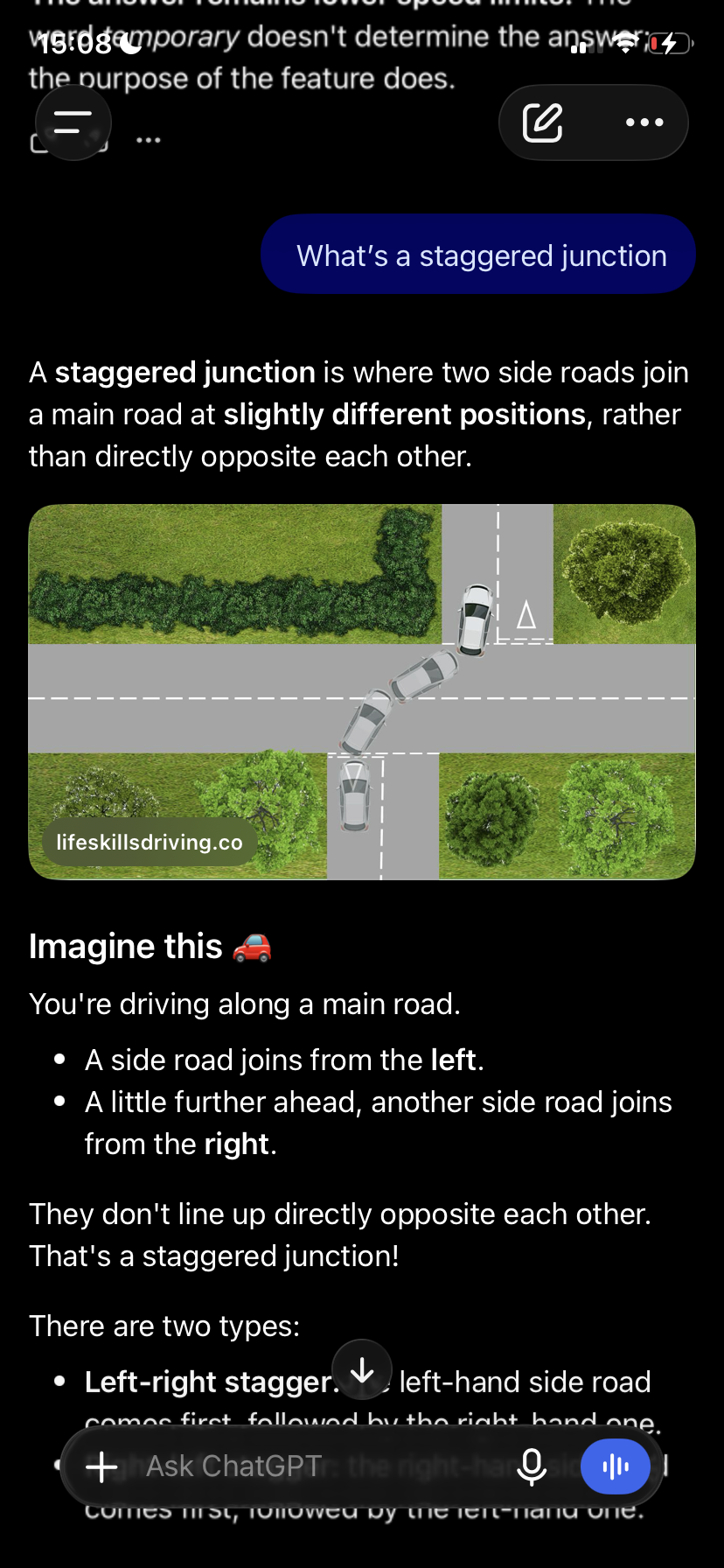
What’s a staggered junction
If a question says “ Why is there a warning Reduce speed now'?” What do u do
Look at signs
What type of vehicle uses an amber flashing beacon on a dual carriageway?
Select one answer
• DVSA revision question
A fire engine
An ambulance
A doctor on call
A tractor
And when must mobility scooters/powered wheelchairs use Amber flashing beacon
Tractor on an unrestricted dual carriageway
The rule applies to vehicles with a maximum speed of 25 mph
Mobility scooters/powered wheelchairs use Amber flashing when On a dual carriageway where the speed limit exceeds 50 mph.
What should you do if it's raining and you're following this lorry on a motorway?
Select one answer
• DVSA revision question
Switch your headlights onto main beam
Allow a two-second separation gap
Move into a lane that has less spray
Be aware of spray reducing your vision
Be aware of spray
two seconds is the normal minimum gap in good conditions, but rain makes the road more dangerous.

Doors opening on parked cars
You intend to turn left at the traffic lights.
What should you do just before turning?
Select one answer
• DVSA revision question
Move up closer to the car ahead
Check for bicycles on your left
Check your right mirror
Move out to the right
Check for bike
What will become more expensive after you've been convicted of driving while unfit through drink or drugs?
Select one answer
• DVSA revision question
Driving licence
Insurance premiums
Road fund licence
Vehicle test certificate
insurance premiums

Steady Amber light
You're driving on a one-way street. What should you do if you realise you've taken the wrong route?
个
Select one answer
• DVSA revision question
Turn around in a side road
Reverse into a driveway
Continue and find another route
Reverse out of the road
Continue and find another route. ✅
Turn around in a side road: You shouldn't turn around unless it's legal and safe to do so.
Reverse into a driveway: Reversing into a driveway isn't the appropriate way to correct your route.
Reverse out of the road: Dangerous because other drivers won't expect you to reverse against the flow of traffic.

vehicles may pass either side to reach the same destination.
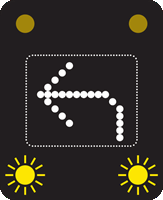
You will see this on matrix screens or overhead gantries when the motorway is closed entirely further ahead, forcing all remaining traffic to exit.
Memory Trick: Think "L" for Leave.

Move into the lane to your left as soon as it is safe to do so.
When it is used: It warns you that your current lane is closing or blocked further ahead. It is a precursor to a Red X
Can be opposite too (right)
in a three lane two way road what is the middle kne used for
Overtaking from either side or turning right

Trans must stop

To allow children to see and be seen when they're crossing the road.
Why?
Cars parked on the school keep-clear markings can block a child's view of approaching traffic. They can also hide children from drivers.
What's likely to happen if you put too much oil in your engine?
Select one answer
The timing belt will slip
The clutch pedal will lock
The oil seals will leak
The air intake will become blocked
Oil seals will leak
How would under-inflated tyres affect your vehicle?
Select one answer
The vehicle's headlights would aim high
The flash rate of the vehicle's indicators would increase
The vehicle's gear change mechanism would become stiff
The vehicle's stopping distance would increase
Stopping distance would increase
A casualty is not breathing normally and needs cardiopulmonary resuscitation
(CPR). At what rate should you press down and release on the centre of their chest?
120beats per minute
You arrive at the scene of a motorcycle crash. No other vehicle is involved. The rider is unconscious and lying in the middle of the road. What's the first thing you should do at the scene?
Select one answer
Move the rider out of the road
Warn other traffic
Clear the road of debris
Give the rider reassurance
What’s debris
Warn other traffic.
Debris: scattered pieces of broken or damaged material.
What hazard should you be especially aware of if you're turning left into a side road?
Select one answer
One-way street
Parked vehicles
Pedestrians
Traffic congestion
Pedestrians
One-way street: This is a type of road where traffic travels in only one direction. It isn't necessarily a hazard when turning left because the question is about what you should watch out for during the turn, not the direction of traffic.
- Parked vehicles: These can obstruct your view or make the turn narrower, but they're usually stationary and easier to account for. Pedestrians can move into your path, so you need to watch for them particularly carefully.
- Traffic congestion: This means lots of vehicles slowing down or queuing. It can make turning more difficult, but it's not the specific hazard being tested here. The key risk is that pedestrians may be crossing the road you're turning into.
You've just passed your driving test.
What's the maximum authorised mass
(MAM) of any trailer that you can tow?
Select one answer
5,500 kg
6,500 kg
4,500 kg
3,500 kg
3,500
It's the maximum permitted weight of the trailer when fully loaded, including the trailer itself and everything inside it.
Where is your vehicle most likely to be affected by side winds?
Select one answer
On a narrow country lane
On a busy stretch of road
On a long, straight road
On an open stretch of road
On an open stretch of road, there are fewer buildings, trees and other obstacles to block the wind. That means strong gusts can hit your vehicle directly and push it sideways. 🌬🚗
Why not the other options?
A narrow country lane: Hedges, trees and banks may shelter you from the wind, although not always.
A busy stretch of road: Traffic might obstruct some wind, but the main issue here is not how busy the road is.
A long, straight road: A road can be long and straight but still be sheltered by buildings or trees.
Why are vehicles fitted with rear fog lights?
Select one answer
To make them more visible in thick fog
To make them more visible when driving at high speed
To show when they've broken down in a dangerous position
To warn drivers following closely to drop back
To make them more visible in thick fog.
To make them more visible when driving at high speed: Rear fog lights aren't designed for speed. They're designed for poor visibility.
To show when they've broken down in a dangerous position: That's what hazard warning lights are for.
To warn drivers following closely to drop back: You should maintain a safe following distance, but rear fog lights aren't a warning signal for tailgaters.
When may you drive without wearing your seat belt?
Select one answer
When you're moving off on a hill
When you're carrying out a manoeuvre that includes reversing
When you're testing your brakes
When you're driving slowly in queuing traffic
The correct answer is ✅ When you're carrying out a manoeuvre that includes reversing.
Why?
When you're reversing as part of a manoeuvre, you're allowed to remove your seat belt if necessary because the belt may restrict your movement when looking behind you.
Modern cars are often fitted with a variety of technologies, called advanced driver assistance systems (ADAS). What is the main purpose of these systems?
Select one answer
To reduce journey times
To make the roads safer
To reduce environmental pollution
To make driving easier
The correct answer is ✅ To make the roads safer. 🚗
What are ADAS?
ADAS = Advanced Driver Assistance Systems.
These are technologies in modern cars that help drivers detect hazards, avoid collisions and drive more safely.
Examples include:
Automatic emergency braking: Can brake automatically if a collision is likely.
Lane departure warning: Alerts you if you drift out of your lane.
Blind-spot monitoring: Warns you when a vehicle is in your blind spot.
Why are the other answers wrong?
To reduce journey times: These systems aren't primarily designed to get you to your destination faster.
To reduce environmental pollution: They're not mainly designed to reduce emissions, although some vehicle technologies can help with efficiency.
To make driving easier: They can make driving easier, but that's a secondary benefit. Their main purpose is improving safety.
Theory test trick: ADAS = assistance with avoiding danger and preventing collisions. The main purpose is making roads safer, not making your car a self-driving chauffeur.
When will your vehicle use more fuel?
Select one answer
When its tyres are of different makes
When its tyres are under-inflated
When its tyres are over-inflated
When its tyres are new
The correct answer is ✅ When its tyres are under-inflated.
Why?
Remember, your tyres need the correct air pressure to roll efficiently along the road.
When tyres are under-inflated, they're softer and flatten out more against the road. This increases rolling resistance, which means the engine has to work harder to keep the vehicle moving.
Engine works harder → uses more fuel. ⛽
Why not the other options?
Tyres of different makes: This isn't automatically what increases fuel consumption. However, tyres should still be suitable for the vehicle and used in accordance with the manufacturer's recommendations.
Over-inflated tyres: This can reduce grip and cause uneven tyre wear, but under-inflation is the usual theory-test answer for increased fuel consumption.
New tyres: New tyres don't automatically make your vehicle use more fuel.
What action should you take when you see flashing amber lights under a school warning sign?
Select one answer
• DVSA revision question
Wait at the lights until they stop flashing
Reduce speed until you're clear of the area
Keep up your speed and sound the horn
Increase your speed to clear the area quickly
The correct answer is ✅ Reduce speed until you're clear of the area.
Why?
Flashing amber lights beneath a school warning sign tell you that children may be crossing or entering the road nearby, especially around school opening and closing times.
You should:
Reduce your speed so you have time to react if a child steps into the road.
Watch carefully for children near the pavement and crossing points.
Be prepared to stop if necessary.
Why not the other answers?
Wait at the lights until they stop flashing: You don't have to stop just because the amber lights are flashing. You should slow down and proceed cautiously.
Keep up your speed and sound the horn: This doesn't make the area safer. A horn isn't a substitute for slowing down.
Increase your speed to clear the area quickly: This increases the danger because children can behave unpredictably.

Features of flashing amber achool warning lights
🚸 Flashing Amber School Warning Lights
What they look like: Amber (yellow-orange) lights flashing underneath a school warning sign showing children.
What they mean: Children may be crossing or entering the road nearby, particularly around school arrival and leaving times.
What action should you take?
Reduce your speed until you’re clear of the area.
Watch carefully for children near the road.
Be prepared to stop if necessary.
Important: You don’t automatically have to stop just because the lights are flashing. These are warning lights, not traffic-control lights.
Driving theory answer: Reduce speed until you’re clear of the area.
You've just passed your driving test.
What's the maximum authorised mass
(MAM) of any trailer that you can tow?
Select one answer
• DVSA revision question
5,500 kg
6,500 kg
4,500 kg
3,500 kg
3.500

Temporary maximum speed
When may you wait in a box junction?
Select one answer
• DVSA revision question
When oncoming traffic prevents you turning right
When approaching a pelican crossing
When you're stationary in a queue of traffic
X
When approaching a zebra crossing
When oncoming traffic prevents u from turning right
Situation 1: Oncoming traffic is coming
You enter the yellow box because you want to turn right, but cars coming towards you prevent you from turning.
You can wait inside the box for a safe gap in oncoming traffic.
Situation 2: Your exit is blocked
You want to turn right, but there's a queue of stationary traffic blocking the road you want to enter.
Don't enter the box if you can't clear it because of that queue.
On coming in traffic wouldn’t affect cars going left because in the UK to go left you stay on the left hand lane
Whate a crossroads
A crossroads is a junction where four roads meet.
When would you increase the pressure in your tyres so that it's above the normal value?
Select one answer
When the vehicle is fitted with anti-lock brakes
When the roads are slippery
When the tyre tread is worn below 2 mm
When carrying a heavy load
The correct answer is When carrying a heavy load. ✅
Why?
Your tyres support the weight of your car. When you carry extra passengers or heavy luggage, the tyres have to support more weight.
Increasing the tyre pressure to the vehicle manufacturer's recommended pressure for a heavy load helps the tyres support that extra weight safely.
Why not the other answers?
Anti-lock brakes (ABS): These prevent the wheels from locking during hard braking. They don't require higher tyre pressure.
Slippery roads: You should drive more carefully and reduce speed, not change tyre pressure to compensate.
Tyre tread worn below 2 mm: Increasing pressure won't restore worn tread. You need to check the tyres and replace them if necessary.
How can you reduce the damage your vehicle causes to the environment?
Select one answer
Brake heavily
Use narrow side streets
Anticipate well ahead
Use busy routes
The correct answer is Anticipate well ahead. ✅
Why?
When you look far ahead and anticipate what's happening on the road, you can:
Brake less suddenly, reducing unnecessary braking.
Accelerate more smoothly, using less fuel.
Maintain a steady speed, reducing fuel consumption and harmful exhaust emissions.
Basically, smoother driving means your car wastes less fuel and produces less pollution. 🌍
Why not the others?
Brake heavily: Wastes energy and causes more wear on your brakes.
Use narrow side streets: Doesn't necessarily reduce fuel consumption or pollution.
Use busy routes: Stop-start traffic can increase fuel consumption.

This is the crossing with flashing amber beacon

OOn a vehicle, where would you find a catalytic converter?
Select one answer
On the exhaust system
In the fuel tank
In the air filter
On the cooling system
On the exhaust system
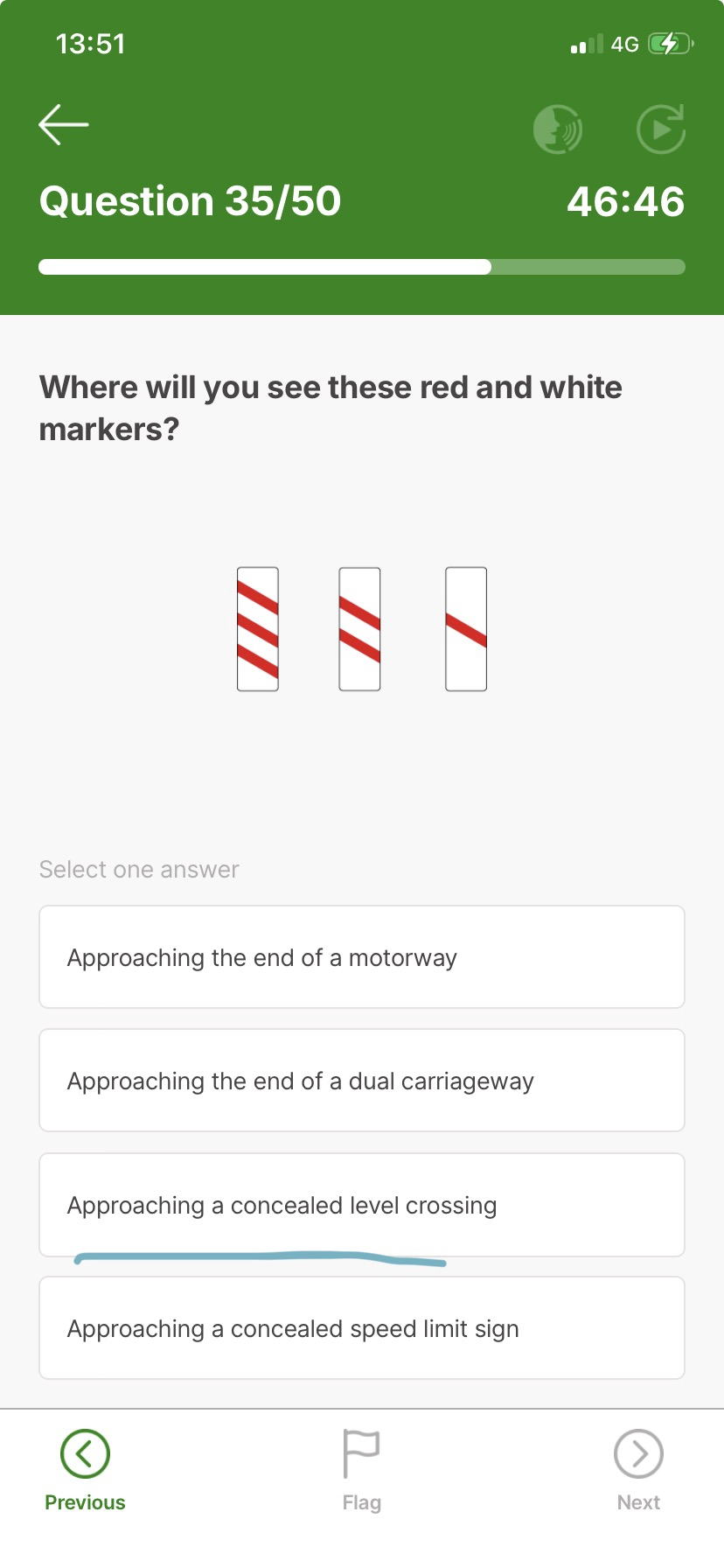
Approaching concealed level crossing
Why should you check for motorcyclists just before turning right into a side road?
Select one answer
They may be emerging from the side road
They may be following you closely
They may be overtaking on your left
They may be overtaking on your right
The correct answer is: They may be overtaking on your right. ✅
Here's the simple explanation:
Imagine you're driving along a road and want to turn right into a side road.
A motorcyclist behind you might try to overtake you on your right, because you're slowing down to turn.
If you turn right without checking, you could crash into them. Motorcycles are smaller, so they're easier to miss. 😭