Ascomycetes with Various Fruiting Bodies
 Call Kai
 Learn
Learn Practice Test
 Spaced Repetition
 Match
Match Flashcards
 Knowt Play
1/40

There's no tags or description
Looks like no tags are added yet.
Name | Mastery | Learn | Test | Matching | Spaced | Call with Kai | Chat |
|---|
No analytics yet
Send a link to your students to track their progress
41 Terms
Onygenales
family Onygenaceae, Onygena equina and corvina on old hooves, horns, feathers, and hair
what are stalked ascomata called
mazaedia
ajellomyces dermatidis
blastomycesis
ajellomyces capsulatus
histoplasmosis
Coccidiodes immitis
Valley Fever (coccidiomycosis)
ajellomyces capsulatus details
dimorphic, grows as yeasts at 37C and mycelium below 37C, occurs in soil, associated with bird and bat feces, infection occurs via inhalation of spores

first and second arrow
conidia

third arrow
conidiogenous cells (phialides)

fourth arrow
supporting cell (branch or metulae)
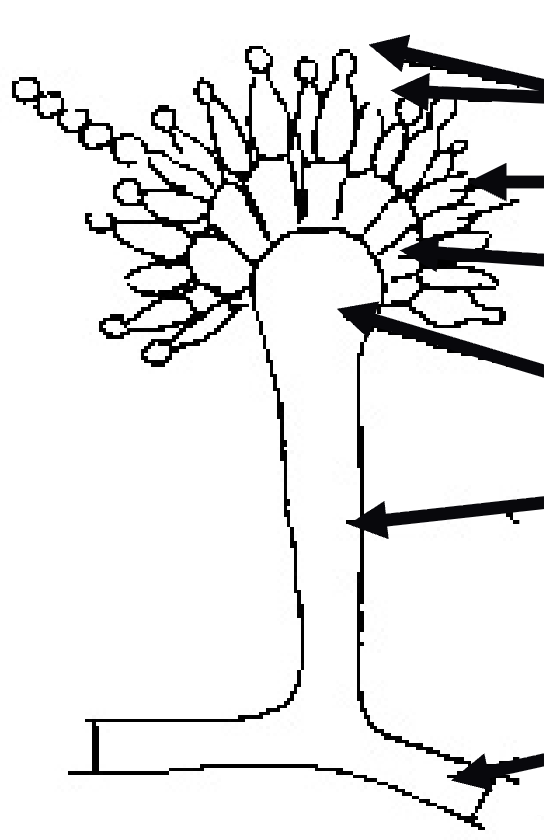
fifth arrow
swollen apex of conidiophore (vesicle)

sixth arrow
conidiophore
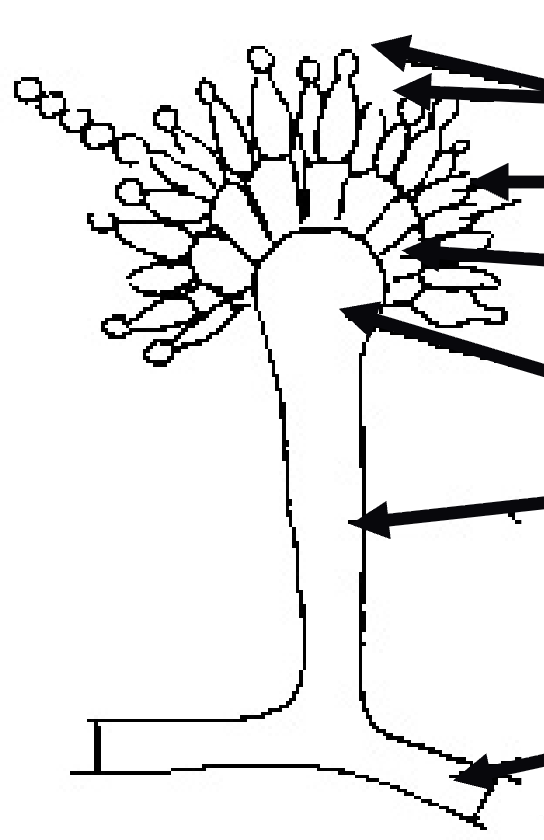
seventh arrow
basal part of conidiophore (foot cell)

first arrow
phialides

second arrow
branches
Pericillium spp.
antibiotic production
Penicillium camemberti and roqueforti
Camembert and blue cheese
Aspergillus sojae
production of soy sauce
aspergillus niger
production of citric acid
penicillium spp. other thing
blue and green molds on bread, cheese, fruits, vegetables
aspergillus flavus
aflatoxins (moldy peanuts)
A. flavus / A. niger
aspergillosis
Erysiphales
powdery mildews, biotrophs of vascular plants, most species are host-specific (a few are omnivorous, infecting hundreds of host species)
Erysiphales characteristics
mycelium is mostly superficial, overwinter as mycelium infected buds or as ascomata, asexual reproduction via conidia, sexual reproduction via ascospores formed in chasmothecia
Erysiphales sexual reproduction
chasmothecia with appendages, formed on superficial mycelium in late summer/early fall, one to numerous asci/chasmothecium, in hymenium, ascospores hyaline, one-celled ovoid, 1-8 ascospores/ascus

uncinula

phyllactinia
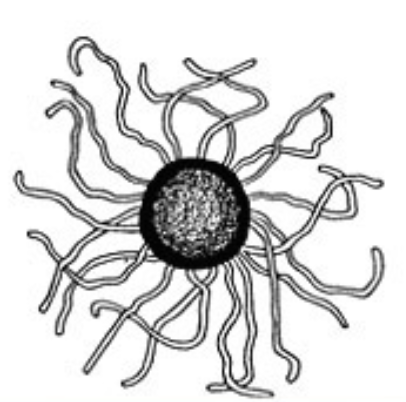
one ascus
Sphaerotheca

several asci
Erysiphe

one ascus
podosphaera

several asci
microsphaera
Erysiphales identification
number of asci/ascocarp, chasmothecial appendages, myceloid-herbaceous hosts vs rigid-woody hosts, spear-like with inflated base, with curled tips, with dichotomously branched tips
Discomycetes
filamentous ascomycetes that produce apothecia (apothecium singular)
Rhytismatales
ascomata embedded in stroma, apothecia open up at maturity, almost all members of the order are parasitic on plants (mostly on meedles or leaves), needle blight and cast, tar spot
Class Pezizomycetes
large, conspicuous apothecia (amyloid and non-amyloid species)
Morels
belong to the genus Morcella, black morels, common morels, burn morels, all species considered edible, asci are amyloid
amyloid meaning
blue-black color change when in contact with an iodine-based reagent
burn morels
3 distinct “species” fruit on burned soils the first spring after a fire in a coniferous forest
Truffles
hypogenous fruiting bodies, asci do not forcibly discharge ascospores, mycorrhizal with trees
Tuber melanosporum
black Perigord truffle
Tuber magnatum
white truffle of Italy
Tuber oregonense
oregon black truffle