Patel Pure maths
 Call Kai
 Learn
 Practice Test
 Spaced Repetition
 Match
 Flashcards
 Knowt Play
1/33

Earn XP
Description and Tags
34 Terms
What does exponential mean?
increasingly increasing growth. ie: the rate of change increases as the value rises. Eg: doubling vs +2 each time.
what does a y = ex look like graphically
never touches x axis. Y intercept at 1. exponential curve.

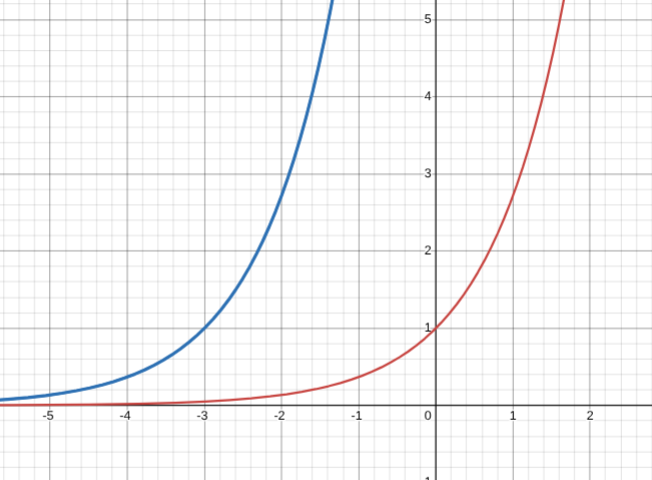
What about Ax = y. Where A = 1, 2, and 3. This has the same rough effect as ekx.
A affects the gradient of the curve. A=3 causes graph to dip lower when negative and become steeper when positive. A=1 causes the graph to start higher, and become shallow.
kx —> f(ax) hence the graph stretches horizontally, but y -intercept stays the same

Draw y = 1/ex (same as saying y = e-x)
reflection in the y-axis (whenever ex is larger, 1/ex is small, thus the values flip)

draw ex+3 . What effect does this have on the graph [same a f(x+a)]
Shifts the graph 3 spaces left. as such the y intercept becomes e³, or about 8.
What effect would ex+1 have - f(x)+1 - have? it would move it up by 1
What is a logarithm?
Sqrt is the opposite of x2. Logarithms are the opposite of exponentiation. You can think of taking log2 and taking the base as 2, to be opposites.


Why can bases not have negative bases, or negative arguments?
Arguments: ea cannot equal a negative (if both are positive). The graph approaches a negative vertical asymptote at x=0.
Bases: cannot be negative as if the exponent is an even fraction, you need to take a negative even root, which results an imaginary non-real number (This means it is not longer a one-to-one function and discontinuous)
What are the 3 basic log laws?
Multiplication rule: logb(xy) = logb(x) + logb(y)
Division rule: logb(x/y) = logb(x) - logb(y)
Power rule: logb(xk) = k logb(x)
What are the 2 methods to easily derive these rules?
aloga(x) = x —> [when you see loga(x) - take the base a]
loga(ax) = x —> [When you see a base - take the log]
NOTE: (am) n = amn
What are the special cases of the log laws?
loga(x-1) = - loga(x)
loga(1) = 0
NOTE: {a : a > 0 , a ≠ 1}
a ≠ 1 because log1(1) = y —> 1y = 1
which has infinite solutions, which is a one-to-many relationship, so not defined for the function
What is the generalised method to solve exponentials
eg:
3x+1 = 4x-1 (NOTE: using ln(x) instead of log(x) can be good practice for a general method)
Take the logarithm of both sides :
ln(3x+1)=ln(4x−1)
Apply log rules :
(x+1)ln(3)=(x−1)ln(4)
Expand and collect like terms :
xln(3)+ln(3)=xln(4)−ln(4)
ln(3)+ln(4)=xln(4)−xln(3)
ln(12)=x(ln(4)−ln(3))
x=ln(12) / ln(4)−ln(3)
what is the derivative of ex ?
ex (derived from chain rule). This means the rate of increase of ex is exactly equal to its value at that point. In other words, the rate of increase and the size of the function are proportional (not simply related).
what is the derivative of ekx+1+3
kekx+1 —> Multipliers of x go on the outside, and the power stays the same
This is part of “chain rule” which is in differentiation
same as x^k, hence we get ke^x, but the power doesn’t change since anything raised to the power of e always has proportional rate
What does Aex + c do? What does e-x do?
“A“ multiplies the y-intercept (it does NOT change the gradient noticeably)
“c” increases the y intercept AND the horizontal asymptote.
e-x reflects the graph across the y-axis —> f(-x)
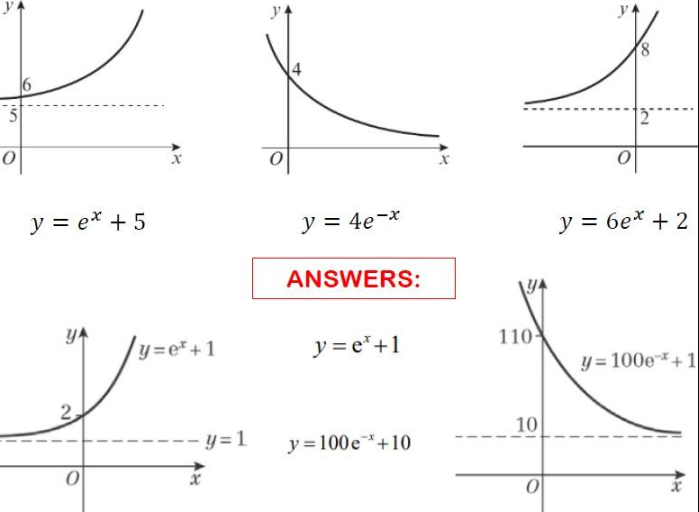
what are some examples where exponential graphs can be used?
Population growth, compound interest, radioactive decay (using e-x)
The form y = Ae-kt is extremely common. Define the purpose of each part, and an example application?
“A“ is the initial value —> When t = 0
“-k“ is a constant to control the gradient. the fact it is NEGATIVE, means the graph is reflected in y-axis. It means the maximum value will be A.
“t“ is the time and the x-axis variable.
NOTE: a “ + c “ term would mean the minimum would always stay above a set value (particularly useful for something like the value of a car, which has a base value for its scrap parts)
Eg: the number of pesticides in a field over time (it starts from a maximum value, and since the exponent is negative, the rate of decrease of the pesticide decreases (this is known as decay) reaching an asymptote approaching 0)
What are the effects of a, b and c in y = eᵃˣ⁺ᵇ + c?
a controls horizontal scaling/reflection (if neg) —> f(ax) [scaling not noticeable]
b controls horizontal translation —> f(x+b)
c controls vertical translation
where:
horizontal asymptote is y = c
what is ln(x)
the inverse of ex is ln(x). It is thus a reflection in the line y = x
the graph increases decreasingly (logarithmically) and there is a vertical asymptote at x = 0

Solve e2x+3 = 14 (NOTE: whenever e is the base, don’t try to use a regular base, always default to ln.)
Taking ln of both sides:
e²ˣ⁺³ = 7
ln(e²ˣ⁺³) = ln(7)
2x + 3 = ln(7)
2x = ln(7) − 3
x = (ln(7) − 3)/2
Answer:
x = (ln(7) − 3)/2 ≈ 0.4739
Solve e2x + 5ex = 14
Let y = eˣ.
So:
y² + 5y = 14 —> y² + 5y − 14 = 0
(y + 7)(y − 2) = 0
Therefore:
y = −7 or y = 2
But eˣ > 0, so y = −7 is impossible.
eˣ = 2
Taking ln of both sides —> ln(eˣ) = ln(2)
Answer: x = ln(2)
How do you turn a y = axn (polynomial) into a linear graph in the form y=mx+c? What are the axes? eg: even something like y = 2x
y = axn
log(y) = log(axn )
log(y) = log(a) + n log(x) —> NOTE: order of operation a + xn —> n log(x)
y-intercept: log(a) —> NOTE: NOT “a” (a was the y-intercept on the original graph)
gradient: n —> the exponent
axes: log(y) against log(x) —> NOTE: we say y against x
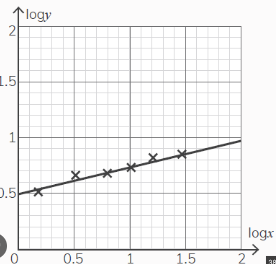

How would we turn this (polynomial) table into a graph?
Turn the table into a log table
turn the exponential equation into the form log(y) = n log(x) + log(a)
find the y intercept and gradient by plotting points
with log(y) against log(x) on the axes

How do you turn y = abx (exponential) into a linear graph in the form y = mx+c
y = abx
log(y) = log(a) + log(b) x
y-intecept = log(a)
gradient = log(b)
axes: log(y) against x

When is an exponential model appropriate, and how do you evaluate one?
If the rate of change is proportional to the current value, an exponential model is appropriate.
For a model, consider:
the initial value (t = 0)
behaviour for large t
whether its predictions remain realistic
whether the model could be improved/refined
How do prove by deduction?
Facts —> logical and valid algebra —> statement of proof
the EASIEST way to do this, is to create an identity, eg:
“prove the product of 2 odd numbers is odd“
(2p+1)(2q+1) ≡ 2(n) ± 1
NOTE: the ≡ symbol means is ALWAYS equal to, hence we do operations to 1 side, and the goal is ALWAYS to make RHS = LHS
Be aware this is just ONE way of setting out a proof by deduction, and is most often NOT the most efficient. So instead I would write out the identity at the top to know how to structure your answer, BUT THEN the actual proof is just logical algebra from the statement in the question.
NOTE: to state a value is always positive, know that n² > 0,
HENCE n²+c is n² > -c —> not just stating adding a positive number to s square is always positive.
prove that if (x-p) is a factor of f(x) then f(p) = 0
f(x) = g(x)(x-p)
f(p) = g(x)(p-p) => g(x) × 0
HENCE: f(p) = 0
NOTE: other weird applications is:
proving an inequality for the constant k in a quadratic using the discriminant based on the number of roots/intersections it has,
proving a triangle on a graph is a right angled triangle using coordinates,
proving a derivative from first principles,
and proving results for geometric and arithmetic series.
ALSO JOTTINGS.
When do we apply Jotting’s method? How do we do it?
NEVER start a proof with the statement you are trying to prove, it must be a different equation from the given statement, OR a true fact.
This is really important because proof relies on the initial statement being TRUE. We use jottings when the initial statement is, itself definitely true AND is quadratic such that it we can easily turn it into a true statement where “x²+c > 0” (completing the square)
Once we reach the completed square form, we cross out the old process we used to reach that point, then start from “assume x²+c > 0” —> to the original statement
How are exhaustion proof and counter-example proof related? How do you do each?
Both exhaustion and counter example involved testing values for a given statement.
HOWEVER, exhaustion requires you to verify every value leads to an answer
There are 3 forms of this:
numerical example substitution - given a specific small range of around 5 values, satisfy the inequality of the domain of a given statement
algebraic example substitution - usually proving a statement for both ODD and EVEN numbers. This can be seen from SPLITTING the conditions of the initial input into exhaustive cases, for example “all square numbers“ is defined as (2n+1)² OR (2n)².
Integer solutions - given a DOTS (x-5)(x+5) = 11 for example, there are a limited number of integer solutions to this equation, hence we can test values 6 and - 6 (note that to find these integer solutions you can usually solve the equation). Applications of this type could make you find any valid equation, then find a specific category of input
Counter example means finding a NUMERICAL value for which the statement is false. Start by using easy values like 0, 1 and -1, then test the mathematical boundaries of equations, then test intercepts. —> we are disproving a universal claim with 1 example.
What is proof by contradiction? How is it done?
Assume the opposite a statement is True —> show logical steps to reach a contradiction (these logical steps maybe be deduction or exhaustion or counter example)
We use counter-example contradiction for proofs at infinity, for example: proving there are infinite odd numbers, or infinite prime numbers, or no least positive rational number (NOTE: these counter examples are constructed algebraically)
We use deduction contradictions for proofs involving proving a number is specifically in a category, for example: proving that values to an equation are ALL even, proving √2 is irrational (the definition for a rational number is n= a/b where a and b are integer)
We use exhaustion contradictions for proofs involving proving that BOTH even AND odd inputs lead to a certain category of answer, for example: there are no integer solutions to an equation (using DOTS), or prove that some value squared always fits a category.
Contradiction: prove a number cannot be an integer
Recognise it when: you need to prove an expression cannot be an integer.
Assume the opposite of what you want to prove.
use the rational numbers definition
prove that the expression is further divisible
OR set up then solve an equation to show that the answer is non integer
Prove there are infinite primes.
Recognise when: you need to prove there are infinitely many objects, such as primes or odd numbers.
Assume there are only finitely many.
Use the complete list to construct a new number (in this case multiply every known prime in the set of finite primes, then add 1)
Show that this creates a contradiction with the list being complete (as a number is prime when there exists no prime factor which divides it apart from itself, and this constructed number has a remainder of 1 when divided by any prime)
Note for odd numbers it is as easy as saying n+2 is a bigger odd number
Deduction: prove an expression is always positive.
Recognise it when: an expression must always be positive or negative.
Complete the square if possible.
Use the fact that a square is always non-negative.
Alternatively, factorise or use inequalities.
Show that the expression has the required sign for every permitted value.
Example: (n − 3)² + 1 > 0 because a square is at least zero, so adding 1 makes it strictly positive.
You may be asked to spot an error in a proof. What are the common errors?
Using an invalid assumption —> you cannot subtract 1 from a rational number to prove there is no smallest rational number since the value could be negative,
Dividing by zero
Incorrect algebra — expanding, factorising or rearranging incorrectly.
Incomplete exhaustion — checking some cases but failing to cover every possible case.
Using examples as proof — showing a statement works for a few values and claiming it works for all values.
Incorrect contradiction — reaching a result that is not actually contradictory to the original assumption.
Incorrect integer reasoning —> assuming a number is integer without justification.
Confusing implication and equivalence — assuming that because A implies B, B must imply A.
—> Example: If x = 2, then x² = 4. Therefore, if x² = 4, then x = 2 ❌
Failing to check the domain — obtaining solutions that do not satisfy the original conditions.
Incorrect counterexample — giving a value that actually satisfies the statement rather than disproving it.
What are the valid sets of numbers
ℕ — Natural numbers: Positive counting numbers
ℤ — Integers: Positive, negative, zero
ℚ — Rational numbers: Expressible as a/b
ℝ — Real numbers: All number-line values
ℝ \ ℚ — Irrational numbers: Real but not rational