Anatomy- Respiratory System
 Call Kai
 Learn
 Practice Test
 Spaced Repetition
 Match
 Flashcards
 Knowt Play
1/43

There's no tags or description
Looks like no tags are added yet.
44 Terms
Describe the various functions of the nasal cavity
Warms, humidifies, and filters air you breathe
Supports sense of smell and helps voice resonance
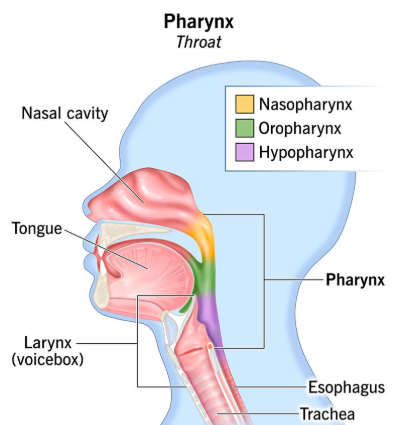
What are the 3 regions of the pharynx divided into?
Nasopharynx
Oropharynx
Laryngopharynx (hypopharynx)

Pharynx serves as passageway for what?
both air and food

What is the larynx composed of?
a framework of 9 cartilages connected by ligaments and membranes

What structure closes the Larynx when swallowing?
Epiglottis

What is the function of the larynx?
Voice production (voice box), hold airway open, direct air and food (Epiglottis)

Where is the larynx in relation to the pharynx?
located inferior and anterior of the lowest part of the pharynx (laryngopharynx)

How to remember difference between pharynx and larynx
“Phood” “Language/lower”
What structure/tissue keeps the trachea open and prevent collapse?
15-20 C-shaped rings of Hyaline Cartilage (most common)
What is the Trachea? Where is it located?
Trachea is the windpipe, it descends from the larynx through the neck and
into the mediastinum, where it divides into two main (primary) bronchi.
What is the carina? Where is it located?
cartilage at the base of the trachea that splits into the right and left bronchi
What are the subdivisions of the bronchial tree?
Primary (Main) Bronchi
Secondary (Lobar) Bronchi
Tertiary (Segmental) Bronchi
Bronchioles
Primary (Main) Bronchi
Largest subdivisions, enter the lungs

Secondary (Lobar) Bronchi
3 on the right side – right lung
2 on the left side – left lung
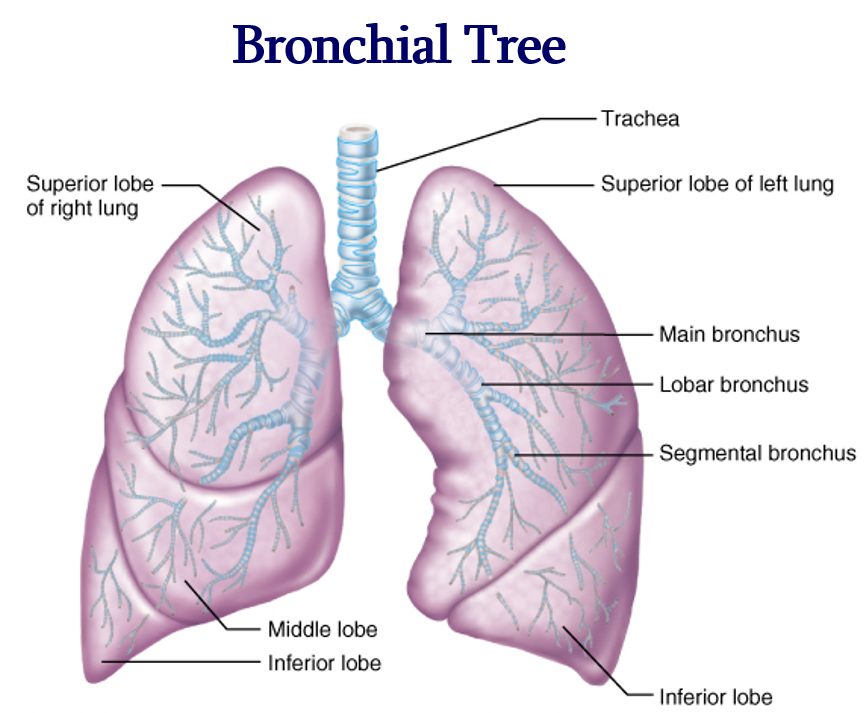
Tertiary (Segmental) Bronchi
branch into each lung segment

Bronchioles
small bronchi, less than 1 mm in diameter, connect to alveoli

What is the outer pleura that lines the body wall called?
Parietal Pleura (tough outer layer)
What is the inner pleura that surrounds each lung called?
Viseral Pleura (delicate inner layer, adheres to each lung)
Where is a foreign body most likely to end up if inhaled? Why?
the right bronchus, this it is because wider, shorter, and runs more vertically
How many segments is the right lung? (answer from top to bottom)
3 superior
2 middle
5 inferior
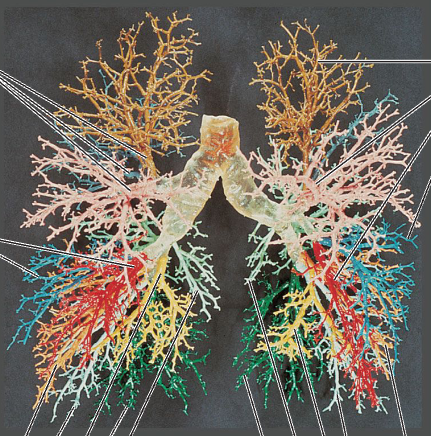
How many segments is the left lung? (answer from top to bottom)
4 superior
5 inferior

What is gas exchange? Where does it occur?
a diffusion where alveoli and capillaries trade oxygen and carbon dioxide through their thin membranes (simple squamous)

What is an alveolus?
microscopic air sac lined by simple squamous epithelium
Multiple alveoli are surrounded by capillaries, elastic connective tissue fibers, and lymphatics

What is the space between the 2 layers of pleura
Pleural cavity/ Pleural space

What is the recess where a pleura tap is most often preformed? Why?
Costodiaphragmatic recess, chosen for safety as to not pop the lung

What is the difference between ventilation and respiration?
Ventilation is the mechanical process of moving air in and out of the lungs
Respiration is the chemical process of gas exchange
How do the muscles move during inspiration?
diaphragm + external intercostals contract; increases thoracic volume which drops lung pressure, air is sucked in
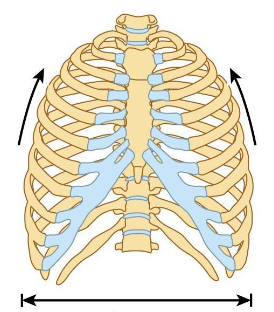
How do the muscles move during expiration?
diaphragm + external intercostals relax; decreases thoracic volume which spikes lung pressure, air is pushed out (abdominal muscles also slightly contract to help push air)

Which vertebral nerves keep diaphram alive?
C3-5
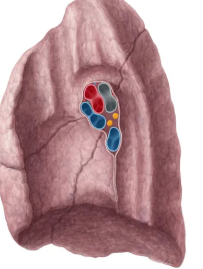
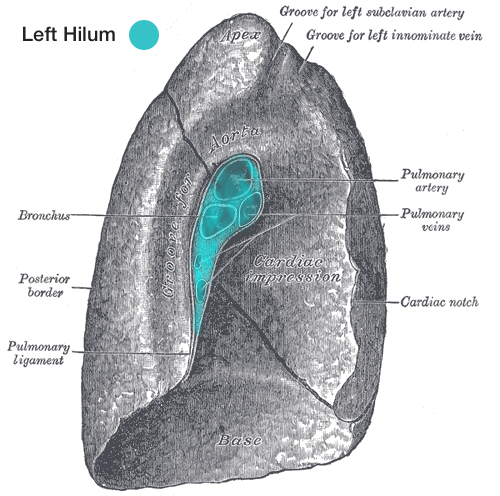
What is the hilum?
The wedge-shaped depression on the medial (inner) surface of each lung where major blood vessels, bronchi, nerves, and lymphatic vessels enter and exit
What is the conchae?
thin, scroll-shaped bony plates inside the nose that warm, humidify, and filter air

What is the function of pleural/ serous fluid?
acts as a lubricant to reduce friction
Right Oblique fissure
the curved lower deep groove lined with tissue that separate the right middle and right bottom lobes

Horizontal fissure
the upper horizontal double-fold of visceral pleura in the right lung that separates the right upper lobe from the right middle lobe

Left Oblique fissure
the only curved deep groove on the left lung that separates the upper left from lower left lobe

Cardiac notch
an indentation on the anterior border of the left lung that makes room for the heart

Pulmonary arteries in the lungs
carry deoxygenated blood away from the heart towards the lungs
Pulmonary veins in the lungs
carry oxygenated blood back to the heart

Parietal Pleural
outer membrane layer that lines the inner chest wall

Visceral Pleural
inner membrane layer that directly adheres to the organ (lungs)

Pulmonary Innervation
comes from the pulmonary plexuses located at the bifurcation of the trachea

Vagus Nerve Parasympathetic
motor to smooth muscle, counteract vasodilation
Pulmonary Innervation - Sympathetic
fibers are Bronchodilator, Vasodilator, Inhibitory to the alveolar glands – slows secretion and thickens the mucous
What is the angle called where a needle is inserted into the lung
‘costo-phrenic angle‘