PNB 2264 Practical 1-Axial Skeleton/Muscles
 Call Kai
 Learn
Learn Practice Test
 Spaced Repetition
 Match
Match Flashcards
 Knowt Play
1/57

There's no tags or description
Looks like no tags are added yet.
Name | Mastery | Learn | Test | Matching | Spaced | Call with Kai | Chat |
|---|
No analytics yet
Send a link to your students to track their progress
58 Terms
components of compact bone
Osteon (contains central canal, canaliculi, osteocytes, lacunae, lamellae)
Perforating (Volkmann's) canals
Interstitial lamellae
Circumferential lamellae
components of spongy bone
trabeculae and red bone marrow
frontal bone (anterior view)
forms the forehead

zygomatic bones (anterior view)
form the cheekbones

maxillae bones
upper jaw

mandible
lower jaw

nasal bones
bridge of nose

ethmoid
an unpaired bone in the skull that separates the nasal cavity from the brain. It is located at the roof of the nose, between the two orbits.

cribriform plate of ethmoid bone
the part of the ethmoid that forms the roof of the nasal cavity
crista galli of ethmoid bone
superior projection in the middle of the cribriform plate of the ethmoid bone; providing a point of attachment for the dura mater, helping to secure the brain within the skull
temporal bones
form the sides and base of the cranium

mastoid process of temporal bone
sternocleidomastoid insertion

mandibular fossa of temporal bone

zygomatic process of temporal bone

external auditory meatus of temporal bone
The opening through which sound waves are conducted to the ear.

parietal bones (lateral view)

occipital bone
back of head

occipital condyles of occipital bone
rounded processes that articulate with the atlas (C1)

sphenoid bone
Bone that joins all of the bones of the cranium together

greater and lesser wings of sphenoid bone
greater wings are highlighted

lacrimal bones
make up part of the orbit at the inner angle of the eye

palatine bones
facial fused bones that form posterior part of hard palate
coronal suture
the suture between the parietal and frontal bones of the skull

saggital suture
joins the two parietal bones

lamboidal suture
joins both parietal bones with the occipital bone

squamous sutures
joins temporal and parietal bones

ear ossicles
malleus, incus, stapes
hyoid bone
the only bone that does not articulate with another bone

foramina
a passage or opening; a hole in a bone through which blood vessels or nerves pass
foramen magnum
means "big hole"
-the largest foramen and the entry for the spinal cord

jugular foramen
between temporal and occipital bones, entry of cranial nerves glossopharyngeal (IX), vagus (X), accessory (XI)
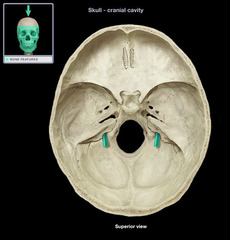
carotid canal (foramen)
anterior and medial to the jugular foramen, entry of internal carotid artery
superior orbital fissure (foramen)
between greater and lesser wings of the sphenoid bone; entry of cranial nerves
body of vertebrae
the thick, disc-shaped anterior portion which is the weight bearing portion

spinous process of vertebra
The portion of the vertebrae that sticks out posteriorly.

transverse process of vertebra
forms joint with ribs in thoracic region, site for muscle attachment in lumbar region

vertebral foramen
canal through which spinal cord passes

cervical vertebrae
C1-C7; neck

atlas (C1)
first vertebra, supports globe of head; body and no spinous process

axis (C2)
Odontoid process (dens) - provides a type of pivot and collar allowing the head and atlas to rotate around the dens

thoracic vertebrae
T1-T12; articulate with ribs; cartilaginous, symphysis joints

lumbar vertebrae
L1-L5; lower back

sacrum
5 fused bones

coccyx
3-5 fused bones; tailbone

sternum
consists of manubrium, body, xiphoid process

manubrium of sternum
top of sternum; articulates with ribs 1, 2, & clavicles

body of sternum
the middle portion of the sternum

xiphoid process of sternum
bottom of the sternum

ribs (24 total)
1-7 true ribs
8-10 false ribs
11-12 floating ribs
-costal cartilages
temporalis
closes jaw
O: temporal bone
I: mandible

masseter
closes jaw, elevates mandible
O: maxilla
I: mandible

digastricus
opens mouth, depresses mandible
O: mandible and mastoid process (temporal bone)
I: hyoid bone

sternocleidomastoid
flexes and laterally rotates the head
O: sternum and clavicle
I: mastoid process (temporal bone)

medial pterygoid
close jaw; lateral excursion (moving mandible laterally)
O: sphenoid bone
I: mandible

lateral pterygoid
lateral excursion; with medial pterygoid can lower mandible and allow yawning; opens jaw
O: sphenoid
I: condyloid process of mandible

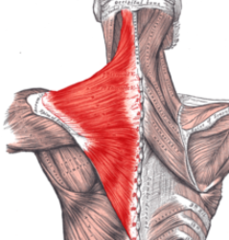
trapezius
Elevates, depresses, retracts, and rotates the scapula;
O: C7-T12 and occipital bone
I: clavicle and scapula
latissimus dorsi
extends and adducts humerus; draws shoulder down and backwards
O:thoracic, lumbar, sacrum, and iliac crest
I: humerus

pectoralis major
flexion, adduction, and medial rotation of shoulder
O: sternum, clavicle, 1-6 ribs
I: humerus
