Thermoregulation in Exotics SDL
 Call Kai
 Learn
Learn Practice Test
 Spaced Repetition
 Match
Match Flashcards
 Knowt Play
1/20

Earn XP
Description and Tags
Learning outcomes Describe the advantages and disadvantages of homeothermy and poikilothermy Explain the thermoregulatory mechanisms employed by reptiles and amphibians Describe the strategies used by birds to shed or retain heat Compare and contrast the adaptations for heat and cold in commonly kept small mammals and explain their relative tolerance for heat Outline the normal body temperatures of a rabbit and a bird and compare these to other species you have studied
Name | Mastery | Learn | Test | Matching | Spaced | Call with Kai | Chat |
|---|
No analytics yet
Send a link to your students to track their progress
21 Terms
What is a homeotherm
body temp is internally dependendt
mammels/ birds
poikilotherm
relies on external body temperature
reptiles/ fish
Poliokiotherm activities..
low dietry requirements
activity level low
cannot live in a range of enviroements..
Bird normal body temperate range
39 -43c’
Normal body temperature of a rabbit..
38.5-40
The normal body temperature of birds and rabbits are higher than those of other animals you have studied, e.g. dogs, cats, horses and cows.
•Why do you think this is?
Very high metabolic rate..
Why do bearded dragons change colour during the day…
WIll change colour to darker to absorb more light..
lighter to reflect it..
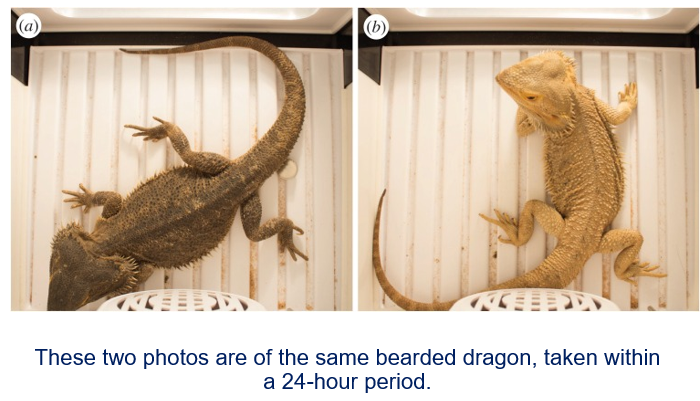
What is colour change in bearded dragons referred too..
Metachromatism - many functions including Camouflage + display…
Specialised skin cells for thermoregulation
melanophore —> melanin, carotenoids,
Iridophore —- >beneath and reflect structural colours..reflective guanine crystals
(xanophores - cartonenoids = oragnes and reds, many range of pigments which produce a range of colours, crystal gauning prodces the white light.
Why do frogs not freeze
Produce to prevent ice crystals forming in cells.. This is b decreasing water potential…
Will a bigger bird pr little bird suffer more from heat stree
smaller bird = faster metabolic rate
therefore will be hotter and will loose heat more rapidly..

What are the 4 adaptions for high temperatures…
•Extending wings
•
•Elevate scapula feathers to expose skin at back of neck
•
•Shade seeking
•
•Bathing
AVain thermoregulation…
birds have no brown adipose tissue which ususllay uses insulin,
Behavioural and physiological nethods to keeep warm..
birds conserve heat by migration and puff feathers to trap air insulate
penguiins huddle…Insulating feathers..
cardiovascular adaption for heat loss
no feathered legs
shunt blood too them.. via valve shutting

What are reppiratory stratergies of bird heats…
Birds can loose heat by evaporation and dissapation from the oral mucosa from thermal pantings
+ heat can be lost from air sacs when running and flying..
What is non-shivering thermogenesis…
involunatry rapid contractions to generate heatsustained bones, belwo 20c’ anerobic fibres..
What is non-shiveringthermogenesis…
Increase in metabolic heat not associated with muscle activity e.g. trying to generate an exothemic reaction
Mammals = in brown fat is used in order too produce feet
birds increase metabolic rate, more ca2+ back and forth to generate an exothermic reaction — futile calcium cycling..
What are small mammals prone too heat stress..
Heat stress
high metabolic rate
large surgace aresa
prone to eat stress due to lack of sweat glands + thick fur, multiple hair follocles from compound hair..
Stretch out go in the shade, and burrow underground in the ground..
•Small mammals can use vasoconstriction and vasodilation, arteriovenous shunting and countercurrent exchange to thermoregulate.
ears
legs
tail
anywhere without fur
What is torpor
temporary, involuntary shutdown of vital systems in hamsters, similar to a mini-hibernation. During torpor, a hamster’s core temperature, heart rate, and metabolism drop dramatically, sometimes below 32°C (89.6°F), and the episode can last from 6 hours to a few days
What is torpor
An energy saving status of the hamster
can be from heat loss, cold or food scarcity