China: Notable Religious Figures, Theologians, Philosophers, and Scholars (and their Contributions) and Notable Religious and Philosophical Concepts
 Call Kai
 Learn
 Practice Test
 Spaced Repetition
 Match
 Flashcards
 Knowt Play
1/27

There's no tags or description
Looks like no tags are added yet.
28 Terms

900s BCE - I Ching / Book of Changes / Classic of Changes (All Facts)
Ancient Chinese divination text that is among the oldest of the Chinese classics
Cited by Jesuit missionaries in China under Emperor Kangxi of Qing as an excellent book of physics and morality

551 BCE - 479 BCE - Confucius / Kung-Fu-Tzu / Kong Qiu // Confucianism (All Facts)
Chinese Philosopher
Born into the lesser nobility of the principality of Lu in the region of Shandong
He worked for a time as a civil servant, where he was in charge of supervising granaries
He tried convincing Chinese rulers to follow his advice on how to institute sound government but failed to find one that would do so
Thus, he turned to private teaching
From there, he continued to refine his doctrines until his death
Argued that long ago people lived in a serene age when everyone knew his place in society and carried out the duties that went with it
His doctrines seek a return to that time
He claimed that the principles of this time in the distant past were forgotten or obscured over the centuries
At the heart of his teaching is the concept of order: that everything in the universe had a rightful and natural place or position
He argued that order could be ensured if people, especially those in government, stuck to their moral obligations towards each other and towards society as a whole
Thus, this ideal favored those institutions which were most inclined to lead to the persistence of order, most notably the family and social hierarchy
He argued that ensuring order required
honesty, integrity, and respect for elders and betters
unpatronizing fairness towards people in lower social positions
Proposed that government rulers and administrators adhere to four things, which were
Care and respect for records
Decent conduct
Loyalty
Faithfulness towards superiors and colleagues
Believed that a good administrator who carried out his duties scrupulously could expect to be rewarded without pursuing success
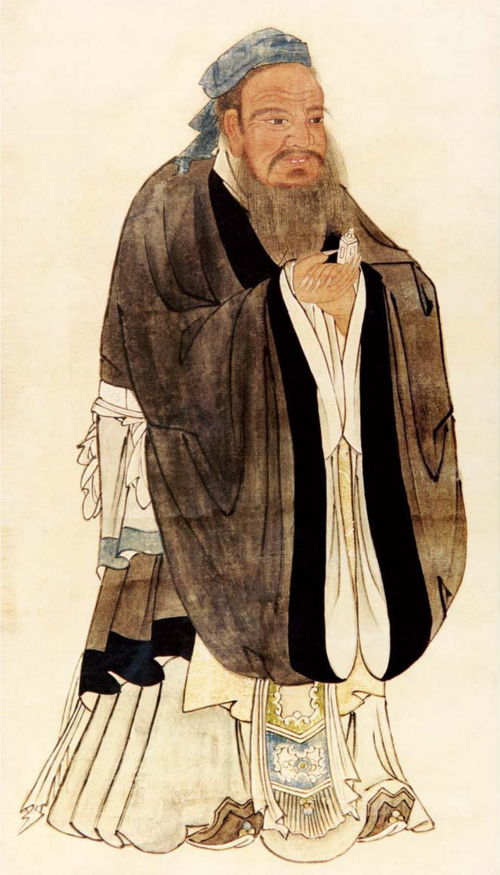
551 BCE - 479 BCE - Confucius: Analects (All Facts)
60s CE - Chinese Buddhism (All Facts)
Religion which came to China from the west along the string of oases known as the Silk Road
Had come to China from its birthplace in India via the Silk Roads
It ran from the Kushan Empire in central Asia into China and from the east on the China and from the south via Burma
Its first practitioners were foreign merchants
Eventually, indigenous monasteries were founded, and the namesake emerged with a Taoist flavor
Large sections of the namesake population were converted
Was distinctly Chinese
Most of the Chinese translations of the namesake religion’s texts used Taoist terminology
No longer seen as a foreign religion, its promise of freedom from pain and suffering attracted millions of converts, having made it the fastest growing religion in China by the 60’s CE
By 85 CE, it reached the oases of Tarim
When the Xiongnu occupied Loyang, Confucian scholars fled, thus leaving the field open to the namesake monks who provided the barbarian Xiongnu conquerors with a literate civil service
By 399, during the Northern Wei Dynasty, it spread throughout China, working its way along the trade routes from Central Asia and India
Regarded as something of an intellectual curiosity by the Han Court, it became a recognized religion
During this time, Indian translators worked on the huge task of providing versions of its original teachings, which were written in Sanskrit, into Chinese
It owed as much to the fall of the Han Dynasty and the “age of confusion” that followed
The small states of the north which had easy contact with India were particularly receptive to the namesake
Although its presence was evident between the later Han and Sui Dynasties, it became popular for the first time during the Tang Dynasty
During the Tang Dynasty, it was attacked due to the jealousy it aroused amongst leaders and practitioners of the native Chinese religions of Daoism and Confucianism
By the Song Dynasty, it was less hostile but it still did not promote the namesake religion on a widespread level, rather preferring to emphasize China’s native traditions like Daoism and Confucianism
By this period, the namesake had a strong presence and many Confucians began to adopt its ideals into their daily lives
The development of printing had made its scriptures widely available to the Confucian scholar gentry
82 CE - 167 CE - Wang Fu (All Facts)
Chinese Confucian philosopher during the Han Dynasty
Remembered for his criticisms of
The luxury of consumer goods
The exodus from the land
Filial Piety (All Facts)
Confucian idea that refers to the duty of family members to subordinate their desires to those of the male head of the family and to the ruler
148 CE - 180 CE - An Shigao (All Facts)
Parthian Monk who becomes famous for being a Buddhist missionary to China after travelling from Parthia and arriving in Loyang
He initiated the first project for a systematic translation of Buddhist texts into Chinese from originals in Sanskrit or Prakrit
226 - 249 - Wang Bi (All Facts)
Chinese Confucian Philosopher during the Three Kingdoms Period
He changed the course of Chinese thought
Produced commentaries on the I Ching and Tao Te Ching, which were highly influential in subsequent Chinese philosophy
344 - 413 - Kumarajiva (All Facts)
Chinese Buddhist Monk and Kuchean Translator
He was of Indian descent and born in central Asia
He is considered one of the greatest translators of Chinese Buddhism
His excellent translations of Buddhist texts allowed the Chinese to gain a real understanding of Buddhism as a philosophy, which they had not been able to obtain up to that point
Taught at Changan in Shensi province
He preached versions of Buddhism previously unknown in China
337 - 422 - Faxian (All Facts)
Chinese Buddhist Monk
He traveled on foot from Jin China to medieval India to acquire Buddhist scriptures
He set out from Changan on a long pilgrimage, spending several years
Walking the Silk Road
Visiting Temples
Studying with holy men
Recording the traditions and customs of the counties through which he passes
He was one of a number of monks who found their own path to the secrets of Buddhism, having travelled along the Silk Road to study the true doctrine at the sources of (Chinese) Buddhism
365 - 448 - Kou Qianzhi (All Facts)
Court official of the Northern Wei Dynasty
He succeeded in establishing Taoism as the state religion of the Northern Wei Dynasty in China
Yungang Grotto (All Facts)
Large Buddhist Grotto fashioned in a cave temple in a sandstone cliff in the northern Shanxi province in China by thousands of employees
Consisted of imposing figures carved out of rock
Depicts Indian gods carved in a style similar to Greek statuary
Naively, its artists incorporated Greek mythological themes without understanding them
To its smaller figures, however, there was a much more Chinese feel, in which they were carved by native craftsmen who were not inhibited by Buddhism’s non-Chinese (Indian) origins
602 - 664 - Xuanzang (All Facts)
He founded Wei-Shi Buddhism
He helped build Buddhism’s popularity in China during the Tang Dynasty
Chinese Buddhist monk who
Traveled to India for 15 years where he
Traveled west on the Silk Roads to Central Asia, then south and east to India
Along the way and while in India, he met many Buddhist monks and visited many Buddhist shrines
In order to gain more insight into Buddhism, he studied for years in Buddhist monasteries and at Nalanda University in Bilar in India
Came back to contribute significantly to Chinese Buddhism by
Collecting Buddhist scriptures in India written in Sanskrit and bringing them back to China so he could translate them into Chinese
He ended up only being able to translate 75 sections of the 1300 or so sections of text, but these particular sections were very significant
These texts were highly instrumental in the growth of Buddhist scholarship in China
He sent many petitions to the Emperor at the time, Taizong of Tang, but the Emperor repeatedly refused, so he left for India without informing the Emperor, given how great his conviction was that Buddhism in China would benefit from his travels
He claimed he could defeat the feared Uyghur Khaganate with a magic sword
His failure gave the Tang Emperors another reason to persecute Buddhists
770s - 840s - Neo-Confucianism (All Facts)
Philosophy which was a syncretic system, combining rational thought with the more abstract ideas of Daoism and Buddhism
Philosophy which emphasized ethics rather than the mysteries of God and nature
Philosophy which became immensely popular in China during the Song Dynasty; as well as in Japan, Korea, and Vietnam
Giant Wild Goose Pagoda (All Facts)
Built during the Tang Dynasty to hold sutras and figurines of the Buddha that were brought to China from India by Xuanzang
Wei-Shi Buddhism (All Facts)
Chinese branch of the Indian Yogacara Buddhist tradition
Its central tenet is "consciousness-only,” which posits that no phenomena exist outside the realm of the mind; what we perceive as reality consists only of "dharma appearances" or "dharma characteristics"
School of Buddhist thought founded by Xuanzang
Nestorian Christianity (All Facts)
Religion introduced into China during the reign of Emperor Taizong of Tang
Manichaeism (All Facts)
Religion introduced into China during the reign of Empress Wu Zeitan of the Wu Zhou Dynasty
688 - 763 - Jianzhen / Ganjin (All Facts)
Chinese Buddhist Monk of the Tang Dynasty
He was blind
He reached Japan after five unsuccessful attempts in the hopes of propagating Buddhism there
These efforts culminated in his founding of the Toshodaiji Temple in Nara, Japan
He was granted a center of studies and ordination platform in the Temple for his efforts
Chan School (All Facts)
Precursor to Japanese Zen Buddhism developed in China by 850
Mahayana Buddhism (All Facts)
Strand of Buddhism that focuses on spiritual growth for all beings and on service
Strand of Buddhism which became strongest in China (as well as Korea)
Four Noble Truths (All Facts)
Stresses the idea that personal suffering can be alleviated by eliminating cravings or desires and by following the Eightfold Path
Eightfold Path (All Facts)
Buddhist precepts that can lead to Nirvana including
Right speech
Right livelihood
Right effort
Right mindfulness
Zen Buddhism / Chan Buddhism (All Facts)
Strand of Buddhism that is syncretic in that it combines Buddhist doctrines with Daoist traditions
Strand of Buddhism which formed after monks had introduced Buddhism to the Chinese by relating its beliefs to Daoist principles
For example, the Buddhist doctrine of “Dharma” became translated as “Dao” (“the way”)
Strand of Buddhism which emphasizes direct experience and meditation as opposed to formal learning based on studying scripture
Strand of Buddhism which became very popular in China due to its fusion with Chinese beliefs
Strand of Buddhism which culminated in China in the development of its Buddhist monasteries appearing in many major Chinese cities
Despite this Buddhist denominations’ monasteries having been closed and land seized due to jealous Tang bureaucrats, it remained popular among ordinary Chinese citizens
This is because this “foreign religion” drew individuals away from China’s native religions, which made Daoist and Confucians jealous and made Daoist and Confucian leaders fear they were losing their grip on power over the people

1130 - 1200 - Zhu Xi (All Facts)
One of the most influential exponents of Neo-Confucianism
He is known for his commentaries called “The Four Books”

1669 - 1732 - Jiang Tingxi (All Facts)
Chinese Encyclopedist during the Qing Dynasty
He was appointed Grand Secretary by the Qing Dynasty
1650 - 1741 - Chen Menglei (All Facts)
Chinese Philosopher, Historian, and Encyclopedist during the Qing Dynasty
He was brought back from exile by Emperor Kangxi of Qing
He was then appointed tutor to Prince Yinzhe by Emperor Kangxi of Qing, the prince of whom became his patron and funded his work
1725 - Chen Menglei and Jiang Tingxi: Complete Classics Collection of Ancient China / “Gujin Tushu Jicheng” / “Collection of texts and illustrations old and new” (All Facts)
Remarkable Encyclopedia of Chinese knowledge compiled by the namesake author and publisher, which consisted of no fewer than 10K chapters with a table of contents of 40 chapters and was so large that only 64 copies could be printed