Geology Study guide 3
 Call Kai
 Learn
 Practice Test
 Spaced Repetition
 Match
 Flashcards
 Knowt Play
1/87

There's no tags or description
Looks like no tags are added yet.
88 Terms
What does tension do to a body of rock?
Stretches and thins it
Complete the sentence: "Rock that is deformed ____ is more likely to ____."
slowly; bend
Which statement describes elastic deformation?
The rock bends, then springs back to its original shape when the stress is removed
The Andes are rising where the Nazca Plate sinks beneath South America. What is the main stress building these mountains?
Compression
A chocolate bar from the freezer snaps when you bend it, but one left in a warm car bends. Which factor changed? [LO2]
Temperature
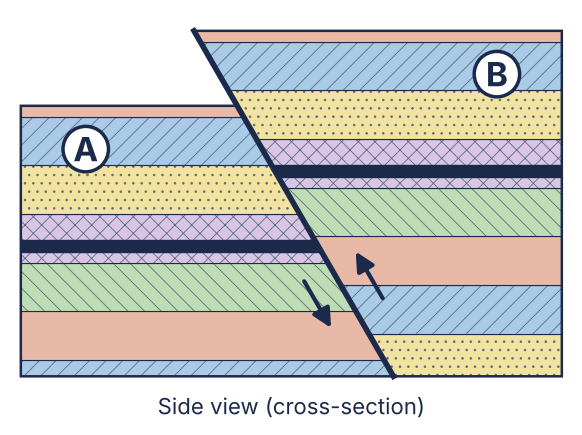
What type of stress produced this fault? [LO4]
Compression
What does compression do to a body of rock? [LO1]
Shortens and thickens it

What part of the fold is labeled 1?
The hinge

The fold directly below letter P is a(n): [LO3]
Anticline
Seismic surveys show that young sediment in the top ~100 m beneath the Coyote Hills, next to CSUF, has been bent into folds. What best explains how layers so close to the surface could fold instead of break? [LO2]
They were squeezed slowly, and young layered sediment is weak
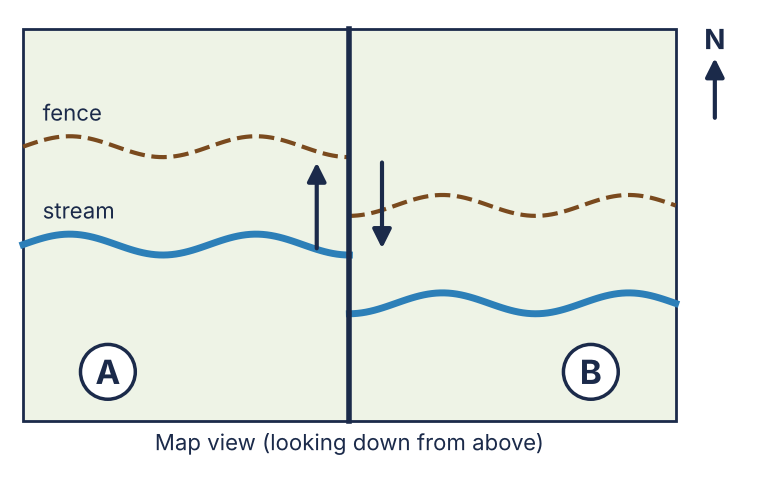
What type of stress produced this fault? [LO4]
Shear
In a sandbox model, a wall pushes layered sand from one side, and the layers stack up and fold. Which kind of plate boundary does this model? [LO1]
Convergent
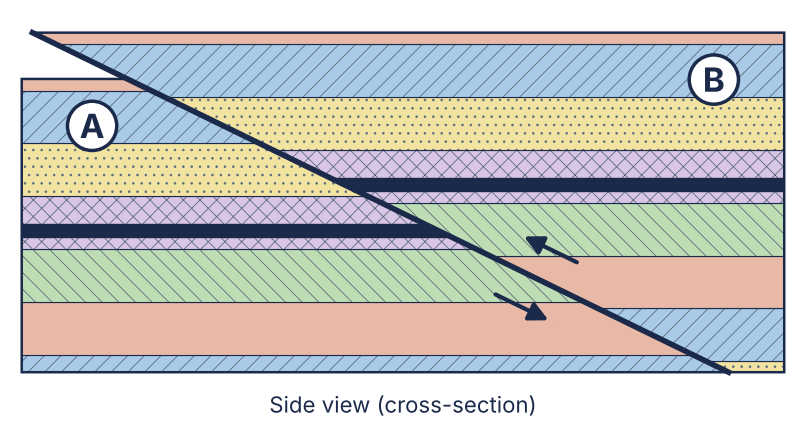
What type of fault is shown? [LO4]
Thrust fault
An anticline is a fold in which: [LO3]
The hinge points up and the limbs slope down away from it (an arch)

What type of fault is shown? [LO4]
Normal fault

What type of stress produced the fault shown in this figure? [LO4]
Shear

In roughly what direction were the rocks squeezed (shortened) to form this fold? Note the north arrow. [LO3]
East-west

What type of structure is shown in this figure? [LO3]
Plunging anticline
Silly Putty stretches into long strands when you pull it slowly, but snaps cleanly when you yank it fast. Which factor explains the difference? [LO2]
Strain rate (how fast it is deformed)

Which unit is the YOUNGEST? [LO1]
Granite Z
For which question should you use the OVERLAP of fossil ranges? [LO7]
When did a layer that holds two kinds of fossils form?

In which outcrop did the fault move AFTER the dike formed? [LO3]
Outcrop 1: the fault breaks and shifts the dike
It is far too old: almost no carbon-14 is left after about 60,000 years

Which sequence of events made the labeled surface? [LO2]
Layers deposited, folded, eroded, then new layers deposited on top

Is the labeled surface an unconformity? [LO2]
No: the granite pushed into the layers and holds pieces of limestone

A student wrote: “Sandstone A is the youngest unit because it is on top (superposition).” What is wrong? [LO3]
Granite Z cuts through A, so Z is younger; superposition doesn't apply to intrusions
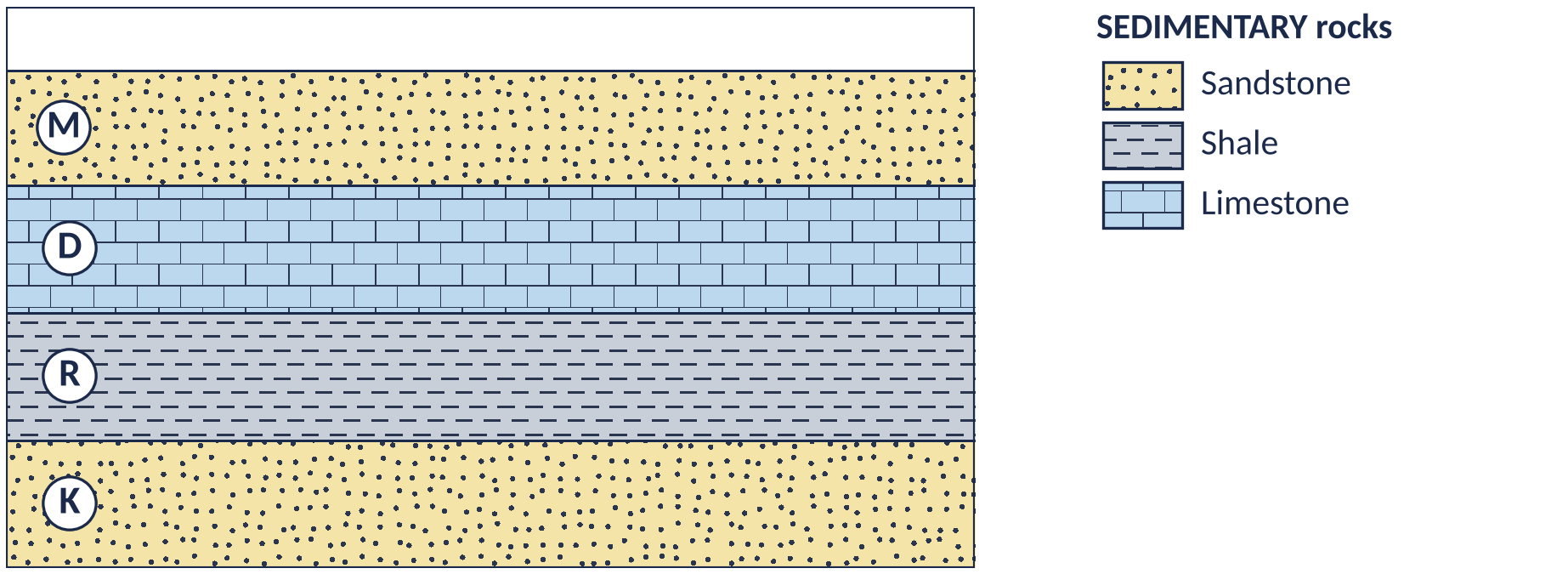
Which layer in this outcrop is the OLDEST? [LO1]
Sandstone K

A dike's zircons have 91% of their uranium-235 left. Use the graph: how old is the dike? [LO5]
100 million years
Why can radioactive decay be used as a clock? [LO4]
Parent atoms change into daughter atoms at a steady, known rate
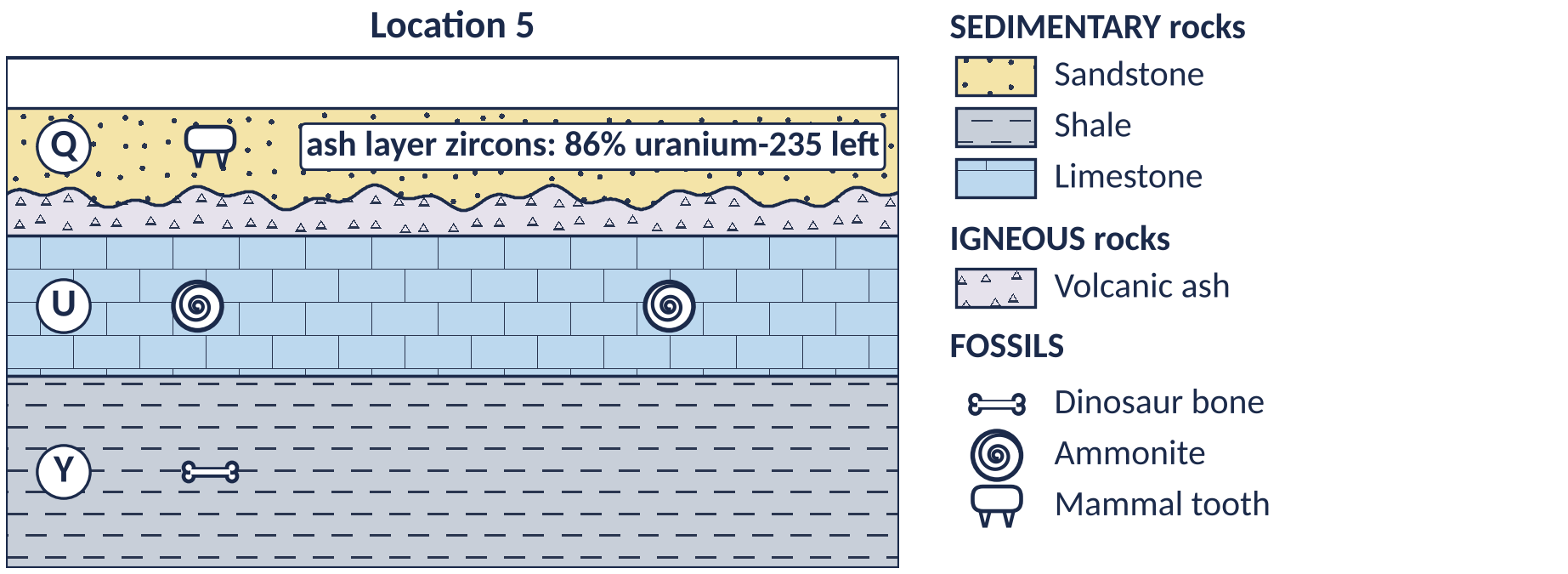
The ash layer's zircons give an age of 150 million years. What can you say about sandstone Q from the ash alone? [LO7]
Q is younger than 150 million years
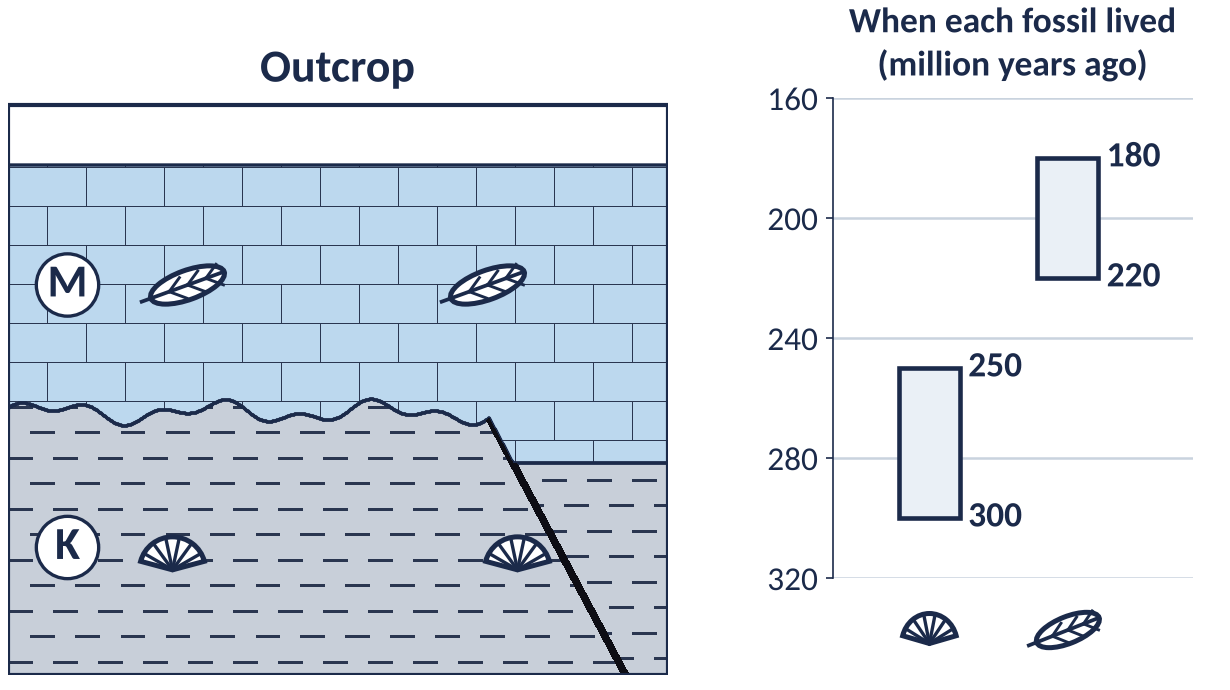
The fault breaks shale K but not limestone M. When did the fault move? [LO7]
Between 300 and 180 million years ago

Which list goes from OLDEST to YOUNGEST? [LO8]
Precambrian, Paleozoic, Mesozoic, Cenozoic
Why can't we date a sandstone by measuring uranium-lead in its sand grains? [LO6]
The grains were eroded from older rocks, so they are older than the sandstone
Which statement gives an ABSOLUTE age? [LO4]
The volcanic ash fell 150 million years ago
Which statement describes the Holocene Epoch? [LO8]
The warm time since the last glaciation ended, about 11,700 years ago, up to today
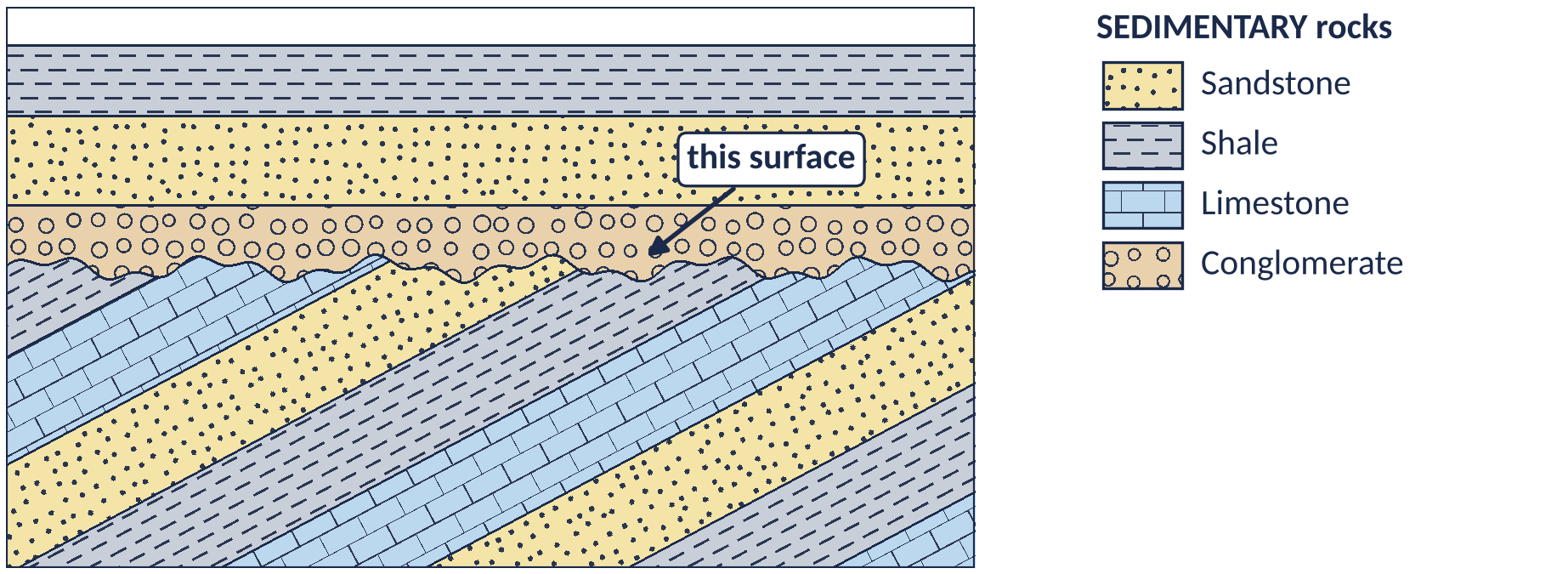
What does the labeled surface represent? [LO2]
A gap in time: the tilted layers were eroded before new layers were deposited

Limestone Q and limestone Y sit at the same level on opposite sides of the valley. What is the best explanation? [LO1]
They were once one continuous layer that the valley later cut through

Potassium-40 has a half-life of 1.3 billion years. A mineral has gone through 3 half-lives. How much potassium-40 is left, and how old is it? [LO5]
12.5%; 3.9 billion years
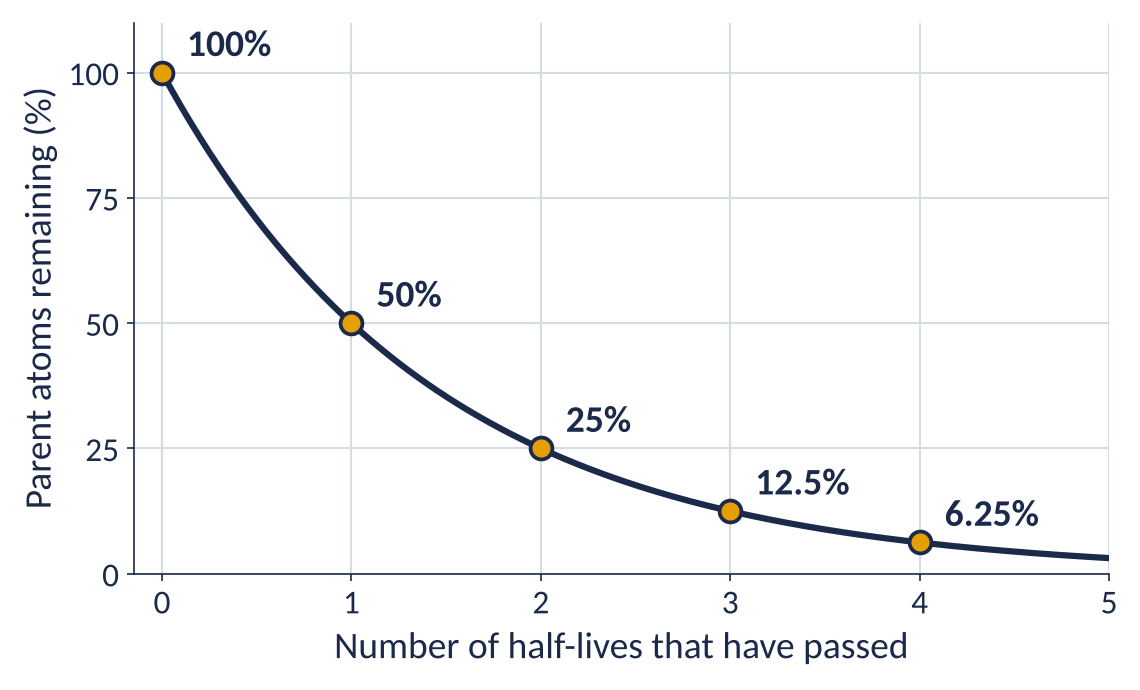
A bone from a cave has 6.25% of its carbon-14 left. Carbon-14's half-life is 5,730 years. How many half-lives have passed, and how old is the bone? [LO5]
4 half-lives; 22,920 years

The graph shows where Earth's fresh water is stored. About what fraction of Earth's fresh water is groundwater?
About 30%
North and central Orange County, including Fullerton, get most of their tap water from wells. The Orange County Water District sends Santa Ana River water into about 30 shallow basins in Anaheim and Orange, where it slowly sinks into the ground. Which reservoir supplies most of this tap water, and which process refills it?
Groundwater; infiltration
The Mojave River at Victorville runs through the desert, where only a few inches of rain fall in a year, and its bed is dry most of the time. Yet it has carried floods of more than 30,000 cubic feet per second. What is the best explanation?
Its drainage basin reaches up into the San Bernardino Mountains, where winter storms drop much more rain

Heavy rain falls only where the storm cloud is. Which towns could see the creek next to them rise? Select the 2 towns that apply.
town 2 and 3
Days after a storm, a slow river (about 5 cm/s) is still brown with mud. Why?
Silt and clay settle only when water is very slow (below about 1 cm/s), so they stay suspended
A flooding creek slows down as it enters a lake. Which grains settle out first, closest to where the creek enters the lake?
Gravel

Water flows at 30 cm/s (orange line). Which grains would settle to the bed (be deposited) at this speed? <strong>Select the 2 that apply.</strong>
100 mm cobble and 10 mm cobble
A steep mountain stream reaches a flatter valley, carrying more gravel than it can move. What channel pattern is it most likely to form?
A braided channel: many shallow channels split by gravel bars

House 2 sits on a sandy area on the inside of the bend. What is happening to the ground there?
Slower water drops sediment there, so the land slowly builds out toward the channel
A student collects sediment from a riverbed at the headwaters, halfway down, and near the mouth. Which pattern should she expect?
The grains get smaller and rounder downstream

Read the graph. What is the lag time for City Creek, the time from the heaviest rain to the peak discharge?
About 2 hours
Recent event. Over Christmas 2025, a strong atmospheric river (a long band of moist air from the Pacific) soaked Southern California. On December 24, rain fell at an inch or more per hour in places, and by that morning some foothills had already received 4 to 8 inches. A flash-flood warning covered much of Los Angeles County. The city of Los Angeles ordered about 130 homes evacuated below Pacific Palisades hillsides that had burned in the January 2025 Palisades Fire, and crews rescued drivers from flooded roads in the mountain town of Wrightwood. Governor Newsom declared a state of emergency for Los Angeles and other Southern California counties. Sources: Reuters (via RNZ), Dec. 25, 2025; The Guardian, Dec. 2025.
Forecasters warned that neighborhoods below burned hillsides were at special risk. Why do burned slopes flood faster than unburned slopes?
Burned ground soaks up less water, so more rain runs off quickly; like pavement, it shortens the lag time

Both creeks drain basins of the same size and got the same storm. Why does City Creek peak higher and sooner than Forest Creek?
Roofs, roads and storm drains: less water soaks in, and runoff reaches the creek quickly

The Mojave River record covers about 95 years. Floods larger than 30,000 cfs (dashed line) happened 4 times. What is the recurrence interval of a flood this big, and the chance of one in any given year?
About 24 years; about 4%
Which of these is a nonstructural way to reduce flood damage (one that does not build anything to control the water)?
Limiting new development on the flood plain
What is the chance that a 50-year flood happens in any given year?
2%
Which statements describe real downsides of lining a river channel with concrete, as was done to the Los Angeles River?
Less water soaks into the ground to refill groundwater
Floodwater reaches towns farther downstream faster

Remember: seismic moment M₀ = rigidity × area × slip. Which fault releases the larger seismic moment, and why? [LO3]
Fault B, because twice the area slipped by the same amount in the same rock
Two earthquakes are recorded by the same Wood-Anderson seismograph, both 100 km away. The tallest wave from earthquake A is 2 mm; from earthquake B it is 200 mm. On Richter's scale, how much larger is B? [LO3]
2 magnitude units
The San Andreas Fault is more than 1,000 km long, yet its largest earthquakes reach only about M8, while subduction zones reach M9+. What limits the San Andreas? [LO4]
Its locked part is only about 15–20 km deep, so the area that can slip is limited

Which statement does the graph support? [LO2]
The farther you are from the earthquake, the longer the gap between the P and S waves
About 40 km below the San Andreas Fault, the two plates still move past each other, but almost no earthquakes are recorded there. Why? [LO1]
The rock is hot enough to flow, so it cannot store elastic energy
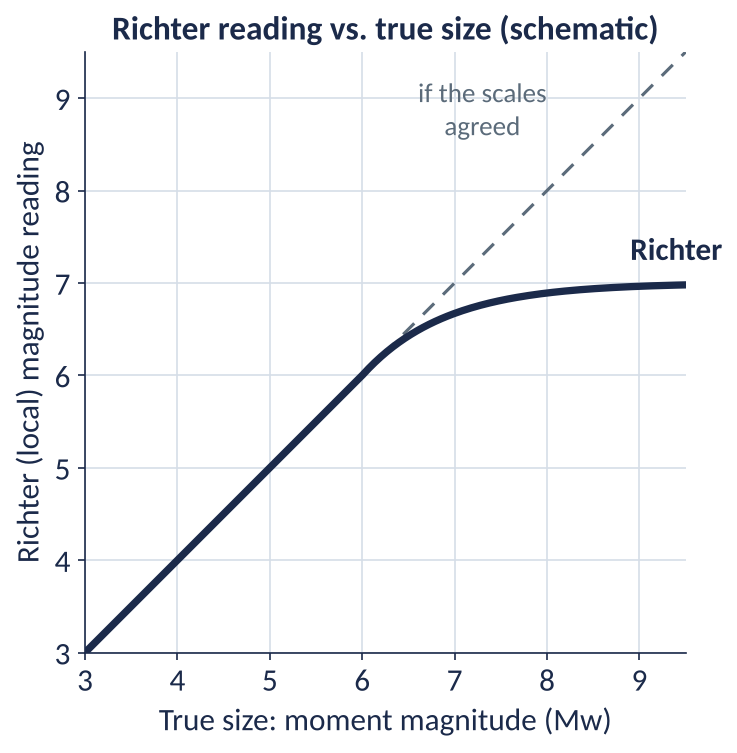
Why does the Richter curve flatten out for the largest earthquakes? [LO3]
Bigger earthquakes shake longer, but the tallest wave on Richter's seismograph stops getting taller
Which kinds of seismic waves travel through the inside of the Earth, not just along the surface? Select the 2 that apply. There are 2 correct answers. [LO2]
P waves
S waves

The same earthquake was recorded at two stations. Which station is farther from the earthquake, and how can you tell? [LO2]
Station 2: the waves arrived later, the P-to-S gap is longer, and the shaking is weaker

Which real faults do Fault 1 and Fault 2 most resemble? [LO4]
Fault 1: the San Andreas Fault; Fault 2: the fault that caused the 1964 Alaska earthquake
An earthquake early-warning system detects P waves near the epicenter and sends phone alerts in less than a second. In which city would people get the MOST time between the alert and the strong shaking? [LO2]
A city 200 km from the epicenter

Use the Oklahoma graph. In 2015, Oklahoma had about how many times more M3+ earthquakes than its 1978–2008 average? [LO4]
About 450 times
Which statements describe P waves?
They are the fastest seismic waves
They can travel through solids, liquids and gases
They are the first waves to reach a seismometer

Use the GPS graph (hypothetical data). What was happening to the rock near the fault between 1995 and 2014? [LO1]
It was bending elastically and storing energy, because the fault was stuck

Use the USGS graph and the rule that each magnitude step releases about 32 times more energy. In a typical year, which releases more energy: all of the M6 earthquakes together, or the one M8? [LO3]
The one M8: it releases about 1,000 times the energy of an M6, more than all 134 M6s combined
Old trees near Wrightwood show damaged growth rings starting in late 1812. How did this help scientists? [LO6]
It dated the 1812 earthquake and tied it to the San Andreas, because the damaged trees grow along that fault.

Use the USGS graph and the rule that each magnitude step releases about 32 times more energy. In a typical year, which releases more energy: all of the M6 earthquakes together, or the one M8? [LO3]
The one M8: it releases about 1,000 times the energy of an M6, more than all 134 M6s combined

These records show the same earthquake at two sites the same distance from the fault, drawn at the same scale. Which site is most likely on soft, loose sediment? [LO4]
Site 2, because its shaking is stronger and lasts longer
The 1906 San Francisco rupture was about 477 km long. If the rupture traveled about 3 km per second, about how long did the fault keep breaking? [LO2]
About 2.6 minutes

The timeline shows the moderate (about M6) earthquakes at Parkfield from 1857 to 1966. On average, about how many years apart were they? [LO5]
About 22 years
What did the 1992 Landers (M7.3) and 1999 Hector Mine (M7.1) earthquakes in the Mojave Desert teach us? There are 2 correct answers. [LO2]
A large earthquake can change the stress on nearby faults and help trigger another one.
One rupture can jump across several separate faults

Remember: seismic moment M₀ = rigidity × area × slip. Which fault releases the larger seismic moment, and why? [LO3]
Fault B, because twice the area slipped by the same amount in the same rock
The plates move steadily, a few centimeters every year, yet the San Andreas moves in sudden jumps (earthquakes) separated by long quiet periods. Why? [LO1]
Friction locks the fault, so strain builds up in the rocks until they slip all at once.
The San Andreas won’t make a big tsunami. Why should coastal Californians still prepare for tsunamis? [LO4]
Earthquakes around the Pacific, such as in Alaska, Japan or Chile, can send tsunamis across the ocean to California.
In 1906, fires burned San Francisco for three days and did more damage than the shaking itself. Why couldn’t firefighters stop them? [LO4]
The earthquake broke water mains, so there was little water to fight the fires.

Use the graph (schematic). About what would the Richter scale read for an earthquake whose true size is Mw 8.5? [LO3]
About 7
A friend says a big earthquake could make California "fall into the ocean." Which response is best? [LO1]
No. The plates slide sideways past each other, so there is nowhere for California to fall.

The graph shows earthquakes near Ridgecrest in July 2019. What should we call the M6.4 earthquake of July 4? [LO2]
A foreshock, because a larger earthquake followed

This trench is on the San Andreas in the Carrizo Plain. The fault breaks layers 1 to 6 (layer 6 = AD 1700) and is covered by layer 7 (AD 1900). Could this break be from the 1857 Fort Tejon earthquake? [LO6]
Yes. The earthquake happened between 1700 and 1900, and 1857 fits.
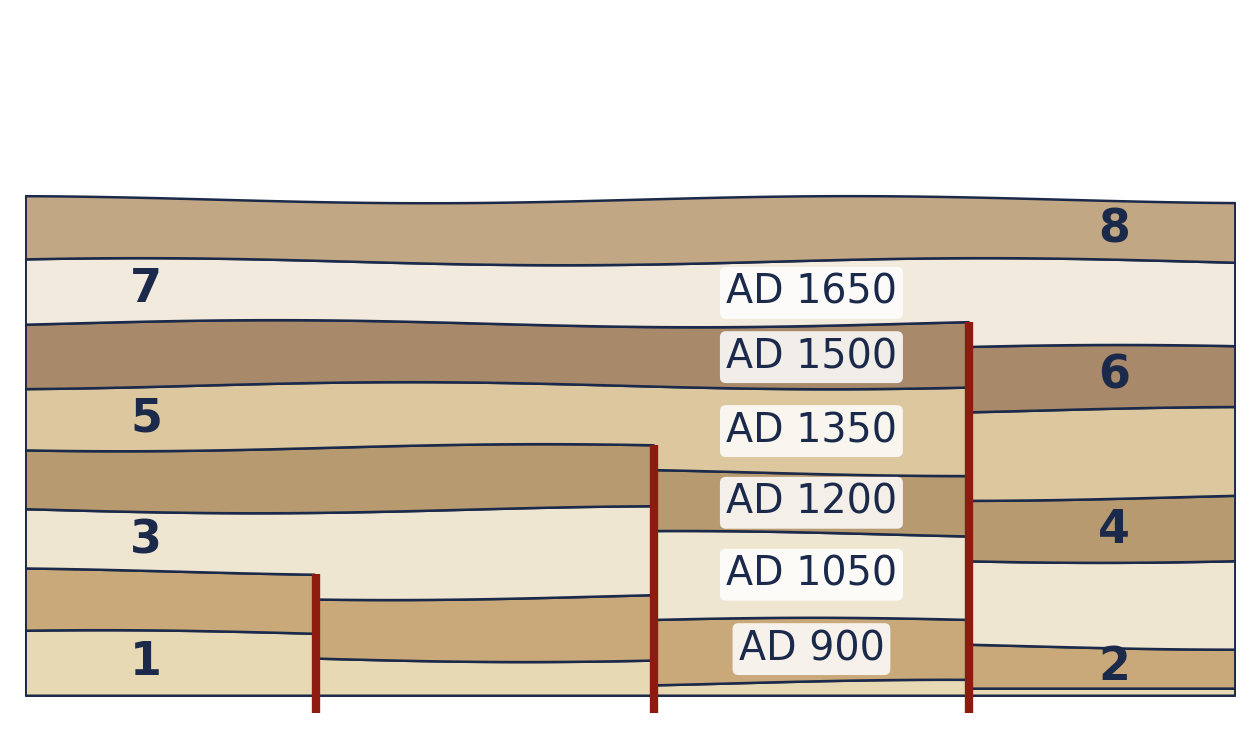
Use the trench. The middle strand breaks layers 1 to 4, and layer 5 lies on top of it unbroken. When did that earthquake happen? [LO6]
After layer 4 was laid down and before layer 5
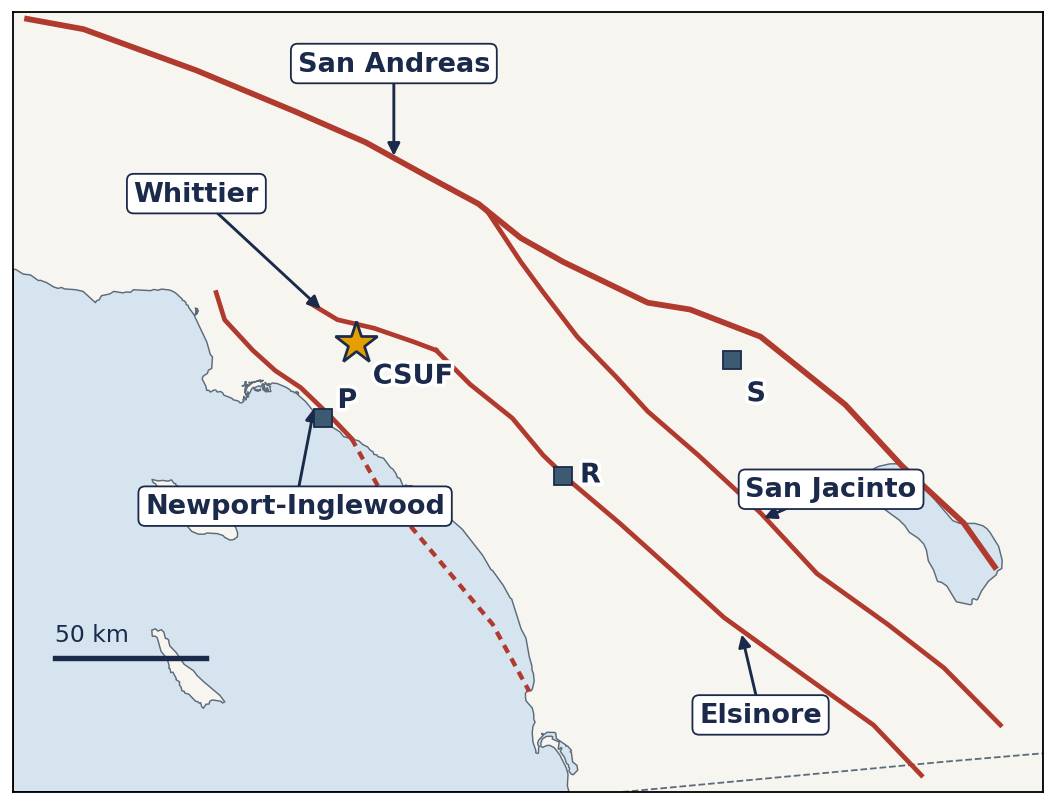
Use the map’s scale bar. About how far is the San Andreas Fault from the CSUF campus? [LO1]
About 60 km
A fault rupture races along a fault at about 2.5 km per second. How many seconds does it take to break a 200-km-long fault? Enter a number of seconds. [LO2]
200 km ÷ 2.5 km/s = 80 seconds. The ground near the fault keeps shaking for at least that long. (Box 4)

Using the roughly 22-year pattern after 1966, when did scientists predict the next Parkfield earthquake? [LO5]
Around 1988