Reproduction in plants-2
 Call Kai
 Learn
Learn Practice Test
 Spaced Repetition
 Match
Match Flashcards
 Knowt Play
1/84

Earn XP
Description and Tags
this has 85 flashcards,prettyyy long~!!
Name | Mastery | Learn | Test | Matching | Spaced | Call with Kai | Chat |
|---|
No analytics yet
Send a link to your students to track their progress
85 Terms
Structure of flowers

Calyx
The outermost layer which comprises the sepals.
Usually green
Protect the flower in the bud
Corolla
Ring of petals
Attract insects
Male part of the flower - stamen
A filament supporting an anther which produces pollen grains.
Filament
Contains vascular tissue, which transports sucrose, mineral ions and water to the developing pollen grains
Anther
Contains four pollen sacs arranged in two pairs.
When mature, the pollen sacs dehisce = open and release the pollen
Carpel
Female parts of the flower.
Ovary
Style
Stigma
Carpel

Pollination definition
The transfer of pollen grains from the anther to the mature stigma of a plant of the same species
Protandry definition
The stamens of a flower ripen before the stigmas
Self pollination
The pollen from the anthers of a flower is transferred to the mature stigma of the same flower/ a flower of the same plant
Genetic implications of self pollination
Depend only on independent assortment and crossing over during meiosis and mutation to bring about genetic variation in genomes of the gametes = display less genetic variation
Greater chance of 2 potentially harmful recessive alleles being brought together at fertilisation
Advantage of self pollination
It can preserve those successful genomes that are suited to a relatively stable environment
Cross-pollination
Pollen is transferred from the anthers of one flower to the mature stigma of a flower on another plant
Genetic implications of cross-pollination
Combines gametes from 2 individuals = more genetic variation
Reduces the chance of producing harmful allele combinations
In the struggle for survival, some genomes are more successful than others. It may allow a species to survive in a changing environment, as there are always likely to be some members of a population with a suitable combination of alleles
How is cross-pollination ensured?
1. Separate male + female flowers on the same plant
2. Separate male and female plants
3. Dichogamy - stamen + stigma ripen at different times
4. Anther below the stigma = pollen can't fall onto it
5. Genetic incompatibility
Protogyny
Stigma ripens first
Insect pollinated flowers
Colourful petals
Scent and nectar
Anthers within the flower
Stigma within the flower
Small quantities of a sticky pollen
Larger pollen grains
Wind pollinated flowers
Petals usually absent
No scent or nectar
Anthers hanging outside the flower
Large, feathery stigmas hang outside flower
Large quantities of smooth pollen
Small pollen grains
Wind pollinated flowers
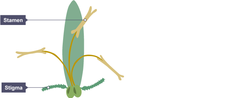
Where are male gametes developed?
In pollen sacs of the anther
Process of male gamete formation
Diploid microspore mother cells undergo meiosis
|
|
|
4 immature pollen grains in a tetrad = four haploid cells ( 0.5 number of chromosomes)
|
|
|
In the pollen grain, the haploid nucleus undergoes mitosis to produce 2 nuclei = a generative nucleus and tube nucleus
The generative nucleus undergoes mitosis to produce 2 male nuclei = the male gametes
How does the pollen get out?
When the pollen is mature, the outer layers of the anther wall will dry out causing tension in the lateral grooves.
Dehiscence occurs
What is dehiscence?
The walls of the anther are pulled apart and the edges of the pollen sacs curl away. An opening called the stomium exposes the pollen grains and they are carried away by wind or insects
Pollen grain diagram

Development of the female gamete
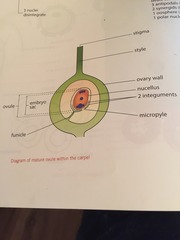
- The ovary contains one or more ovules
- In each ovule, a megaspore cell, surrounded by cells of the nucellus, undergoes meiosis making 4 haploid cells
- 3 disintegrate
- The remaining cell undergoes 3 rounds of mitosis, producing 8 haploid nuclei, one of which is the female gamete
- 2 of the haploid nuclei fuse to make a diploid nucleus called the polar nucleus
What does each embryo sac contain?
3 antipodals = haploid
2 synergids = haploid
1 oosphere = haploid
1 polar nucleus = diploid
Diagram of a mature ovule
Cross section of an anther

Parts of the anther
- Pollen sac
- Surrounding the pollen sac is the tapetum
-Lateral groove
- Vascular strand
Fertilisation definition
The fusion of a female and male gamete, producing a zygote.
Double fertilisation
1. When a compatible pollen grain lands on the stigma, it germinates in the sucrose solution secreted by the stigma and produces a pollen tube
2. Pollen tube nucleus = infront of 2 male nuclei
3. Pollen tube grows out of the pollen grain through a gap in the cell wall, called a pit, + down the style, up a gradient of chemoattractants
4. The pollen tube nucleus codes for the production of hydrolases, including cellulases and proteases, and it digests its way through the tissues of the style
5. The pollen tube grows through the gap in the integuments, the micropyle and passes into the embryo sac
6. The pollen tube nucleus disintergates having completed its function of controlling the growth of the pollen tube
7. The tip of the pollen tube opens, releasing the 2 male gametes into the embryo sac.
8. Male + female gametes are haploid. One of the male gametes fuses with the oosphere to form a zygote - diploid
9. Other male gamete fuses with the diploid polar nucleus to form a triploid nucleus = endosperm
Development of endosperm tissue
Endosperm divides repeatedly by mitosis, it generates the endosperm tissue, which takes over from the nucellus in providing nutrition for the developing embryo.
Fate of zygote
- Divides by mitosis to form the diploid embryo
What does the embryo consist of?
Plumule
Radicle
Cotyledon/s
Fate of triploid endosperm nucleus
- Divides by mitosis to form endosperm tissue
What happens to the outer integument?
Dries out
Hardens
Waterproof w/ deposits of lignin
Becomes the testa ( seed coat )
Micropyle remains as a pore in the seed
What happens to the ovule ?
Becomes the seed
What happens to the funicle?
Becomes the funicle of the seed. It attaches to the seed of the hilum
What happens to the ovary?
Becomes the fruity
- In a cherry: the wall becomes sweet, juicy and pigmented
- Almond - wall is dry and hard
Example of a dicotyledon
e.g. broad bean
Its seeds have 2 cotyledons. The embryo lies between them
Plumule = shoot
Radicle = root
Endosperm = absorbed into the cotyledons = a non-endospermic seed
Example of Monocotyledon
e.g. maize
Has only one cotyledon
Endosperm remains as the food store = endospermic
Cotyledon remains small and does not develop further
Testa fuses with the ovary wall = one-seeded fruit
Monocots
- One cotyledon in seed
-Leaf veins = parallel
- Sepals, petals and stamens in multiples of three
- Vascular bundles scattered in stems
- Vascular bundles in roots
Dicots
- 2 cotyledons in one seed
- Leaf veins form a network
- Sepals, petals, and stamens in multiples of 4 or 5
- Vascular bundles in a ring
- Vascular bundles in center of root
What is seed dispersal?
The movement of seeds away from the parent plant
Why is seed dispersal important?
- If a seed grows near its parent, the parent plant would be more successful at obtaining water and minerals from the soil
- This plant would be taller meaning it would cast shade over the seedling + prevent it from photosynthesizing properly
- Those dispersal methods have been subject to natural selection
Different methods of seed dispersal
Wind
Transport e.g. birds egest feces
Rolling
Bursting
Water
Carrying
Seed survival methods - 1
A low metabolic rate meaning they can survive very cold weather
Seed survival methods - 2
Testa is chemically resistant meaning seeds survive adverse chemical conditions
Seed survival method - 3
The water content of a dormant seed is reduced below 10% and so seeds can survive very dry conditions
Seed survival method - 4
The testa can physically protect the embryo
Seed survival method - 5
The endosperm for cotyledons provide a supply of nutrients which lasts until the emerging seedling can photosynthesize adequately
Seed survival method - 6
They can be dispersed great distances from the parent plant and so do not compete with it
Seed survival method - 7
Dispersal allows the colonisation of new habitats
Seed survival method - 8
Inhibitors may only allow germination at a suitable time of year. They are broken down in very cold weather, in a process called vernalisation so that the seed can germinate in spring
Cabbage = in seed
Tomato = in fruit
Why is a suitable temperature needed for germination?
The optimum temperature for germination is the optimum for the enzymes involved in the process.
Usually between 5C and 30C
Why is water needed for germination?
To mobilise enzymes for transport in the xylem and phloem, and to vacuolate cells, making them turgid
Why is oxygen needed for germination?
Aerobic respiration releases energy, which fuels metabolism and growth
How does light affect different seed species?
Some need light to germinate, others need darkness
How is water taken in to the seed?
Through the micropyle
What is the effect of water being taken up?
Causes the tissues to swell and provides suitable conditions for enzyme activity
Why must the food reserves be broken down?
Food reserves in seeds are insoluble in water and cannot be transported to the embryo
What does amylase do?
Hydrolyses starch into maltose
What do proteases do?
hydrolyse proteins to amino acids
What happens to soluble products?
Transported to the embryo and carried in the phloem to the apical meristems of the plumule and radicle
What happens to sugars?
Converted to cellulose for cell wall synthesis
What does aerobic respiration do?
Releases energy from sugars
What are amino acids used for?
Synthesise proteins
Emergence of the radicle
Swollen tissues rupture the testa
The radicle is positively geotrophic, meaning it grows downwards
Emergence of the plumule
Positively phototrophic meaning it grows upwards
What happens during germination? - step 1
1. The cotyledons of the broad bean remain below ground. The part of the plumule above the ground btwn the embryo and cotyledons elongates rapidly, pushing the plumule upwards
What happens during germination? - step 2
2. Plume = shape of a hook which protects it from soil abrasion
What happens during germination? - step 3
3. If a seed is planted at the correct depth in the soil, when the plumule emerges, the hook straightens and the leaves begin to photosynthesise
Food reserves in cotyledons are depleted
What industry are barley seeds used in?
The brewing industry to make beer
The effect of gibberellic acid step 1
The barley embryo secretes a plant growth regulator (GA), which diffuses through the endosperm to the aleurone layer
What is the aleurone layer?
The cells towards the outside of the seed which has a high protein content
Effect of gibberellin step 2
The GA switches on genes in the cells of the aleurone layer, resulting in transcription and translation, producing enzymes e.g. proteases, amylase
Step 3, what doe proteases do?
Hydrolyse protein in aleurone layer to amino acids, which are used to make amylase
Step 4, what does amylase do?
Diffuses out of the aleurone layer and hydrolyses the starch stored in the endosperm cells
Step 5, what do maltose and glucose do?
Diffuse back through the endosperm to the plumule and radicle of the embryo
Step 6, what are maltose and glucose required for?
Energy, which fuels biosynthesis and cell division and which brings the seed out of dormancy
How are gibberellins used?
The brewing industry to speed up germination so that barley seeds need to kept warm for less time and more malted barley can be produced
Germination in non endosperm seeds
1. Water imbibed through the micropyle
2. Cotyledons swell
3. testa splits - allows entry of more oxyegn for aerobic respiration
4. Food reserves from the cotyledons are mobilised through hydrolysis
Provides sources of energy for respiration and growth of the plumule and radicle
Germination and mass graph

Hilum plant
