PSYC 444 Midterm 2
 Call Kai
 Learn
 Practice Test
 Spaced Repetition
 Match
 Flashcards
 Knowt Play
1/85

There's no tags or description
Looks like no tags are added yet.
86 Terms
Memory Consolidation
Memory reactivation during sleep can be decoded from EEG, locked to slow oscillations and spindle complexes
Methods to Study Sleep and Memory Consolidation
1. *Observational* - looks for correlations after learning (e.g., sleep stage %)
2. *Sleep deprivation* or selective sleep stage deprivation
3. *Targeted memory reactivation* (TMR) - cues paired with learning and then replayed during sleep to see if there is any brain reactivation during sleep
4. Closed-loop acoustic stimulation—sounds timed to slow-wave UP states boost slow oscillations and memory; replications mixed
Sleep-dependent Memory
- Sleep protects memory from forgetting.
- REM sleep is for memory consolidation
- Sleep facilitates forgetting
Dual Process Models
Different sleep stages (REM and NREM) are associated with different kinds of memory consolidation
REM in Memory Consolidation
- REM improves procedural learning (mirror tracing, finger tapping).
- Emotional learning
- REM integrates newly learned memories into larger autobiographical networks
SWS and memory consolidation
- Strengthens declarative and semantic learning
- Strengthens connections between engrams
Active System Consolidation
- Main EEG characteristics thought to play a major role in the hippocampal-neocortical dialogue
- Consolidated memory becomes resistant to interference and independent of the hippocampus
- Slow waves (facilitate spindles); nest hippocampal ripples
- Memories are replayed, potentiated, transformed, and embedded in long-term storage
Sleep and Extracting the Gist
- Sleep does not consolidate all information uniformly
- It extracts the importance of context, goals, motivations, etc.
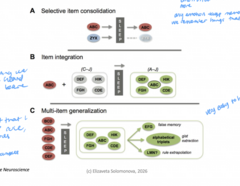
Offline processing
- Selective Item Consolidation (learning 2 things during the day, but only remembering 1)
- Item Integration (integrating new information with information you already know)
- Multi-item Generalization (creating new memories by extracting ideas from a large memory; i.e., false memories, gist extractions, rule extrapolation)
Sleep to forget, sleep to remember theory
- Sleep reduces the "affective blanket" surrounding experience
- Emotion "tags" some memories as more relevant for consolidation
REM sleep: consolidation and integration of emotional memory while decoupling that memory from emotion, thus reducing further anxiety when reactivated
REM Sleep and Emotional Memory
- When you reactivate a memory, you should feel less emotion compared to the original experience
- Over time with sleep, the amount of emotional memory decreases and you'll reach a point where the factual memory doesn't have emotions attached to it
- The amygdala mediates the strength between memory and emotion
With PTSD, this is not the case; the emotions tied to the memory do not go away. This could be caused by issues with memory consolidation in sleep
Amydala
Involved in memory and emotion, particularly fear and aggression
*Sleep deprivation increases amygdala response*
With sleep, the amygdala is more connected to the prefrontal cortex
Without sleep, the amygdala has a stronger response due to less connectivity to areas like PFC
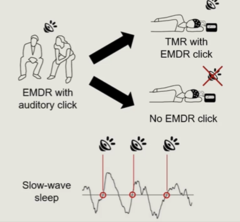
Targeted Memory Reactivation (TMR)
presenting sounds during sleep that reactivate specific memories; enhances memory consolidation
Memory replay in REM Sleep
the same regions that were activated during a procedural task (in wake) are reactivated during REM (in sleep)
reactivations predict post-sleep task improvement
Odors and Memory Consolidation in Sleep
Odor + SWS: improves declarative memory (via hippocampus)
Odor + REM: not an effective driver of memory consolidation
Verbal Memory Cueing
a specialized form of TMR in which spoken words, syllables, pseudowords, or verbal cues paired with learning material during wakefulness are re-played during sleep
study found that cueing a prior learned foreign vocabulary world during sleep improved recall later on
Sleep and Psychopathology
sleep serves as “amplifier” for psychopathologies
sleep reactivity = potential trait
deprivation acts on: emotion regulation pathways, stress reactivity, immune function, memory consolidation, and “negativity bias”
disturbances part of diagnostic criteria for: anxiety, mood dsorders, psychosis, etc
changes in sleep often “prodromal” for onset/worsening of psych disorder symptoms
Sleep Deprivation
high sleep pressure; differs from insomnia
Sleep Deprivation Study
Randy Gardner participated in sleep deprivation study, spending 264.4 hrs awake (approx. 11 days) → resulted in cognitive + psychiatric symptoms, “waking dreams” after 4-5 days (possibly microsleeps), negative emotions (resentment, suspiciousness), disorientation with time, and bodily sensations like burning eyes and fatigue
experienced major REM rebound in first sleep post-experiment
Insomnia
State of chronic hyperarousal - metabolism, heart rate, and cortisol elevated across 24 hrs
- *Bidirectional* - high daytime stress + anxiety disrupt sleep architecture, while poor sleep quality and dysphoric dreaming exacerbate daytime psychological distress (a self-reinforcing cycle)
Insomnia Prevalence
Chronic, clinically significant insomnia: about 10% of adults
Canada: ~40% report at least one insomnia symptom ≥3 nights/week; 13% meet criteria for insomnia syndrome
—> strong correlates = older age, female sex, lower SES
Insomnia - DSM Criteria
predominant complaint of dissatisfaction with sleep quantity or quality, associated
with one (or more) of the following symptoms:
difficulty initiating sleep
difficulty maintaining sleep, characterized by frequent awakenings/ problems returning to sleep
early-morning awakening w/difficulty returning to sleep
the difficulty must occur at least 3 nights a week, for at least 3 months AND cause clincially signifigant distress to individual
The “3 Ps” Model of Insomnia
Perpetuating - behaviors like time in bed, napping, worrying etc — what CBT-I targets
Precipitating - stressors, illness, life events
Predisposing - hyperarousal (high cortisol, HPA reactivity, etc), sleep reactivity, genetics
Insomnia Treatment - CBTI
- sleep restriction schedule: restriction of time spent is bed to strengthen homeostatic sleep drive before a gradual increase
- stimulus control: a set of instructions designed to reinforce the association between the bed and bedroom w/ sleep and to reestablish consistent sleep-wake schedule — include things like going to bed only when sleepy and waking up at same time each day
- relaxation training: clinical procedures (e.g., progressive muscle relaxation) aimed at reducing autonomic arousal, muscle tension, and intrusive thoughts that interfere w/ sleep.
- cognitive restructuring: reduce excessive worrying about sleep and reframe unhelpful beliefs about insomnia and its daytime consequences via questioning and behavioral experiments
- sleep hygiene education: general guidelines about health practices (e.g., diet, exercise, substance use) and environmental factors (e.g., light, noise, excessive temperature) that may promote or interfere with sleep - not an effective treatment when used in isolation
Insomnia - Pharmacological Treatment
typically benzodiazepines or similar drugs
effective for shortening sleep onset + maintaining sleep
short-term only - should only be used for up to 4 weeks
orexin receptor antagonists
block the wake-promoting orexin signal rather than boosting GABA + can be used for up to ~3 months, longer in some cases
may be effective short-term but do not address root cause of insomnia
Sleep-State Misperception / Paradoxical Insomnia
A discrepancy between objective sleep length/quality and subjective experience of how much/how well one sleeps — one study estimated ~25% of insomniacs underestimate sleep length
can also be positive but rarely
sleep in “super-percievers” often marked by more micro-arousals (which may impact feelings of being rested)
Orthosomnia
characterized by patients seeking treatment to “fix” sleep problems (as defined by tracker) - a perfectionistic pursuit of sleep ideal
trackers overestimate sleep + poorly detect wake
may reinforce perpetuating insomniac behaviors (like leading one to spend more time in bed)
Sleep Mentation
Any form of internal subjective experience that occurs during sleep + is remebered by individual upon waking
"Classic" Dream
A more precise subset of mental activity during sleep — complex + narrative auditory, visual, etc experiences
Building blocks of Dreams
Emotions, thoughts, sensations, narrative structure/schenarios, characters, and memory sources
Freud: Traumdeutung
The “interpretation of dreams” —> viewed dreams as necessary expulsion/expression of psychic energy characterized by catharsis (emotional relief) + cathexis (attachment of energy to neutral object)
argues dreams serve 2 purposes: 1) protect dreamer against wake and 2) fulfill wishes via unconsciousness enactment of desire
Latent and Manifest Content of dreams
Latent content: unconscious, underlying meaning behind dream
Manifest content: observable content in dream that has undergone dreamwork (transformation) — allows for catharis and cathexis
Repression
a psychic process in response/defense of intolerable wishes, desires, and impulses
repressed energy expressed via cathexis
Dreamwork Mechanisms
How latent content of dreams transform into manifest: condensation, displacement, symbolization, secondary revision — serve to preserve one’s ego
Day Residue
Elements from the day prior that make their way into dreams
may disguise other symptoms/latent thoughts
How to study dreams
- Retrospective self-reports
- Dream diaries
- Lab awakenings
- Expert participants (e.g., lucid dreamers)
- Large online samples
- REM sleep as a proxy
- Clinical and group settings
Experience, Memory, and Report
experience: what occured during sleep
memory: what remains available after awakening
report: what the person describes
Dream Recall
depends on attention, attitudes toward dreams, sleep patterns, and interference — ~60% of dreams in study recalled content while ~15% remembered dreaming but lost content (rest reported no experience)
Types of Dream Experiences
- Hypnagogic (sleep onset)
- Hypnopompic (upon waking)
- NREM short dreams (thinking, images)
- REM dreams (vivid + immersive)
- Intensified dreams (nightmares, epic dreams)
- Lucid dreams
- Mixed-states: sleep paralysis, sleepwalking
Dream Reports Across Sleep stages
N1: ~90% report
N2: ~60% report
N3: ~50% report
REM: ~80% report
N2 + N3: increased likelihood of reporting a dream experience but being unable to recall exact details
Activation-Synthesis (Hobson)
brainstem switch: REM initatied via activation of neocortex
activation: PGO waves hit thalamus + cortex — “pseudo-stimuli” + reflexive eye movements triggered, odd images and scenes created
synthesis: forebrain creates a “best-fit” story/narrative to make meaning of bizarre stimuli
evidence: cell recordings in cats
a bottom-up model
AIM Model of Conscious States (via Activation-Synthesis)
A (activation): how active the brain is
I (input source): arousal via external or interal experience
M (modulation): aminergic (serotonin, noradrenaline) or cholinergic (acetylcholine)
helps to explain how wake and REM differ — have different inputs and neurochemical properties
ex) an active PFC is what sets lucid dreaming apart from regular dreaming, making it an “intermediary” state
Neuropsychoanalysis (Mark Solms)
Main claim: the brainstem switches REM on, but in order for dreaming to occur, there needs to be affect and desire (via the forebrain’s “seeking” circuits) — a top-down approach
evidence: lobotomies preserve REM but abolish dreaming
Covert REM Theory (Nielsen)
Main idea: some dreams in NREM sleep could be explained by the presence of some elements of REM in NREM (atonia, desynchronized eeg, etc)
Evolutionary Functions of Dreams
1. evolutionary function - dreams were selected for their capacity to increase fitness (how?)
2. function within the cognitive system (not necessarily for survival/reproduction, but a particular role)
We Dream to Forget (Crick & Mitchison)
Reverse learning: REM sleep weakens “parasitic” connections in an overloaded cortical network (a connectionist model)
Overfitted Brain Hypothesis
A more modern conceptualization of Crick & Mitchison’s model — argues unusual, varied dreams counter overfitting and support generalization,
Typical Themes of Dreams Across Cultures
Being chased
School
Falling
Sexual Experiences
Threat Simulation Theory (Revonsuo, 2000)
Main idea: dreaming evolved to rehearse threat perception and avoidance in a safe, offline simulation
predicts real threatening events encountered by the individual during wakefulness lead to an increased frequency and severity of threatening events in dreams
Social Simulation Theory
Main idea: dreams simulate the social world + serve as practice for social interactions during wake — had 3 hypotheses
sociality bias: dreams are more social than waking life —> supported
strengthening: dreams rehearse bonds with close others —> yes under seclusion
compensation: dreams make up for mising social contact —> not supported
Studied via 18 people on a volunatry seclusion in Finland w/ no social contact + dream diaries
Who Appears in dreams?
Daily interaction generally predicted appearances; family patterns differed across within- and between-person analyses.
Covid-19: a natural experiment
Main dream themes of participants: trying again and again (52%), sexual experiences (41%), arriving too late (33%), separated from a loved one (30%), being chased (29%)
Finding: Current concerns appear in dreams. These observations alone do not demonstrate social rehearsal or compensation
Cognitive Function of Dreams
memory consolidation, problem-solving/creativity, emotional adaptation
Incorporation of Memory Sources into Dreams
Memories appear in dream content but are incorporated in a novel way, never a
complete what–where–when replay (except in PTSD and some brain lesions)
Day-residue effect: incorporation peaks 1–2 days after an event
Dream-lag effect: a second peak 5–7 days later, in REM dreams, for personally significant events
Tetris
After hours of Tetris, players reported intrusive images of the game at sleep onset, including 3 amnesic patients with bilateral medial temporal lobe damage who could not remember playing
Dreaming of the Maze
99 people learned a virtual maze, then napped or stayed awake. Nappers who dreamed of the maze improved about 10 times more than nappers who did not; thinking about it while awake did not help.
Dreams and Memory: Summary
Dreaming of a learning task goes with better memory after sleep more clearly for NREM than REM dreams
Tracing memory sources in dreams is hard: it is not an exact ‘replay’, but a transformation of memory
REM and NREM dreams may serve different memory processes (episodic, declarative, consolidation, integration…)
TMR has a small, delayed effect on dream content
Dreams and problem-solving
Sleep onset is a “creative sweet spot” — ≥ 15 s of N1 tripled the chance of
finding shortcut to a puzzle; going on into N2 erased the benefit
hypnogogic images did not predict insight
Hyperassociativity
dreams work in a hyperassociative manner by linking temporally distinct experiences
emotional and personally relevant experiences may be incorporated
preferentially; dreams extract the gist and create a central image
NEXTUP: Network Exploration To Understand Possibilities
Dreaming searches for weak, unexpected associations to extract meaning from new experiences and prepare for possible future
Emotion Assimilation in Sleep (Malimowski & Horton)
emotion tags a waking experiences as important
tagged memories are re-activated in sleep + linked to older memories
dreams show this linking via metaphor and hyperassociativity
emotional intensity fades + memory is integrated into pre-existing networks (assimilation) — failure results in repetitive dreams + post-traumatic nightmares]
found: incorporated waking experiences were more emotional, but not more stressful
Hartmann's Theory
Proposes that dreams are a form of "nighttime therapy" that helps integrate emotional difficulties or traumas into existing memory networks
—> memory sources in dreams are structured by affection/emotion
—> central images serve as visual metaphor for key emotional issues — uses tidal wave as example as represting emotional weight and terror
—> thymophor: translation of emotion into imagery
Cartwright: Dream after Divorce
People going through a divorce, with and without depression; dreams collected from REM awakenings; depression re-assessed about a year later — found that more negative dreams early in night, and fewer later, predicted MDD remission
in those who later remitted, dreams of ex-spouse carried more emotion and more links to older memories; in those still depressed, they lacked affect and connection
Fear in Dreams
experiencing fear in dreams may help to modulate + regulate emotional responses to fear during wake
Ankle-Cuff Study
An ankle cuff supplied pressure at sleep onset and during REM sleep. EEG guided timing; participants reported their experiences after awakening — resulted in various forms of incorporation of feeling into dreams
sleep onset: sensation and personal association
REM: a false awakening
Cueing Biased Dreams toward a Learned Task
Task memories and the sound cue itself are separate incorporation outcomes
—> one is more likely to dream of task directly + indirectly when cued
—> breathing pattern changes also recorded —- possible physiologucal response to cueing
Functions of Dreams
- Integrate new memories with old (memory consolidation)
- Find unexpected solutions (creativity, NEXTUP)
- Recalibrate emotional memories (emotion assimilation)
- Rehearse threats and social life (simulation theories)
- If told after waking: empathy and bonding (dream sharing)
Nightmares
- Dreams that often involve fear, dysphoria, anger, shame, sadness, or disgust + cause harmful dysfunction in individual
- can be trauma-related (replays an event or reproduces its affect in another setting) or idiopathic (have unknown cause)
Nightmare Distress
sometimes used as a measure
Most Common Nightmares
physical aggression
interpersonal conflict
failure/helplessness
health concerns, death
apprehension/worry
being chased
Nightmares Prevalence
Unknown; ~100% lifetime prevalence w/ ~4% of adults estimated to have disorder
—> 92% of women and 85% of men report nightmares
—> may have familial component — possibly transmitted through matrilineal lines
—> peak around ages 3-5 in children + again in teenage girls until 50s-60s (when more equal across genders again)

Nightmares and Sleep Chronotypes
evening (later) sleep chronotypes more likely to experience nightmares
Nightmares and REM sleep
nightmares thought to be a REM phenomenon + usually occur during second ½ of the night (due to surge in cortisol)
Autonomic Nervous System in Nightmares
ANS dysfunction hypothesized to have a role in nightmares — esp in those that lead to embodied emotional experience (crying, shaking, etc)
Morning after a nightmare
Negative affectivity (anxiety, agitation, etc) higher after waking from nightmare — less reports of feeling joy, cheerful, relaxed, etc
Stress, Nightmares, Sleep Cycle
Those with nightmares often delay sleep, which may lead to a build up in REM pressure and lead to an increase in nightmare quantity
Affect Network Dysfunction
increasing affective load —> more dysphoric dream experiences
dreaming as fear memory extinction — nightmares are an expession of overactive amygdala effect and/or lessened dampening effect of prefrontal areas — a dysregulation of affect system
Stress Acceleration Hypothesis (Nielsen, 2017)
argues early adversity in childhood —> premature ability to self-reflect (have metacogntion) = dysfunctional processing of early life events —> creation of pathway for more global changes in affect regulation system over time
may lead to increase in nightmare experiences as maladaptive way of emotional processing/coping
Differential Suspectibility
suggests that individuals differ in their general sensitivity or malleability to environmental influences "for better and for worse" AKA diathesis-stress model
PTSD and nightmares
those with PTSD experience recurrent nightmares in relation to traumatic experiences — episodic in ~42-53% of patients
traumatic event —> experience of event not adequately processed —> memory encapsulated + persistently relived via dreams and nightmares —> autonomic hyperactivity + inability to downregulate
Treatment of Nightmares
- imagery rehearsal
- lucid dreaming therapy
- hypnosis
- pharmacological treatments
- eye movement desensitization and reprocessing (EMDR)
- other relaxation techniques
Image Rehearsal Therapy
Currently #1 reccomendation for treatment of nightmares
patient gives nightmare report then creates narrative of nightmare changed as they wish — visualization of (new) scenario while in fixed, relaxed setting w/ hyperassociative brain state
helps give patient sense of agency over dream experience and inner mental states
more effective when paired with TMR
Lucid Dreaming Therapy
patients are trained to become consciously aware that they are dreaming during rapid eye movement (REM) sleep so they can actively alter and reframe dream content
Lucid Dreams
a dream where the dreamer is aware of dreaming — a “hybrid” state between wake and REM sleep — exists along a continuum
~50% lifetime prevalence (at least 1)
most frequently has themes of flying, talking, and sex
Isomorphic Relationship Between Sleeping + Dreaming Body
movement performed during a lucid dream can be (subtly) recorded in body
estimation of time appears to be instataneous
physiological reactions align w/ dream content (eg. squatting in dream —> elevated heart rate)
Neural Correlates of Lucid Dreaming
fronto-polar regions: metacognition, internal state processing, evaluation of thoughts + feelings
precuneus + inferior parietal lobe: self-experience + first-person perspective
occipital + lower temporal regions: conscious visual processing (perception)