PT 759 - Neuroplasticity and Neural Repair
 Call Kai
 Learn
Learn Practice Test
 Spaced Repetition
 Match
Match Flashcards
 Knowt Play
1/62

There's no tags or description
Looks like no tags are added yet.
Name | Mastery | Learn | Test | Matching | Spaced | Call with Kai | Chat |
|---|
No analytics yet
Send a link to your students to track their progress
63 Terms
What is neuroplasticity?
A change in neuron structure or function

When does neuroplasticity occur in our lives?
Throughout the lifespan of an individual

What are the 4 groups of categories?
Structural changes in individual neurons
Functional changes in individual neurons
Structural changes in populations of neurons
Functional changes in populations of neurons
What is neuroplasticity essential for?
Learning
Creating new memories
Recovery from CNS damage
What are the various mechanisms related to neuroplasticity?
Experience-dependent plasticity (ex. learning and memory)
Maladaptive neural plasticity (ex. chronic pain)
(can be up or down regulated)
Experience dependent neuroplasticity involves what three processes?
Synaptogenesis (new synapse)
Microstructural changes (dendritic spine, white matter, myelin, receptor, calcium permeability)
Alterations in gene expression (new proteins)
Experience-dependent plasticity involves what processes?
Persistent, long-lasting changes in the strength of synapses between neurons and networks
Experience-dependent plasticity creates changes at the synapse where?
At the pre-synaptic terminal or the post-synaptic terminal depending on type of synapse and location
What are the presynaptic mechanisms that change with experience-dependent plasticity?
Increase or decrease in NT release
What are the postsynaptic mechanisms that change with experience-dependent plasticity?
Increased or decreased response to NT
Change in size or form of dendritic spine
Formation of new synapse
What are the cellular processes associated with experience-dependent neuroplasticity?
Long term potentiation (LTP)
Long term depression (LTD)
Long term potentiation creates what changes at the synapse?
Synaptic connections become stronger/more responsive
Simultaneous firing of pre and post synaptic cells
Increased efficacy of synaptic transmission
Long term depression creates what changes?
Weakening of synaptic connection/response
Decreased efficacy of transmission
Which of the cellular processes of experience dependent neuroplasticity is best understood?
LTP
What is an important mechanism of LTP?
Conversion of silent synapses into active synapses; "unmasks" them
What is the sequence of events for LTP?
Glutamate releases and postsynaptic cell depolarizes
Calcium enters and triggers series of reactions that moves AMPA receptors to postsynaptic membrane
Postsynaptic membrane shape is changed
What is the benefit of new AMPA receptors migrating to the post-synaptic membrane?
Increases the spine's sensitivity to glutamate causing more LTP

What does continued strong signaling during LTP create?
Changes in gene expression resulting in changes to shape/structure of post-synaptic membrane

Explain the steps of this picture.
A)This is a silent synapse b/c the AMPA receptors are NOT at the membrane, and thus aren't active.
B)In response to strongly correlated firing of pre and post-synaptic cells, the NMDA receptors can become active. This allows influx of Ca++ which makes AMPA receptors embed in membrane
C) Once the mobile AMPA receptors become embedded in the post-synaptic membrane, they function as Glutamate receptors
D) With continuing stimulation they may form new dendritic spines, and become a new permanent synapse. Requires gene activity and Ca++ can initiate that.

What is the mechanism of long term depression (LTD)?
Conversion of active synapse into silent synapse
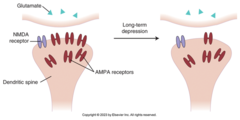
How is an active synapse converted to a silent synapse in LTD? And why is this done?
Removal of AMPA receptors from synaptic membrane in response to lack of stimulation
Where is LTP and LTD seen in the brain?
Hippocampus
Somatosensory, visual, auditory cortices
Cerebellum
What are LTD and LTP key mechanisms in?
Many learning and memory behaviors
LTP and LTD can not only affect the synapse of the neuron undergoing neuroplasticity, but what else too?
Adjacent synapses
What is a neuroplasticity feature of the motor cortex?
Remapping in the presence of BDNF (brain-derived neurotrophic factor) inducing synaptogenesis
In order for remapping of the motor cortex to become permanent what must follow synaptogenesis?
Angiogenesis and formation of new blood vessels

What are the mechanisms of CNS damage?
Physical trauma
Localized lack of O2 (blockage of artery or hemorrhage)
Global deprivation of O2 (cardiac arrest or drowning)
Neurodegenerative disease (ALZ, PD, ALS)
In strokes, TBI, or trauma how does the initial injury area differ from the total injury area?
A limited number of axons or neurons are hurt at first and those injuries create a chain reaction across a widespread area
How can a TBI cause widespread damage to the CNS?
Can cause diffuse axonal tearing creating more degeneration
How does Wallerian degeneration create widespread injury?
Cell death of neuron A prevents synapses from functioning leading to cell death up and down the chain
If an axon is damaged what can happen? And what is this called?
May cause axon and synapses to degenerate leading to cell death
Called Wallerian degeneration
What cannot happen to axons in the CNS that can in the PNS? And why?
Axon regeneration does not occur in the CNS
Scarring, no growth factor, and Nogo (neurite outgrowth inhibitor)
Where is Nogo found and where is it absent?
Found in oligodendrocytes and not in schwann cells
What can axons be severed by?
Injury from sharp object or extreme stretch

What is sprouting in axons?
Growth of a new branch off an intact axon (collateral sprouting) or regrowth of damaged axon (regenerative sprouting)

How fast do axons regrow in the periphery?
Recovery occurs 1-3 inches/month

What problems can occur from sprouting in periphery axons?
Wires can get crossed:
Synkinesis (try to move one muscle and another moves)
Confusion of sensory modalities

When a neuron dies how does the nervous system promote recovery?
Altering specific synapses
Functionally reorganizing CNS
Changing NT release
What happens to a damaged area of the CNS over time?
Remains evident, suggests little repair
In response to CNS damage, how does remaining brain tissue respond?
Tissue can adapt but there is no wholesale remodeling
How can the synapses of the CNS reorganize without repairing?
Return to function to reduce inflammation
Improve efficiency of existing synapses
Unmask silent synapses
Synaptogenesis
Local growth of axons and dendrites
Alter activity of cortex opposite to site of injury (ex. right brain helps left)

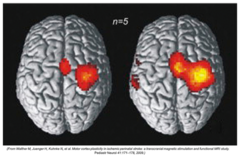
Be able to explain what is happening in each of different parts of this photo

How widespread are synaptic responses to injury?
Affect a limited set of neurons (not just axons)
What is recovery of synaptic effectiveness?
Form of CNS reorganization that occurs after shock, neurons and pathway not damaged, local edema blocks pathway and resolves after edema disappears

What is denervation hypersensitivity?
Form of CNS reorganization when new receptor sites develop on postsynaptic membrane in response to presynaptic neuron destruction

What is synaptic hypereffectiveness?
Form of CNS reorganization when some branches of a presynaptic neuron axon are destroyed and the remaining release more NT in response

What is unmasking of silent synapses?
Also a form of CNS reorganization where LTP brings AMPA receptors to a surface after prolonged strong signaling

How can the cerebral cortex be functionally reorganized?
Cortical maps can be modified by sensory input, experience, learning, peripheral injury, and brain injury
What happens to neurons during oxygen deprivation?
Neuron death

What can cascade from oxygen deprivation in the brain?
Excitotoxicity

What is excitotoxicity?
Overstimulation by glutamate which is toxic to neurons

How is excitotoxicity toxic to neurons?
Mitochondria get burned out
Cell swells due to influx of calcium and water following
Oxygen free radicals created by enzymes in overdrive

What is the net effect of excitotoxicity?
Apoptosis (cell death)

What protective barrier can also be damaged from CNS injury?
Blood brain barrier
If the blood brain barrier is damaged what adverse effects can occur?
Invasion of immune cells (ones that don't normally enter)
Inflammatory response
Further glial scarring (contain inflammation)
Scarring interfering with axon growth
What is the glial response to CNS injury?
Oligodendrocytes and astrocytes create glial scarring
Microglia swell
All become more active and grow

Glial cells becoming more active in response to CNS injury which opposes what?
Regrowth of axons

Why is there controversy about the extent of neurogenesis?
Other vertebrates show neurogenesis
Mammals it is limited; only confirmed in olfactory epithelium and hippocampus
What is the effect of rehab on neuroplasticity?
Enhances process of neuroplasticity after injury
What are the key components of rehab in neuroplasticity?
Find optimal time after injury
Intensity has to be sufficient (initiate change and not cause more injury)
Must be task-specific, not just movement

What did studies in rats that had brain damage induced show about rehab in neuroplasticity?
Rehab started 5 days after injury was better than 1 month after

What did studies on monkeys about rehab in neuroplasticity show?
Cortical reorganization occurring as they relearn hand movements

How is task specific training more beneficial than general use training in rehab for neuroplasticity?
Task specific produced longer lasting changes, better recovery and brain organization