Political ecologies of low carbon transitions
 Call Kai
 Learn
 Practice Test
 Spaced Repetition
 Match
 Flashcards
 Knowt Play
1/5

There's no tags or description
Looks like no tags are added yet.
6 Terms
Political ecology
environmental problems are not neutral, just natural or technical, or an unintended consequence of human activities (think of the externalities); they are heavily shaped by power relations and money. Rich and powerful actor can influence our relationships with the environment, for their benefit.
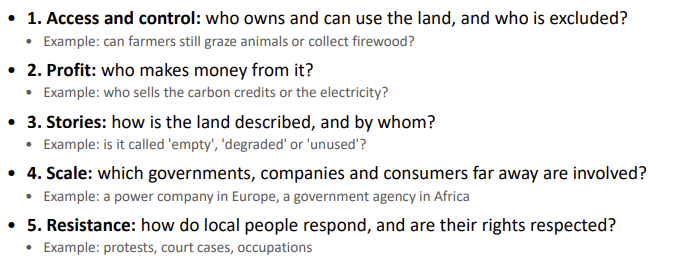
Land grabbing and green grabbing
Land grabbing - purchase or gain of control of vast tracts of land by domestic, national or transnational companies, govs or investors - emerged after financial crisis 2007=2008 when investments resorted to land as a way of securing their capital (land wont lose value in long term and they gain from profits of food, minerals, timber etc)
Green grabbing - taking land and resources for enviro goals e.g. renewables, carbon sequestration etc justify land acquisition and control over access and use of resources
Commodification/financialisation of nature
Commodification of nature created new markets for selling parts of nature, such as carbon. There are markets for everything, from ecosystem conservation, to restoration, and more recently, to transform nature in clean energy.
Finance gap - govs can't pay for conservation etc so ave to fill it with public money
Sustainability goals lack up to $4 trillion a year
Nature now incorporated into a late-stage capitalist system - now part of growth equation in the form of assets, rather than common resources for all
Making nature investable
Split and define the assets e.g. forest provides carbon storage, tourism, biodiversity etc
Translate value into measurement system and valuation currency e.g. $ per ton - buyers look for cheapest place often in poor global S
Make asset tradeable - carbon credits
Economy of repair
Economy of repair - now nature valued twice - once when used for resources and again when used to repair damage
e.g. pollution here repaired by planting trees or protecting forests there
New business - growing economy of repair
How green growth deals with emissions it cannot cut
Carbon offsets
A carbon credit is meant to equal one tonne of CO2 or equivalent that is retained or stored somewhere else e.g. peat restoration, afforestation etc
Compulsory or voluntary
Problems
Additionality - would it have happened anyway?
Leakage - does the damage just move e.g. protecting one forest can push farming into another region where forests are not protected
Permanence - will the carbon stay stored
Upfront credits - some credits sold before trees have even grown - if these fail it is a phantom credit - exists on paper but not in the forest
Most projects in global S whereas buyers are in rich countries - risks of land conflicts, reproduction of colonial and neocolonial practices
Green grabbing example 1
Cavanagh and Benjaminsen
Dutch NGO Face the Future and the Uganda Wildlife Authority develop an afforestation reforestation project in mount elgon national park - plan to sell carbon credits as part of conservation program
Triple win - good for the climate, nature and locals
1990 - dutch electricity generating board sets up the FACE foundation to offset all co2 emissions from new coal fired power station with CCs
Violent dispossession - local people dispossessed from land for the project - characterised as 'encroachers'
No compensation even though law requires it - homes, schools, shops and clinics destroyed for about 10 years
6,000 evicted in project area alone, 150,000+ across whole NP
Land could've fed 84,000 households
After 2003 - failed reforestation - only 8,000 ha out of 25,000 planned and >40% compromised by active community resistance - operations halted
Visible efforts made to disassociate UWA-FACE project from violent eviction process
Conceptually and geographically disconnected from both consumers and sites of sequestration
Face the Future etc continue to enjoy sterling reputations in the western world and are generally presumed to secure socially responsible environmental management outcomes
Negative impacts heavily obscured from western world - north south divide
Mount Elgon is an example of a constructed “triple-win” narrative, where “virtual nature” –a distant imagery of what nature is and how it works is called upon for green goals.
This romantic and positive representation of nature that celebrates climate change mitigation, conservation and employment obscures the social conflicts, violence, and human displacement.
worsened with social media - conservation spectacularised and african nature fetishized