Bioinorganic chem
 Call Kai
 Learn
 Practice Test
 Spaced Repetition
 Match
 Flashcards
 Knowt Play
1/83

There's no tags or description
Looks like no tags are added yet.
84 Terms
Redox reaction
O + R → O+ + R-
What are the equations giving Gibb’s free energy of a redox reactions
ΔGo = -nFEo
n= electrons transferred
F= Faraday’s constant
Eo = redox potential
ΔGo = -RTlnK
R= gas constant
T= temperature
K= equibilrium constant
Eo= ?
Eored’ species- Eoox’d species
Nernst equation
Eo = (RT/nF) lnK
A species with greater Eo will (__) species that have a lower Eo
A species with greater Eo will oxdize species that have a lower Eo
a) which electron transfer mechanism dominates biological electron transfer and b) why?
a) outer sphere
b) the redox centres are inside proteins and too far apart
Outer sphere electron transfer reaction
electron is transferred without any apparent changes to the coordination

Inner sphere electron transfer reaction
involves the formation of a binuclear complex with a bridging ligand provided by one of the reactants
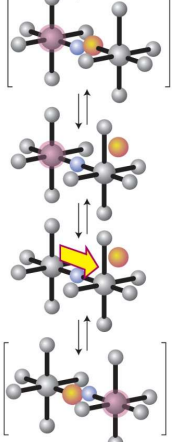
What complexes will only undergo outer sphere electron transfer? (8)
Oh d3, d8
Oh low spin d4, d5, d6
Complex with strong-field ligands
chelating ligands
self exchange reaction
when identical chemical species that differ only in their oxidation state undergo electron exchange
ΔGo for self exchange reactions calculation
ΔGo = 0
What is the relative difference in the rate of self exchange reactions between t2g and eg orbitals and why?
t2g is much faster because non-bonding orbitals do not change in length when electrons are added/removed
Which metal complexes are always high spin?
tetrahedral
Co2+ (almost always)
Which metal complexes are always low spin?
4 and 5d metals
square planar complex
Co3+ (except with F Ligands)
Franck-Condon principle
electron transfer occurs with the nuclei being stationary because electronic motion is faster than nuclear motion
λ= F-C reorganization energy

What causes ΔG‡ to a) increase (2) and b) decrease?
a)
a large change in M–L bond length
extensive solvent reorganization
b) lower ΔG products
How can the effect of solvent reorganization be mitigated?
shield charge on the metal ion from external solvent with hydrophobic ligands
The four types of Gibbs Free energy diagrams for Marcus theory electron exchange

Pre-requisites for an inner sphere mechanism
One reactant, usually the oxidant, possesses a ligand capable of bridging between two metal centres
Which redox partner typically has the following features in inner sphere mechanism: a) bridging ligand, b) substitutional lability
a) reduced species
b) oxidized species
TRUE OR FALSE: NH2 and H2O can be bridging ligands in inner sphere transfer because they both have lone pairs
FALSE: They are not good
What makes a complex labile?
small LFSE
What are the most labile complex configurations and why?
High spin d4 and d9 are Jahn-Teller distorted and have elongated z-bonds
What makes LFSE smaller/ a complex more labile? (3)
weak field ligands
low charge metals
4d/5d transition metals
What type of electron transfer is faster for a) outer and b) inner sphere?
a) between π*→π*
b) between σ*→σ*
TRUE OR FALSE: outer sphere works better in acidic conditions, inner sphere works better in basic conditions
FALSE: outer sphere is unaffected by pH
TRUE: base is favoured for ISET because OH– is a better bridging ligand than H2O
a) what test (and results) can be used to determine whether a complex undergoes outer or inner sphere electron transfer and b) what is the basis behind the observation?
a) The azide/thiocyanate test: k(N3–) / k(NCS–)=
outer sphere ≈ 1 « inner sphere
b) azide ion can form a more stable Inner Sphere intermediate than thiocyanate
Redox complementary reactions
two centres which donate or accept the same number of electron
Non-complementary reaction
When the oxidant and reductant require different changes in oxidation states
What is the problem with non-complementary redox reactions and how can it be overcome?
It would involve a three body collision; an enzyme is needed
How do P450 enzymes receive electrons? make note of the number, transfer mechanism and source
NADH gives 2 electrons to a flavin dependent protein which passes then on one at a time
Cytochrome P450 enzyme structure
where the ring is a porphyrin ring like on haem

Haem structure
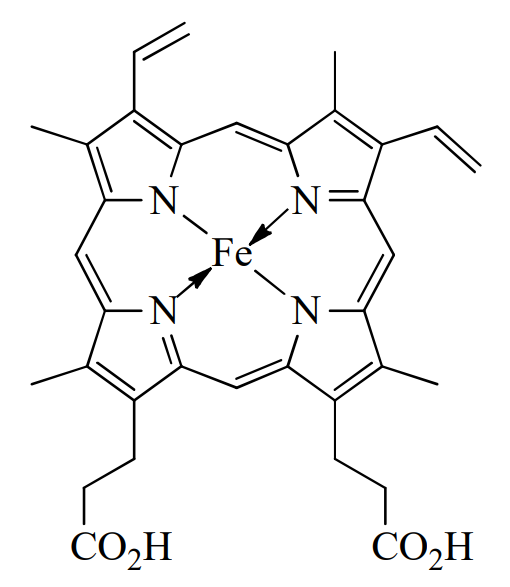
P450 enzyme a) catalyst type and b) reaction equation
a) monooxygenase
b) R−H + O2 + 2e− + 2H+ →R−OH + H2O
P450 physiological functions (4)
Steroid hormone synthesis
Secondary metabolites in plants
Growth of microorganisms on inert substrates
Metabolism of drugs in humans
P450 radical rebound mechanism
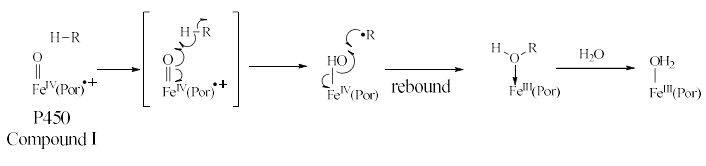
Expanded spectrochemical series (π donors &π acceptors)
I- < Br- < S2– < SCN– < Cl- < NO3- < F- < OH- < C2O42- < OH2 < NCS- < CH3CN < py < NH3 < en < bipy < phen < NO2- < PPh3 < CN- < CO
strong field ligands have increased sterics or has C or N donor (EXCEPT NO3- and C2O42- )
TRUE OR FALSE: All π acceptors are also σ donors
TRUE, BUT all ligands in spectrochemical species are σ donors
What effect do π donors have on a) ΔOh and b) bonding character of t2g orbitals?
a) decrease (TIP: donor decrease)
b) slight antibonding
What effect do π acceptors have on a) ΔOh and b) bonding character of t2g orbitals?
a) increase
b) slightly bonding
What ligands generally stabilise low oxidation states and why?
good π acceptors; back-donation is more significant due to closer energy match of the metal orbital and ligand π* orbitals
Redox potentials are proportional to free energy changes, which include entropy terms contributed to by the degree of ordered solvent around the complex.
Based on this, how does changing charge for a complex impact red/ox favourability?
The further the charge is from 0, more interaction with solvent→ more ordering of solvent→ more negative ΔS→ positive ΔGo→ negative Eo → more favoured higher oxidation state
Important fuels for biological energy generation
fats
sugars
H2
Chemiosmotic theory
The energy from electron transfer is used to pump H+ from the matrix into the intermembrane space to sustain a transmembrane proton gradient
Electron transport chain (5 steps/reactions/enzymes)
NADH dehydrogenase: NADH → NAD+ + H+
NADH dehydrogenase: succinate → fumarate + H+
Cyt c ubiquinone oxidoreductase: e- from Q + cyt c
cyt c oxidase: e- + O2 → H2O + H+
ATP synthase: MgADP + Pi —H+(out→in)→ MgATP
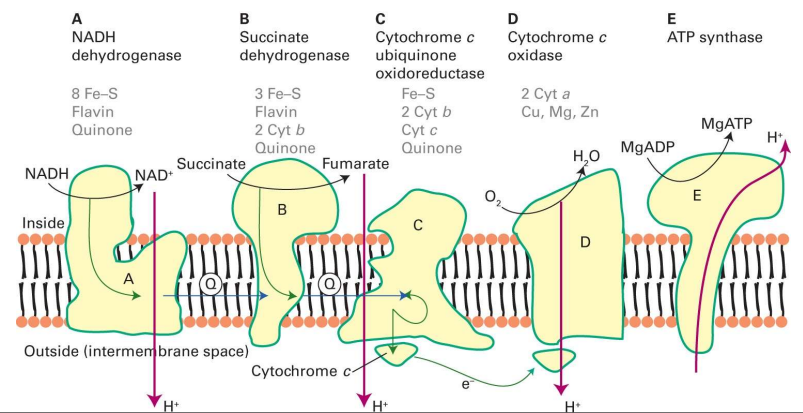
What cofactors does NADH dehydrogenase have? (3)
8 Fe-S clusters
flavin
quinone
What cofactors does succinate dehydrogenase have? (4)
3 Fe-S clusters
flavin
quinone
2 Cyt b
What cofactors does Cyt c ubiquinone oxidoreductase have? (4)
Fe-S cluster
quinone
2 Cyt b
Cyt c
What cofactors does Cyt c oxidase have? (4)
2 Cyt a
Mg
Zn
Cu
Structures /reaction of NAD+ → NADH

How can FMN/ FAD act as electron transfer agents?
become FMNH2 / FADH2 which can accept and transfer individually 1 or 2 electrons

Structures /reaction of quinone electron transfer
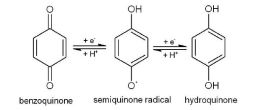
What redox couple in what spin states do cyctochromes use?
Fe(II)/ Fe(III), both low spin
What is a benefit in the cytochromes’ redox couples?
No change in the eg population upon redox therefore low reorganisation energy
What is the structure of a) general cytochromes and b) mitochondrial Cyt c?
a) 6 coordinate Fe, to haem and 2 axial amino acids which tune redox potential
b) His + Met axial
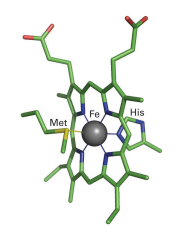
How does the structure of cytochrome favour electron transfer?
the t2g metal orbitals overlap with π* orbitals of extended π system of porphyrin ring so are delocalizsed to the edge, decreasing the distance over which an electron must travel; edge of the porphyrin ring is exposed to solvent and this is the most likely site for electron interaction
a) structure of Type 1 Cu Center and b) what this means
a) Cu(I)/ (II) coordinated to 2 His and 1-2 cysteine, with 2 longer axial bonds to ligands, attached to end of β sheet barrel
b) Reduced/oxidized/no-Cu environments are very similar so there is little reorganization
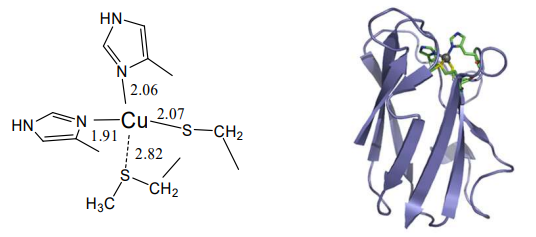
Preferred coordination and ligands for a) Cu(I) and b) Cu(II) in copper electron centre
a) tetrahedral; S binding
b) planar Jahn-Teller distroted; O and N binding
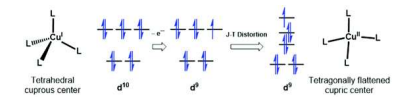
a) What is an entatic state and b) why is/ isn’t the Copper site in Cu Type 1 centres one?
a) a state of an atom or group which, due to its binding in a protein, has its geometric or electronic condition adapted for function
b) it is distorted tetrahedral, with two N ligands (His) and two S ligands from (Met/ Cys), giving it the intermediate configuration preferred by red/ox’d Cu; it is entatic
TRUE OR FALSE: molecules can only bind to proteins folded into their active conformation
FALSE: For instance, Ca binding to Calmodulin changes structure to active
What kind of Copper electron centre is the one in Cyt c oxidase?
CuA

How does the structure of CuA centres contribute to function?
Undergoes a 1 e- oxidation where the unpaired electron is shared between the two Cu centres; Delocalization lowers the reorganisation energy
The types of Fe-S clusters (3)

Fe-S clusters carry out (__) electron transfer
Fe-S clusters carry out single electron transfer
Why are Fe-S clusters effective for electron transfer? (4)
can delocalize electrons; lower reorganization energy
Fe shielded from solvent; lower reorganization energy
Fe tetrahedral/ high spin; e- transfer from the lower energy/ non-bonding e orbitals (Fe+ / 2+)
S ligands; good lead in groups because of large S2- orbitals good overlap
Are Fe-S clusters usually good reducing or oxidizing agents?
reducing (reduction potentials negative; get oxidized)
What oxidation states do the 3 main Fe-S complexes operate under?
S= 0/ 0.5/ 2 indicates spin state
remember the S ligands give -2 each

What is an exception to the typical redox participation of Fe-S clusters? (2)
[4Fe-4S] HiPIP clusters: +3 and +2 oxidation states, Eo= 0.35 V
Rieske centres: stabilizes Fe2+, Eo= >0.2 V
Rieske centres
[2Fe-2S] with SR (Cys) replaced by neutral imidazole (His) on one Fe
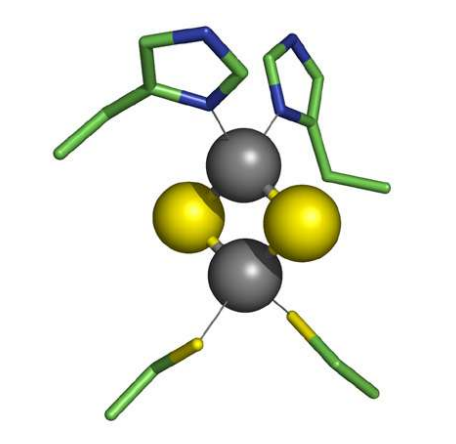
How Fe-S clusters located in hydrogenase enzymes and why?
electrons transferred along a chain of Fe-S clusters to the active site hidden inside to protect from inactivating agents
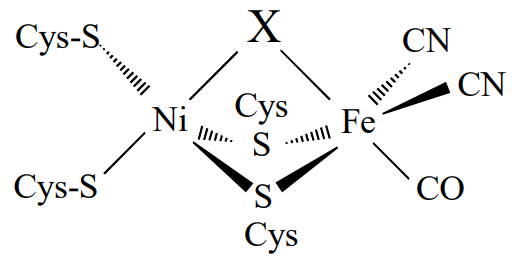
Active site of hydrogenase
Cytochrome c oxidase reaction
4 Fe2+ (cyt c) + 8 H+inside + O2 → 4 Fe3+(cyt c) + 2 H2O + 4 H+out
Cytochrome c oxidase movement of electrons
2 e- from 2x cytochrome c (4 e- total)→ CuA→ haem-a→ heme-a3 + CuB binuclear centre
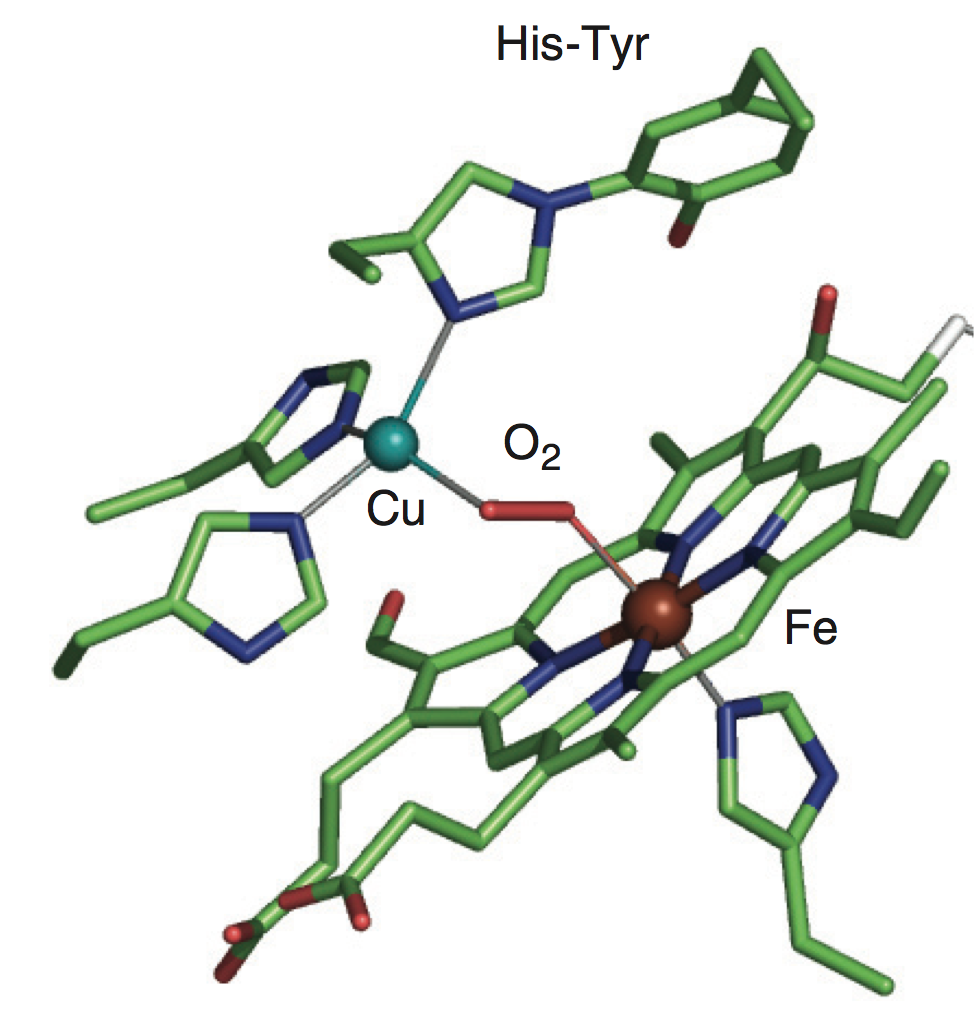
What is the structure of the binuclear active site in cyt c oxidase?
(porphyrin ring)(His)Fe-O2-Cu(His)2(His-Tyr)
To keep the reorganization energy of the systems low the proteins provide…
a ligand environment that does not alter significantly when an electron is added or removed and is shielded from the environment
Rank the metal centres from most negative reduction potential (hardest to reduce) to highest and justify
Fe-S < cytochrome < Cu
most to least number of stabilizing negative ligands

What process do electrons experience in NADH dehydrogenase?
Q catalyses donation of 2e- from NADH to FMN, to Fe-S cluster sequence
What thermodynamically drives electron transfer in NADH dehydrogenase?
increasing favourability of electron transfer to the next cluster with more positive redox potential
Besides electron transfer what does NADH dehydrogenase mediate?
release of 4 H+ into intermembrane space
What process do electrons experience in succinate dehydrogenase?
CAC; succinate→ FAD→ Fe-S clusters→ Q
What are the types of Fe-S complexes in ETC assemblies 1-3?
[2Fe-2S], [4Fe-4S]
[2Fe-2S], [3Fe-4S], [4Fe-4S]
Rieske
What is coenzyme Q?
ubiquinol
What process do electrons experience in cyt c oxidoreductase? (2)
1st e-: Q (at Qo site)→ bL haem → bH haem→ Q (at QI site)→ Qo site; cyclic
2nd e-: Rieske Fe-S→ cyt c1→ external cyt c (→ dissociates)
What processes occur in cyt c oxidoreductase to return it to initial state? (2)
Rieske Fe-S reoxidized, releases H+
Reduced external cytochrome c is reoxidized by complex IV