Energy Revision
0.0(0)
Studied by 10 people Call Kai
 Learn
 Practice Test
 Spaced Repetition
 Match
 Flashcards
 Knowt Play
Card Sorting
1/44

Earn XP
Description and Tags
45 Terms
1
New cards
Name types of batteries mentioned in the course
Lead Acid, Lead Crystal, Li-ion, Tesla Powerpack, Vanadium Redox, PSB, NaS
2
New cards
How do batteries work?
Batteries are devices which store chemical energy. The chemical reactions involve the flow of electrons from one material to another. This flow of electrons creates an electric current which may be used to do work.
3
New cards
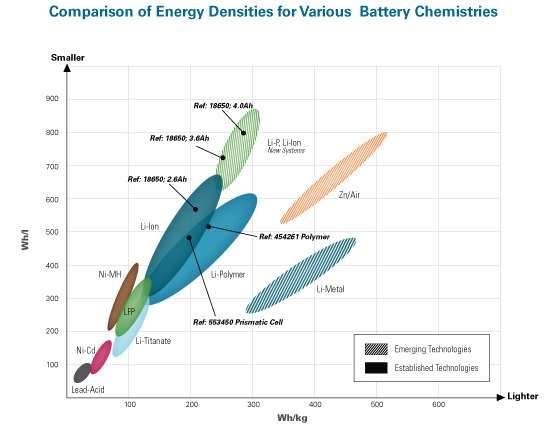
Rank pumped hydro, li-ion, Lead acid from highest to lowest power and energy storage.
Li-ion, Lead acid, Pumped
4
New cards
How has the role of DSM changed in the last 40 years
Originally it was meant for
* Dealing with demand variation
* Deferring investment
* Implemented strategies such as
* Load shifting
* Peak clipping
* Valley filling
Now is used for
* Variations caused by demand
* Renewable generation intermittency
* Deferring investment
* Implements new strategies such as
* Strategic load growth
* Strategic conversion
5
New cards
What is Clark Gelling’s definition of DSM
“A deliberate intervention by the utility in the marketplace so as to change he configuration or magnitude of the load shape.”
6
New cards
What is Palensky & Dieritch’s definition of DSM
“DSM is a portfolio of measures to improve the energy system at the side of consumption. It ranges from improving energy efficiency by using better materials, over smart tariffs with incentives for certain consumption patterns, up to sophisticated real-time control of distributed resources.”
7
New cards
What is LCoE
Levelized Cost of Electricity (LCOE) is an economic measure used to compare the lifetime costs of generating electricity across various generation technologies.
8
New cards
What factors change LCoE
* Higher energy outputs
* Higher capacity factors
* Windier locations will be higher
* Depends on marginal generator
* Discount rate
* Higher capacity factors
* Windier locations will be higher
* Depends on marginal generator
* Discount rate
9
New cards
Types of DSM strategies
* Reducing loads on request
* Fuel switching
* Distributed generation
* Pricing initiatives
* actions on customer side
* Power factor correction
* Fuel switching
* Distributed generation
* Pricing initiatives
* actions on customer side
* Power factor correction
10
New cards
What are some Solar PV materials
* Crystalline Silicon
* GaAs
* Thin Film - non-crystalline Si
* Dye sensitized cells - Titanium Oxide
* Perovskite Solar Cells
* Amorphous Si
* GaAs
* Thin Film - non-crystalline Si
* Dye sensitized cells - Titanium Oxide
* Perovskite Solar Cells
* Amorphous Si
11
New cards
What are the advantages of Crystalline Silicon cells
* Very efficient \~20%
* Long lasting, Usually 30 years
* Minimal losses, \~1% per year
* Resistant to breakage
* non-toxic
* cost of silicon decreasing
* Long lasting, Usually 30 years
* Minimal losses, \~1% per year
* Resistant to breakage
* non-toxic
* cost of silicon decreasing
12
New cards
How does a nuclear reactor work
Water in in the core is heated by nuclear fission, nuclear fission occurs when a neutron collides with a reactant atom (Typically uranium-235) and splits it. This then releases more neutrons and energy in the form of heat (E=mc^2), these released neutrons collide with more atoms creating a chain reaction. The heated water is pumped into a heat exchanger which is used to heat a separate water source producing steam. The steam then goes on to rotates a turbine while the core water is recycled to reheat the process.
13
New cards
What’s the main difference between a uranium and thorium reactor
Like uranium, thorium is also able to absorb neutrons producing heat, although unlike uranium thorium is unable to produce more neutrons to carry on the reaction. There has to be a continuous stream of neutrons in order to carry on the reaction meaning that the reaction is limited by the thorium itself. As Thorium is ‘fertile’ but not fissile it has to be used in combination with a fissile material like plutonium in order to maintain the chain reaction.
14
New cards
How can hydro-power technologies be used for generation and storage
Hydro-power is able to be used for both electricity generation and energy storage. When it comes to energy generation there’s various methods to achieve this such as RoR schemes which use turbines to take advantage of a river’s flow there is also Pumped Storage hydropower where water is stored in a reservoir where the gravitational energy can be used in times of high demand to produce electricity through the use of a turbine at the end of a penstock and in times of low demand the water can then be pumped back into the reservoir.
15
New cards
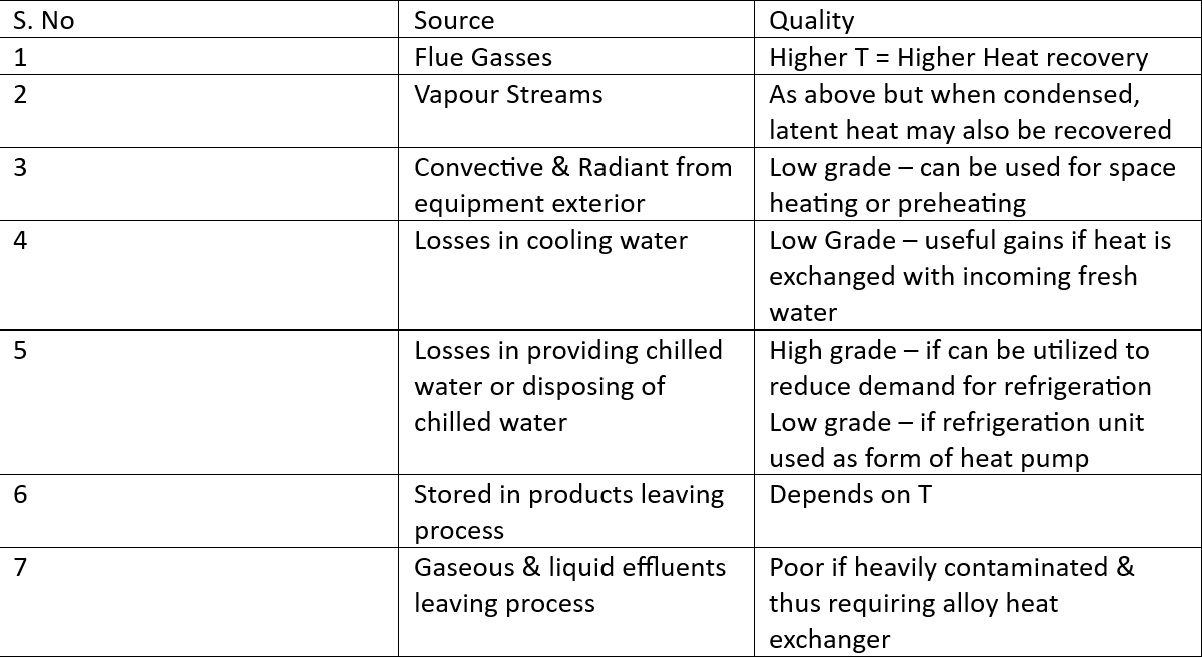
What are some sources of waste heat and their quality
16
New cards
What are the CO2 emissions of a wind turbine compared to fossil fuels
* About 1% of coal’s (per unit of electricity)
* About 2% of natural gas’ (per unit of electricity)
* Can’t produce electricity all the time
* Multiple sites reduce variability
* Electricity required to run
* Back-up required as can’t always meet demand
* Extra fossil fuel generation not needed when new turbines made
* Offset carbon emissions by fossil fuels
17
New cards
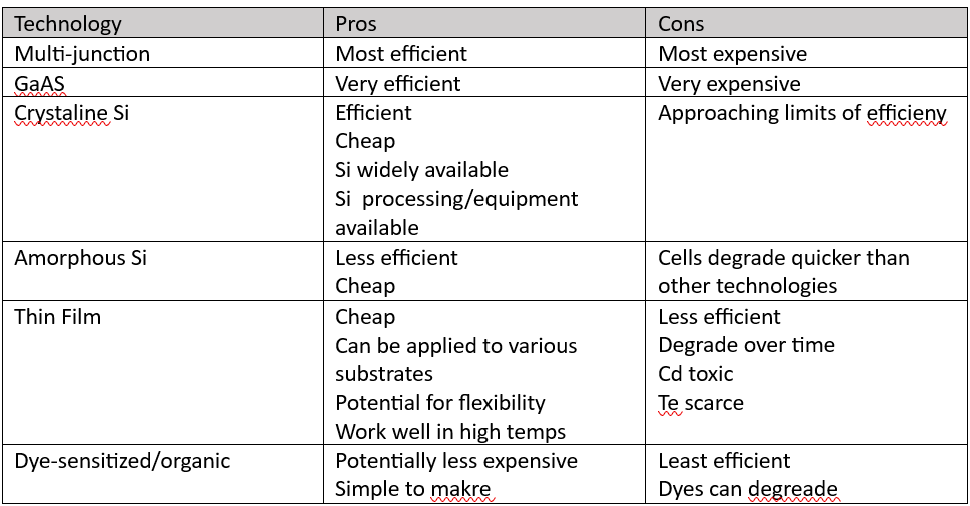
Name Solar PV technologies along with their pros and cons
18
New cards
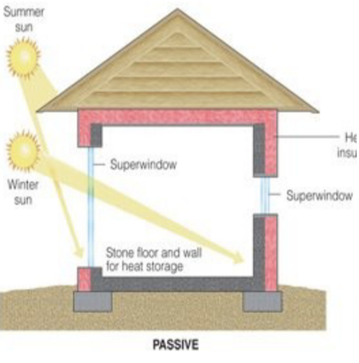
Draw a diagram of a passive solar thermal system
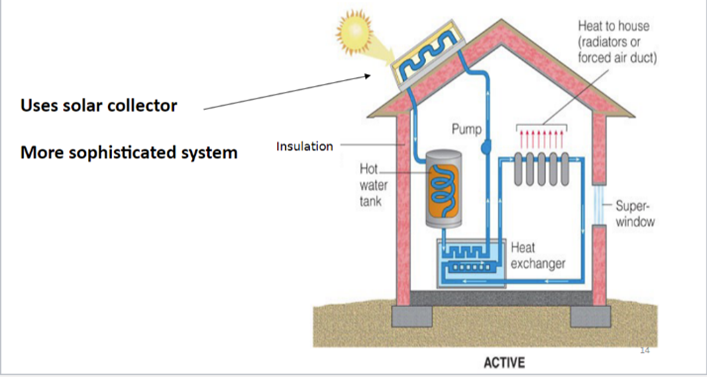
19
New cards
Draw a diagram of an active solar thermal system
20
New cards
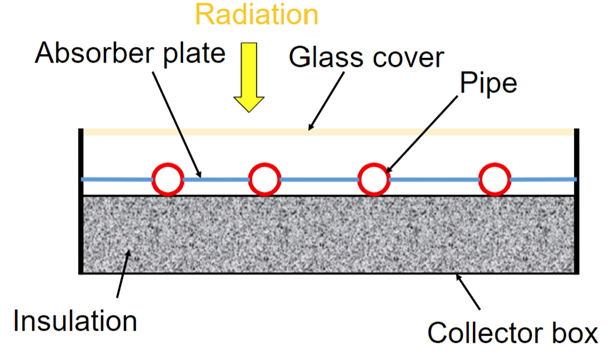
Draw a cross section of a flat plate collector
21
New cards
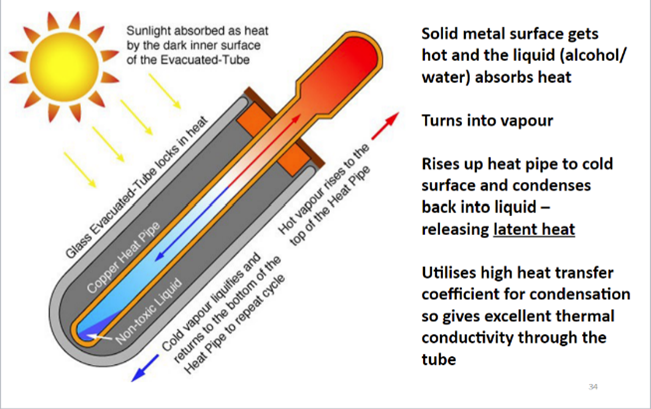
Draw a cross-section for an evacuated tube solar collector
22
New cards
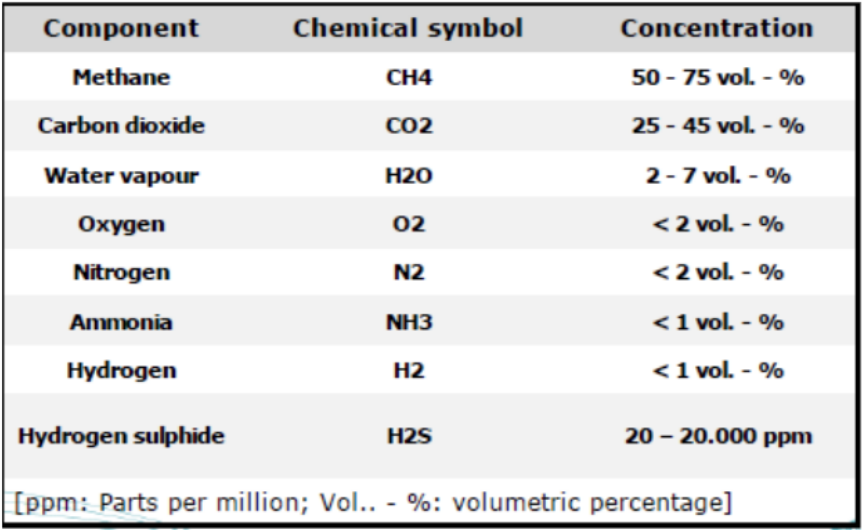
What are some examples of bio-energy sources
Solid bio-fuel
* Wood chips
* Saw dust
* Bark fir
* Wheat
* Briquettes
* Agricultural/municipal waste
Liquid bio-fuels
* Bio-ethanol
* Bio-Diesel
Gasceous Bio-fuels
* Bio-gas
\
* Wood chips
* Saw dust
* Bark fir
* Wheat
* Briquettes
* Agricultural/municipal waste
Liquid bio-fuels
* Bio-ethanol
* Bio-Diesel
Gasceous Bio-fuels
* Bio-gas
\
23
New cards
What are fuel cells?
Fuel cells are a device that uses a fuel(usually hydrogen) and oxygen to produce electricity through an electrochemical process known as reverse electrolysis.
24
New cards
What are the pros and cons of hydrogen fuel cells
__Pros__
* Very efficient
* Theoretical max \~ 83%
* Clean energy
* Versatile
* Quiet and no moving parts
* High energy density
__Cons__
* Hydrogen extraction required
* Cost of raw materials
* Complex storage requirements
* Hydrogen is highly flammable and explosive
* Very efficient
* Theoretical max \~ 83%
* Clean energy
* Versatile
* Quiet and no moving parts
* High energy density
__Cons__
* Hydrogen extraction required
* Cost of raw materials
* Complex storage requirements
* Hydrogen is highly flammable and explosive
25
New cards
How do fuel cells work?
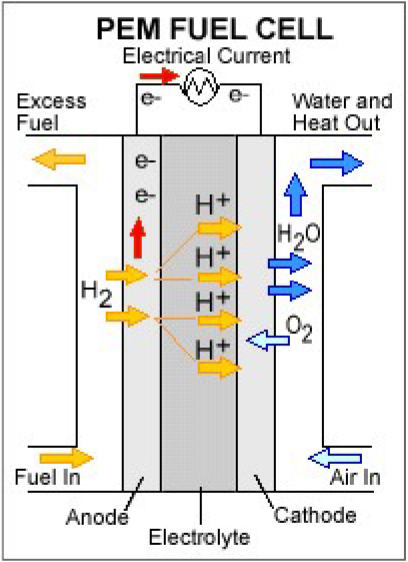
* The electrolysis process works by using DC electricity through an anode and a cathode to split water into hydrogen and water.
* Reversing this process, by combining hydrogen and oxygen electricity can be produced with water and heat also being by-products of the reaction
* This is done by pumping hydrogen gas into the anode which then strikes the catalyst which then splits the hydrogen into electrons and protons.
* On the opposite side oxygen enters the cathode.
* There is an electrolyte between the anode and cathode which allows protons to pass through but not electrons which are forced to flow into an external circuit.
* At the cathode the hydrogen protons and electrons then combine to form water.
26
New cards
What are the pros and cons of geothermal energy
__Pros__
* Renewable
* Environmentally friendly
* Large potential
* Can be used for heating and cooling
* More reliable than wind and solar
* No fuel required
__Cons__
* Limited locations available
* Large amounts of geothermal energy needed
* Such as between tectonic plates
* May trigger earthquakes
* High costs
27
New cards
What factors affect a solar flat plate collectors efficiency
* Heat removal factor
* Effective transmittance-absorbance product
* Heat loss coefficient
* Collector area
* Irradiance
* Effective transmittance-absorbance product
* Heat loss coefficient
* Collector area
* Irradiance

28
New cards
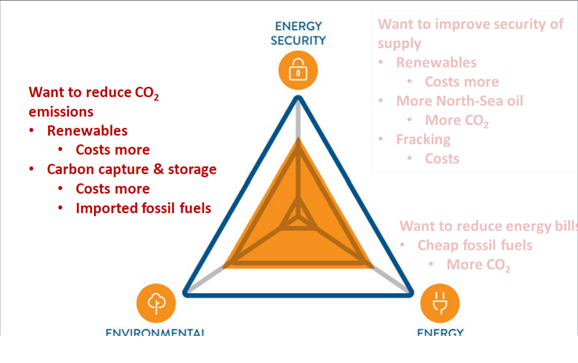
What is the energy trilemma
* Ranks countries based on ability to provide sustainable energy
* Measures overall performance across the three areas, A is the highest ranking
* Measures overall performance across the three areas, A is the highest ranking
29
New cards
How do wind turbines work?
Wind turbines harness kinetic energy from the wind, the amount of this is determined by the mass and velocity of the air. The wind rotated the blades of the turbine which converts the kinetic energy in the atmosphere into useable electrical energy through the use of a generator.
30
New cards
What incentives are there to use wind energy
* Improvements in wind energy technologies
* Higher efficiencies
* More cost-effective
* Government incentives
* Sustainability
* Greater desire for clean and sustainable energy
* Low carbon emissions
* Decreasing costs
* Can be used on small or large scale to provide energy especially in areas with limited resources
* Higher efficiencies
* More cost-effective
* Government incentives
* Sustainability
* Greater desire for clean and sustainable energy
* Low carbon emissions
* Decreasing costs
* Can be used on small or large scale to provide energy especially in areas with limited resources
31
New cards
Why is geothermal considered renewable
Geothermal energy is considered renewable as the earth still contains heat from when it formed due to its hot core and molten layers
* Water can be used to make use of this heat
* When heat is extracted from water it can be pumped ack to gather more heat form the earth
* Water can be used to make use of this heat
* When heat is extracted from water it can be pumped ack to gather more heat form the earth
32
New cards
What are advantages of carbon based fuels?
* Transportable
* Storable
* Well-developed technologically
* Energy dense
* Storable
* Well-developed technologically
* Energy dense
33
New cards
What causes wind?
* Temperature differentials predominately caused by uneven solar heating
* High temp air is less dense than cool air
* High temp air is less dense than cool air
34
New cards
What major issues restrict the development of wind energy?
* Lack of robust technical information
* Environmental concerns such as noise, shadows, wildlife, etc…
* Financial incentives are often not enough
* Poor grid access provided
* Environmental concerns such as noise, shadows, wildlife, etc…
* Financial incentives are often not enough
* Poor grid access provided
35
New cards
What are the pros and cons of tidal flow power?
__Pros__
* Generation is predictable
* Good potential
* Little visual impact
__Cons__
* Many engineering challenges
* Generation is predictable
* Good potential
* Little visual impact
__Cons__
* Many engineering challenges
36
New cards
What are the time periods of a one-way and a two-way turbine
* \~6.2 hrs (two-way)
* \~12.4 hrs (one-way)
* \~12.4 hrs (one-way)
37
New cards
How does a PN junction circuit work?
* contains p-type and n-type semiconductors
* light hits the n-type releasing an electron
* the free to move electron travels through the n-type to metal contacts on the surface
* electron flows through the metal contact creating an electric circuit to meet with a ‘hole’ at the rear contact
* holes travel in the opposite direction through the p-type
38
New cards
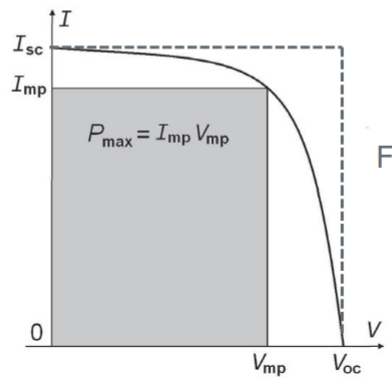
Draw an I-V curve for a PV cell
39
New cards
What is the main process plants undergo to derive energy?
Photosynthesis
40
New cards
What are different solid biomass conversion technologies
* Gasification
* Pyrolysis
* Anaerobic Digestion
* Combustion/Incineration
* Pyrolysis
* Anaerobic Digestion
* Combustion/Incineration
41
New cards
How can bio-ethanol and bio-diesel be made
* Fermentation of glucose, cellulose and starchy plants (bio-ethanol)
* Transesterification of vegetable oil (bio-diesel)
* Transesterification of vegetable oil (bio-diesel)
42
New cards
What are pros and cons of bio-energy?
__Pros__
* Can be carbon neutral
* Can be harvested in liquid form for transport applications
* Large choice of biomass materials that can be \n matched with local climate
* Sustainable energy source (replenishment from Sun)
* Security of supply
* Waste materials can be used
* By-product of some processes is fertilizer
__Cons__
* Low energy per unit area
* Social impact of replacing good food producing land with energy crops
* Only viable as a component of an overall energy delivery system
* There are some often some emissions, but reductions in CO2 emissions relative to fossil \n fuels
* Deforestation
43
New cards
What are the pros and cons of nuclear power?
__Pros__
* Nuclear power costs about the same as coal
* Does not produce smoke or carbon dioxide, so it does not contribute to the greenhouse effect.
* Produces large amounts of energy from small amounts of fuel.
* Produces small amounts of waste.
* Can be used as base load.
__Cons__
* Waste
* small quantities, but dangerous!
* difficult and expensive to handle
* must be sealed up and buried
* A lot of money has to be spent on safety - if it does go wrong, a nuclear accident can be a major disaster
* It is claimed that the Chernobyl accident cost US$ 235 billions over \n 30 years (the value of world nuclear energy in one year!)
* Not a single Nuclear power plant has been finished in time or on \n budget so far
44
New cards
What is waste heat?
* “Dumped” heat that can be reused
* Quality more important than quantity
* Method of saving fuel
* Quality more important than quantity
* Method of saving fuel
45
New cards
What is a heat pump?
Heat pumps are designed to move thermal energy opposite to the direction of spontaneous heat flow by absorbing hear from a cold space and releasing it to a warmer one