MSK Trauma
 Call Kai
 Learn
Learn Practice Test
 Spaced Repetition
 Match
Match Flashcards
 Knowt Play
1/29

There's no tags or description
Looks like no tags are added yet.
Name | Mastery | Learn | Test | Matching | Spaced | Call with Kai | Chat |
|---|
No analytics yet
Send a link to your students to track their progress
30 Terms
Trauma
External force applied to the body which results in an injury. This can be high energy or low energy.
Low energy trauma
Small external force applied to the body resulting in an injury.
High energy trauma
Large external force applied to the body resulting in an injury.
What is the leading cause of death and disability in the first four decades of life?
Trauma
What are the main causes of trauma?
Falls (70%)
Road traffic accidents (RTA - 15%)
Assault (5%)
Other (10%)
Fracture
Disruption in bone continuity
Dislocation
Complete loss of continuity of 2 bones forming a joint.
Subluxation
Partial loss of continuity of 2 bones forming a joint.
Comminution/complex fracture
A fracture with multiple fragments
Fracture dislocation
A dislocated joint with associated fracture
Intra-articular fracture
Fracture extends into a joint
Open fracture
A fracture where there is a direct route between the fracture and the external environment.
What causes a fracture?
Injury mechanism that exceeds max force the bone can withstand (abnormal force)
Co-morbidity that increases risk of fracture after injury (abnormal bone)
Co-morbidity that increases risk of trauma
What types of comorbidities increase risk of fracture?
Congenital conditions like osteogenesis imperfecta
Metabolic diseases like osteomalacia/rickets
Degenerative diseases like osteoporosis (most common)
Tumours
Examples of comorbidities that increase risk of trauma
Visual impairment
Alcohol/drug use
Neuropathy
Balance disorder
Epilepsy
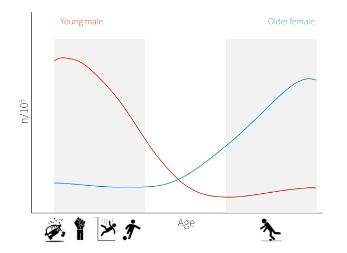
How is the line graph of fracture incidence against age described?
Bimodal distribution - 2 peaks
The first peak is mostly young males (increasing incidence in young women too), and the fractures are mostly high-energy (assault, falls >2m, RTC). Called unimodal young males.
The second peak is mostly made up of older females suffering low-energy fractures from falls (increased incidence in old males too). Called unimodal older females.
2 Main types of fracture pattern
Complete
Incomplete
Complete fractures
Fracture all the way through the bone
Incomplete fractures
The whole cortex is not broken (usually found in children).
Complete fracture patterns
Simple - less than 2 main fragments
Complex - more than 2 main fragments
Compression
Articular involvement: intra- and extra-
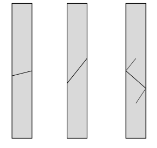
Types of simple fracture
Transverse (straight across)
Oblique (at an angle)
Spiral (goes in a helix around the bone)
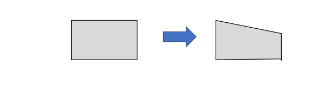
What type of fracture does this diagram of the vertebral body represent?
Wedge compression fracture
Intra-articular fractures
Goes into the joint surface
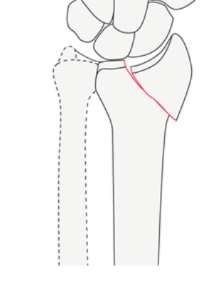
Extra-articular fractures
Does not go into the joint surface
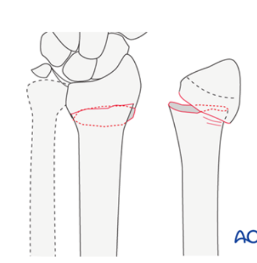
Why are untreated intra-articular fractures risky?
The fracture leads to a step in the cartilage of the articular surface, which leads to pain and destruction of the other side of the joint. It therefore must be reduced as much as possible.
How do we describe a fractures location on a long bone?
Epiphysis
Metaphysis
Diaphysis: this area is split into thirds and junctions (eg. proximal middle, distal third, junction of the middle and distal third…)
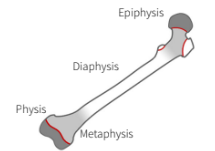
What is the primary investigation for trauma patients?
Radiographs
Why is it important to get a radiograph of a specific area, not just the whole limb, for example?
Beam divergence - X-rays come from a point source and spread out, hitting the detector plate much further apart than they started. This can lead to distortion at the edges of the image.
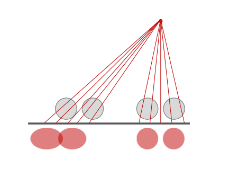
Why should 2 views be requested when getting radiographs done?
To ensure all pathologies are spotted. These radiographs should be 90 degrees to one another.
How to describe a radiograph
There is a displaced/undisplaced…
…fracture of the …(proximal/midshaft/distal)
…bone. (humerus, femur etc.)
Add in qualifiers eg. articular involvement, type of fracture, degree of displacement.