PBIO 2090 Plant Systematics - Major Angiosperm Groups & Families
 Call Kai
 Learn
 Practice Test
 Spaced Repetition
 Match
 Flashcards
 Knowt Play
1/37

Earn XP
Description and Tags
A set of vocabulary flashcards covering the major angiosperm evolutionary lineages, diagnostic morphological terms, and representative plant families for PBIO 2090 Plant Systematics.
38 Terms
Angiosperms
Flowering plants comprising approximately 350,000+ species, 420 families, and 62 orders
Differ from gymnosperms because they have carpels (their seeds are enclosed within a fruit)
Water Lilies, Magnolias, and Relatives
Not monocots or dicots - emerged earlier (basal angiosperms)
Not monophyletic
Generally similar in morphology; mostly tropical and relatively species-poor
Number of floral parts is variable; flower whorls often poorly differentiated
Floral parts often arranged in spirals rather than distinct whorls
Flowers often have strong odors
Examples: water lilies, wild ginger, avocados (magnolia relative)

Monocots
Monophyletic
One cotyledon (first leaf)
Parallel leaf venation
Floral parts usually in multiples of three
Never woody
Important groups include: Juncaceae (rushes), Cyperaceae (sedges), Poaceae (grasses), lilies and relatives, and orchids

Dicots: Rosids & Asterids
Dicots generally have:
Netted leaf venation
Floral parts in multiples of 4-5
Includes Rosids and Asterids

Rosids
Dicots
Petals unfused
Stamens usually more numerous than petals and not adnately fused to them
Carpel #: 3-5
Examples: Rosaceae (roses), Fabaceae (peas), Brassicaceae (mustard), Onagraceae (evening primrose), Ranunculaceae (buttercups), Vitaceae (grapes)

Asterids
Dicots
Fused petals (connate)
Stamens equal to or less numerous than petals and adnately fused to them
Carpel #: usually 2
Examples: Lamiaceae (mint), Plantaginaceae (snapdragon), Asteraceae (asters), Caryophyllaceae (carnation), Polygonaceae (knotweed)

Floral Formula
Shorthand method used to communicate flower structure
Numbers of floral organs
Ca: calyx (sepals)
Co: corolla (petals)
*P: can be used when sepals and petals are indistinguishable from one another (tepals)*
A: androecium (male - stamens)
G: gynoecium (female - pistils)
Fusion of parts: circled/a semicircle drawn between (dotted: partial or weak fusion)
Floral symmetry: a z or a next to the Co - acintomorphic or zygomorphic
Ovary position: line below = superior, line above = inferior
Graminoid Monocots
A descriptive term meaning 'grass-like,'
Includes 3 important families: Juncaceae (rushes), Cyperaceae (sedges), and Poaceae (grasses)
Flowers: small, reduced, and wind-pollinated
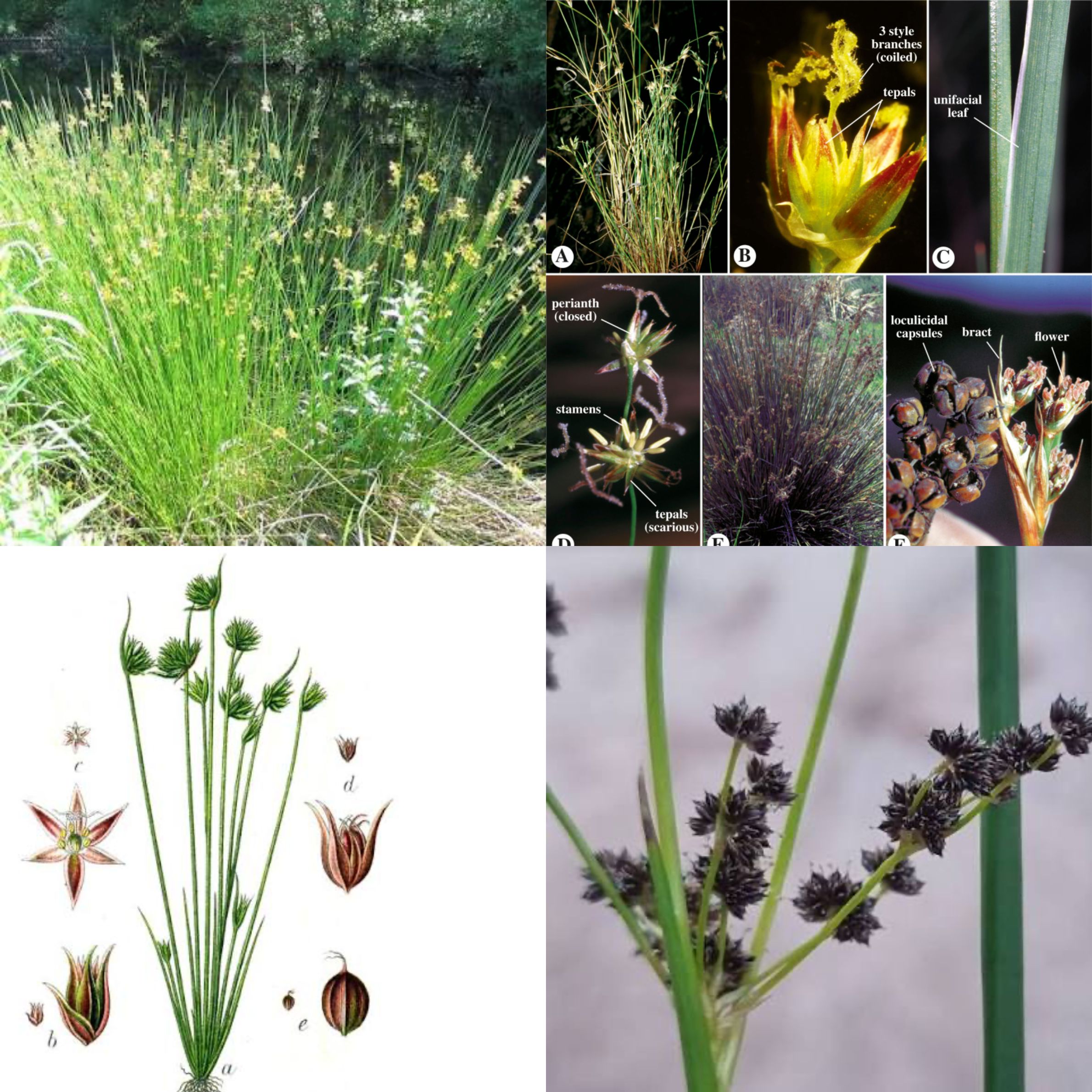
Juncaceae
Rush family
Herbaceous: often rhizomatous and clump-forming
Round stems that are often partitioned and hollow
Leaves: usually basal and round in cross section
Inflorescence: congested cyme (determinate inflorescence, oldest flower at the tip, flat-topped, sort of like an umbel)
Flowers are small, wind-pollinated, usually 3-merous, radial, bisexual
Fruit: capsule
“Rushes are round”
Examples: Juncus, Luzula
Cyperaceae
Sedge family
Herbaceous: sometimes rhizometous
Triangular stems that are solid
Leaves: in 3 ranks, leaf sheaths closed
Flowers: highly reduced, one scale-like bract below each flower, perianth absent or hair-like (stamens and pistils)
Often monoecious
Fruit: achene
“Sedges have edges”
Examples: Cyperus (paper - in VT), Schoneoplectus (sedge islands in Peru + Bolivia)

Poaceae
Grass Family
Herbaceous, stem internodes often hollow
Leaves in 2 ranks, leaf sheaths open, leaves have ligules (flaps of tissue or hairs)
Inflorescence: composed of spikelets, arranged in spikes or panicles
Spikelet: one or more flowers plus associated bracts
Glumes: bracts at the base of a spikelet, lemma and pale = bracts associated with each flower
Floret: one flower together with it’s lemma and pale, lodicules are highly reduced in perianth structures
Flowers: usually perfect, typically with 3 stamens and 2 carpels
Fruit: caryopsis (achene of grasses)
“Grasses have lashes”

Ligule
A flap of tissue or hairs located at the junction of the leaf sheath and blade in Poaceae.

Spikelet
The characteristic inflorescence unit in Poaceae, composed of one or more flowers together with associated bracts.
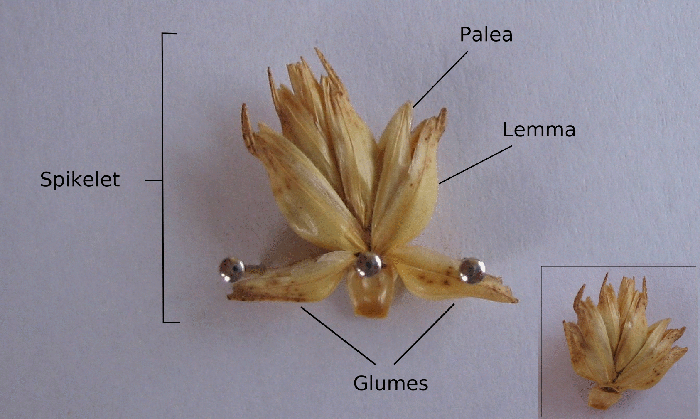
Glumes
The sterile bracts found at the base of a grass spikelet.
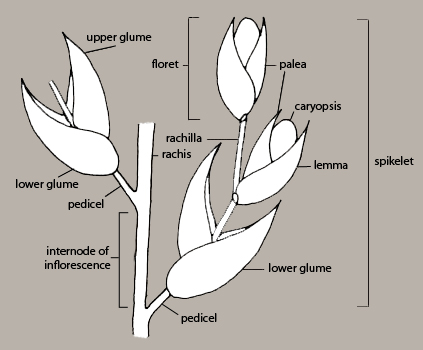
Lemma and palea
The specific bracts associated with each individual flower in a grass spikelet.

Floret
An individual grass flower together with its surrounding lemma and palea.

Lodicules
Highly reduced perianth structures present in the flowers of Poaceae.

Caryopsis
The specialized dry, single-seeded grain fruit characteristic of Poaceae.

Ranunculaceae
Fringe Rosid
Buttercup Family
Herbaceous, some vines
Leaves: variable, alternate or opposite, simple or divided
Inflorescence: cyme or flowers solitary
Flowers: large and radial
Perianth: often petal-like tepals, sometimes sepals and petals distinct
Many stamens and usually many simple pistils
Fruits: usually aggregate fruits of achenes or follicles
Examples: Black Hellebore (not white which is Melanthiaceae, a monocot, black is poisonous), Thalictrum, Elematis, Caltha

Vitaceae
Fringe Rosid
Grape Family
Leaves: alternate, usually palmately lobed or compound, sometimes pinnately divided
Tendrils positioned opposite the leaves
Inflorescence: a cyme, positioned opposite leaves
Flowers: small and radial, 2 fused carpels, ovary superior
Often monoecious
Sepals inconspicuous, petals often fall off as the flower opens, sometimes fused at their tips
Fruit: a berry, 2 seeds per local, usually 4 per berry, seeds have a raphe (raised line)
Examples: Virginia Creeper, River-Grape

Raphe
A distinctive raised line on the seeds of plants in the grape family (Vitaceae).

Rosaceae
Rosid
Rose Family
Herbs, shrubs, and trees
Leaves: usually alternate, simple or pinnately divided
Stipules present, often adnate to the petiole
Flowers: usually in racemes, often large, radial, and 5-merous
Hypanthium present, many stamens, 5-many carpels
Fruit: diverse, includes aggregate fruits (blackberry), achenes (strawberries), follicles (meadowsweet), drupes (raspberry), and accessory fruits (strawberry again), accessory fruits may evolve an enlarged hypanthium or receptacle
Apoximis: seed production without fertilization, generations are genetically identical, similar-looking but evolutionary distinct lineages that do not interbreed create taxonomic changes
Examples: Hawthorn, Rubus, Prunus (cherries)

Hypanthium
A floral cup or tube formed by the fused bases of the sepals, petals, and stamens, prominent in families like Rosaceae and Onagraceae.
Apomixis
The process of asexual seed production without fertilization, resulting in genetically identical generations and taxonomic complexity in Rosaceae.
Fabaceae
Rosid
Pea Family
Usually vines, shrubs, or trees, mostly trees in VT
Leaves: alternate, usually pinnately compound, stipules present, leaflets may be modified into tendrils
Flowers: faboid flowers are 5-merous and bilaterally symmetrical, 5 petals = 1 banner, 2 wings, and 2 keel petals, 10 stamens
Fruits: legume or loment
Nitrogen fixation: bacteria in root nodules convert nitrogen gas into ammonia usable by the plant, the plant supplies organic acids to the bacteria, helps the plant grow in nitrogen-poor soils
Examples: Hogpeanut, Clovers, Lathyrus (rare pea plant found in VT)

Loment
A specialized fruit of the Fabaceae family that breaks apart transversely into single-seeded segments.
Brassicaceae
Rosid
Mustard Family
Herbaceous
Leaves: alternate, often with basal leaves, simple and sometimes lobed, stipules absent
Mustard oils contribute to strong taste or smell
Flowers: usually in racemes, small to medium, often yellow or white, radial, 4-merous, 2 carpels, ovary superior
Tetradynamous stamens: 6 total, 2 shorter outer stamens and 4 longer inner stamens plants
Fruit: silique or silica, a specialized capsule containing 2 locules, contain a replum = thin membrane separating the locules, formed from the placenta and persisting after dehiscence
Examples: Broccoli, Kale< mustard, Radishes
Tetradynamous
A stamen arrangement featuring six stamens total: two short outer stamens and four long inner stamens, characteristic of Brassicaceae.
Replum
A persistent thin placental membrane that separates the two locules after fruit dehiscence in Brassicaceae.
Onagraceae
Rosid
Evening Primrose Family
Herbs and shrubs, herbs in VT
Leaves: alternate or opposite, simple, stipules absent or very small, often hairy
Flowers: usually in racemes, 4-merous, usually radial, reflexed sepals, yellow or pink
Large elongated hypanthium, ovary inferior , 4 carpels
Fruit: usually a capsule
don’t really need to know
Betalains
Beet-red pigments that serve as a synapomorphy for the order Caryophyllales.
Caryophyllaceae
Carnation Family
Herbaceous
Leaves: opposite, simple, entire, nodes swollen
Inflorescence: cyme
Flowers: sepals usually fused, petal-like structures described in lectures are modified stamens, often with notched tips
2-5 carpels, ovary superior
Free-central placentation
Fruit: a capsule that opens by apical teeth
Examples: baby’s breath
Polygonaceae
Knotweed Family
Herbaceous
Leaves: alternate, simple, nodes swollen
Sheathing stipule: ocrea
Often contains oxalic acid, producing a sour taste
Inflorescence: raceme or spike
Flowers: small, sepals and petals approximately identical (tepals), wither 1 whorl of 5 tepals or 2 whorls of 3 tepals
Basal placentation
Fruit: winged achene
Lamiaceae
Mint Family
Herbaceous
Leaves: opposite, simple, entire
Stems: square, glandular hairs, foliage usually fragrant, often minty
Inflorescence: spike-like or axillary
Flowers: sepals fused, 5 petals connate into 2 lips, 4 didynamoous stamens (2 different lengths)
2 carpels, ovary superior, style gynobasic, gynoecium deeply 4-lobed
Fruit: usually a schizocarp, produces 4 nutlets
Examples: basil, rosemary, sage, oregano
Plantaginaceae
Snapdragon Family
Herbaceous
Leaves: opposite or alternate, simple, stems round
Inflorescence: variable,
Flowers: small to conspicuous, 4-5 sepals, connate, 5 petals forming 2 lips, usually 4 didynamous stamens, often an additional staminode
2 fused carpels, ovary superior
Fruit: many seeded capsule
Examples: foxgloves, snapdragons
Asterids: Vegetative Characteristics
herbs in VT, also shrubs and trees
leaves alternate, opposite, or whorled, usually simple and often hairy
plants often smell strongly due to terpenoids
Asterids: Reproductive Characteristics
Capitulum: many small flowers grouped together, surrounded by an involucar composed of bracts called phyllaries
Sepals are modified into a papas, which may consist of bristles, hairs, or awns
petals usually 5 and fused, symmetry varies, 5 stamens, filaments adnate to the corolla and anthers connate
2 carpels, basal placentation
Fruit: achene
Asterid: Flower Development
Stamens form a tube
Style and stigma push through the tube
Pollen is presented to pollinators
Stigma matures later