Biochem Unit 1 Exam
 Call Kai
 Learn
Learn Practice Test
 Spaced Repetition
 Match
Match Flashcards
 Knowt Play
1/116

There's no tags or description
Looks like no tags are added yet.
Name | Mastery | Learn | Test | Matching | Spaced | Call with Kai | Chat |
|---|
No analytics yet
Send a link to your students to track their progress
117 Terms
Gibbs Free Energy Equation AND units

How to go from J to kJ
J * 1000 = kJ
What is another name for dynamic hydrogen-bond network in liquid water?
Flickering
What happens in flickering with liquid water
Hydrogen bonds in liquid water are constantly forming and breaking, so measured distances reflect an average of many configurations
What drives the solubilization of a salt using Gibbs Free Energy?
Entropy (Delta S), of a salt increases more than delta S decreases for water
Do molecules with hydrogen bonds have higher or lower solubility in water than molecules without hydrogen bonds?
HIGHER because water mobility is higher around these molecules, that is hydrogen bonds on solute molecules allow water to rotate with small loss of entropy.
Total entropy (S) also increases within the solution
Does diluting the concentration of salt in a solution increase or decrease the entropy of the entire solution? How does osmotic pressure change?
INCREASES ENTROPY. The osmotic pressure is a force resulting from this favorable increase in entropy. Osmotic pressure DECREASES
What happens to the structural rearrangements (degrees of freedom) of hydrogen bonds when a hydrophobic molecule is present?
LOSE degrees of freedom
Is Urea soluble in water? Why?
Urea is VERY soluble because of the multiple hydrogen bonds it forms with water
Is Isobutene soluble in water? Why?
Isobutene is NOT soluble because water must form a structured cage around an area with no hydrogen bonds.
What are the important things to note about Non-polar molecules in Aqueous Environments? What drives droplet formation?
Hydrophobic molecules have weak molecule to molecule attractions (London dispersion, delta H), not enough to bring molecules together
Placing hydrophobic molecules together reduces the size of the water envelope (hydration sphere or cage), increasing entropy & pushes the hydrophobic molecules together
It is the increase of water mobility/entropy (delta S) that drives droplet formations
Adding any kind of molecule in water does what to the entropy of water?
DECREASES the entropy of water
How do you maximize the entropy of a system for polar and nonpolar molecules?
Polar/ionic solutes dissolve, increasing solute entropy that will make up for the decrease in water entropy
Water molecules form a structured “cage” around nonpolar molecules
What is the hydrophobic effect?
Hydrophobic molecules tend to aggregate in water to decrease the hydrophobic surface area exposed to water
What is the main driving force behind protein folding? How does the change in entropy for water compare to the change in entropy for the protein?
Maximizing the entropy of water (and thus entropy of the system). The entropy of water increases more than the entropy of the protein decreases
Where are hydrophobic residues inside a protein?
Hydrophobic residues are pushed inside
Within a protein during protein folding, what results in a decrease of enthalpy? How does it contribute to Delta G? Is it the main driving force of protein folding?
The formation of hydrogen bonds and Van der Waals interactions within the protein results in a decrease of enthalpy. It contributes to a NEGATIVE delta G, but it is not the main driving force
How does Urea/IPA denature proteins? What kind of effects does each mechanism have?
Direct: forms hydrogen bonds with residues, disrupting the intramolecular hydrogen bonds that hold the folded structure of the protein together. ENTHALPIC EFFECTS (H)
Indirect: reduces mobility of water molecules, weakening the hydrophobic effect. ENTROPIC EFFECTS (S)
What are the levels of protein strucutre?
Primary: the amino acid sequence
Secondary: α-helices and β-sheets
Tertiary: the complete folding of a singular peptide chain
Quaternary: multiple folded peptides assembled together
On pKa sheet, what is pKa 1?
C-terminus pKa
On pKa sheet, what is pKa 2?
N-terminus pKa
In what direction are proteins read
N-terminus to C-terminus
Are protonated acids neutral or positively charged?
Protonated acids are neutral
Are protonated bases neutral or positively charged?
Protonated bases are positively charges
What happens when pH > pKa
Deprotonated
Acids become negatively charged
Bases are neutral
Are deprotonated acids neutral or negatively charged?
Deprotonated acids become negatively charged
Are deprotonated bases neutral or negatively charged?
Deprotonated bases become neutral
In Henderson Hassel bach Equation (pH = pKa + log (A/HA), how do you what what is the base (top) and what is the acid (bottom)
Base (top) = one fewer H+
Acid (bottom) = one more H+
What is to note about Non-polar aliphatic R groups?
Glycine & proline are DISFAVORED in alpha helices.
Glycine is too flexible and proline is too constrained. Both usually cause a sharp kink in chain. Both Promote non-helical structures to form
Non-polar aliphatic amino acids participate in Vander-Waals interactions
What are Van der Waals interactions?
Weak, short-range attraction between uncharged atoms or molecules
What is to note about Aromatic R groups?
Prone to interact with hydrophobic things (tend to find in hydrophobic regions of proteins)
Pi-Pi stacking
What is to note about Polar Uncharged R groups?
Form hydrogen bonds, tend to be hydrophilic (find outside of proteins)
Cysteine can disulfide bond with other cysteines, creating a covalent bond intra OR intermolecularly
Carbonyl carbons (positive) are often targets of nucleophiles (nucleophile electron rich)
Serine & Threonine can be phosphorylated
What is to note about Charged R groups
Sensitive to pH & CAN be protonated
Have a lot of chemistry
What does pI stand for? What is it?
Iso electric point, the specific pH value where a molecule carries a net electrical charge of zero
In a titration curve, where is the pI?
The average of two pKa’s on either side of neutral species
What is a polymorphism
A change in a protein sequence
How are peptide bonds formed? Is it favorable?
Through condensation (aka dehydration) reactions.
One water molecule is lost from the two amino acids forming the peptide bond
Not favorable to release water, so the carboxyl end of the amino acid must be activated
Aminoacyl-tRNA stores energy in ester linkage, letting aminoacyl group to be transferred to the growing peptide
pH < pKa
Protonated
Acids = Neutral
Bases = Positive
pH = pKa
50% protonated, 50% deprotonated
Why is the mixed model the best for understanding protein denaturization?
A denaturant can simultaneously interact directly with the protein (delta H) and indirectly changing the water/solvent organization (delta S)
How is protein folding possible? What happens with and without chaperones?
Made possible by Brownian motion
Random vibration of molecules
Thermodynamic forces, hydrogen bonding, and Van der Waals let it push protein folding in a specific direction
Without help, proteins may be folded into a kinetically favored structure (higher energy state)
Chaperones help guide proteins to the most thermodynamically favored structure (lowest energy state)
In protein folding, is Kinetic or Thermodynamic faster? Which is more stable?
Kinetic = forms faster, but less stable (higher energy)
Thermodynamic = forms slower, but more stable (lower energy)
How are ɑ-helices formed?
i and i+3 have favorable interactions (opposite charges, hydrophobicity, etc) since there’s about 3.6 AAs/turn
Glycine and proline are NOT favored
The carbonyl oxygen (C=O) of one residue hydrogen-bonds with a backbone amino H farther along same polypeptide chain.
Most are right-handed (due to L amino acids)
How are β-sheets formed?
Every other amino acid (i and i+2) has favorable interactions
The carbonyl oxygen (C=O) of one residue hydrogen-bonds with a backbone amino H on an adjacent β-strand
N to C orientation can be same (parallel) or alternate (anti-parallel)
What is Induced fit for protein-ligand binding?
The ligand and protein BOTH change conformation when they bind, allowing tight and specific binding
What is Kd in protein-ligand binding?
Kd is the ligand concentration at which half of the binding sites on the protein are full.
How are Kd and the affinity of the protein for the ligand related?
Kd and the affinity of the protein for the ligand are inversely proportional
High Kd = Low affinity
Low Kd = High affinity
What is the structure of Hemoglobin?
Four subunits, all containing a porphyrin ring
Heme group is made up of porphyrin ring bound to Fe2+
Proximal histidine stabilizes heme (not pictured)
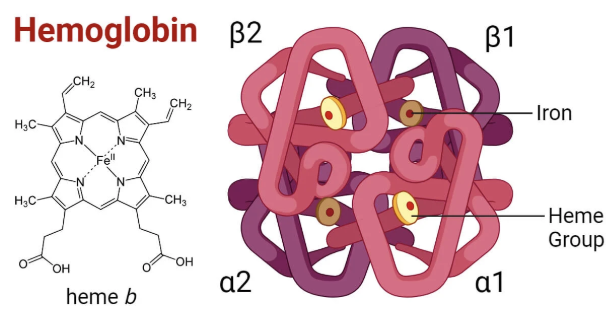
What is T-state for Hemoglobin? What is its affinity for oxygen? When and where is it favored? What coordinate heme is it?
T-state = tense (aka puckered). LOWER affinity for oxygen
Favored when pO2 (partial pressure of oxygen) is lower, like in tissues
5-coordinate heme
4 bonds = nitrogen atoms in porphyrin ring
1 bond = proximal histidine
Last/6th bond = empty
What is R-state for Hemoglobin? What is its affinity for oxygen? When and were is it favored? What is the coordinated heme?
R-state = relaxed (aka planar) HIGHER affinity for oxygen
Favored when pO2 (partial pressure of oxygen) is higher, like in lungs
6-coordinated heme
4 bonds = nitrogen atoms in porphyrin ring
1 bond = proximal histidine
1 bond = O2
What is Cooperativity in hemoglobin?
Oxygen binding to one subunit increases the affinity of adjacent subunits for oxygen (aka shifts them to R-state)
What factors DECREASE O2 affinity?
Higher Temperature
Lower pH or Higher [H+]
Increased 2,3-BPG
Higher pCO2
What Stabilizes the T-state?
The Bohr Effect
Heat
Carbamate formation
2,3-BPG
How does The Bohr Effect stabilize the T-state?
Low pH/High H+ causes protonation of many parts of the polypeptide including the proximal histidine
Protonation allows opposite charges to form salt bridges
How does Heat stabilize the T-state?
Binding of oxygen is EXOTHERMIC
If you think of heat as a product of association reaction, releasing oxygen is favorable when temp is high because some excess heat will be absorbed
**Heat doesn’t directly stabilize T-state, but it does promote oxygen release that makes T-state more favorable
How does Carbamate Formation stabilize the T-state?
CO2 can react with a neutral N-terminus (deprotonated) to create a negatively charged carbamate
Again, opposite charges form salt bridges
How does 2,3-BPG stabilize the T-state?
Produced from 1,3-BPG, which is made during metabolism
Fits into space between ⍺1 β1 and ⍺2 β2 dimers and stabilizes T-state (especially to promote oxygen release when pO2 in the lungs is low)
What are ways to determine peptide sequences?
Edman degradation
Tandem Mass Spectrometry
How does Edman Degradation help determine peptide sequences? What is its con?
Sequences a peptide by sequentially removing the N-terminal amino acid and identifying it using spectroscopy
Very time and Labor Intensive
How does Tandem Mass Spectrometry help determine peptide sequences?
Mass Spec is a machine that breaks a peptide sequence into fragment ions
MS1: Sorting of whole peptides
MS2: Sorting of peptide fragments
Tandem MS is looking at MS2
In mass spec, what do B ions contain?
B ions contain N-terminus
In mass spec, what do Y ions contain?
Y ions contain C-terminus
What is Specific activity? What does it help monitor?
Specific activity is the measurement of protein function
Often has to do with measuring the appearance of product or disappearance of reactant in enzyme-catalyzed reactions, but can be other functions too
Helps us monitor the purity of a mixture of proteins
How does different types of Column Chromatography work?
Size exclusion: Stationary phase beads contain pores that trap small molecules, causing larger molecules to elute first
Affinity: Stationary phase beads are bound to a ligand that specifically binds the protein of interest, like an antibody or enzyme substrate
Ion-Exchange: In cation exchange, the resin is negatively charged. Negative proteins elutes first, then neutral. Positive proteins stick to resin (have to change pH below pI so it is positively charged). Using salt or changing pH to elute at very end.
Cation exchange BINDS cations
Anion exchange BINDS anions
Hydrophobic/Reverse Phase: Hydrophilic like polar mobile phase, so they elute first. Hydrophobic HATE the polar mobile phase and stick to non-polar C18 chains. To elute, change mobile phase by increasing amount of non-polar solvent (gradient elution). So, less hydrophobic come off earlier and strongly hydrophobic come off last
How does Gel Electrophoresis work? What is a Native PAGE and SDS-PAGE?
Gel Electrophoresis uses an electric current to push proteins (or DNA or RNA) through a gel, sorting them by size. Larger molecules stay at top since they can’t travel as far through the gel. Negative charge at top of gel and positive charge at bottom of gel.
Native PAGE: Uses fully folded protein with their normal charges, meaning that the distance a protein travels is affected by both size and charge
SDS PAGE: Proteins are denatured and given a uniform negative charge, and reducing conditions break disulfide bonds, so that proteins are sorted based on size alone.
How can you separate by size?
Ultrafiltration
Dialysis
SDS-PAGE (in gel-electrophoresis)
Size-exchange column chromatography
How can you separate by Density?
Centrifugation
How can you separate by polarity?
Organic solvent extraction
Solid phase extraction
How can you separate by charge?
Cation exchange chromatography
Anion exchange chromatography
Solubility
Isoelectric Focusing
How can you separate by hydrophobicity?
Solid phase extraction
Organic solvent extraction
Precipitation
How does Ultracentrifugation work and how to detect? What are advantages and disadvantages?
Centrifuge through density gradient (more dense at the bottom). Detection by UV or MS
Advantages: Relatively quick, good clean up, mild conditions
Limitations: Crude separations, can separate cells, organelles and large complexes but NOT proteins or peptides.
What is Isoelectric Focusing?
Proteins will stop moving at a specific pH.
High pH at top
Low pH at bottom
How do Western Blots work?
Native proteins are run through gel electrophoresis
The proteins are transferred to a membrane, then washed with a primary and secondary antibody
Primary antibody: Binds selectively to the protein of interest
Secondary antibody: Binds sensitivitely to the primary antibody and allows protein to be visualized by fluorescence, etc.
How does ELISA work?
Simpler than a Western blot, uses a plate bound to a specific molecule
“Sandwich” ELISA uses a plate bound to an antibody
Covid antigen test is example of an indirect ELISA, where the antigen protein is bound to the plate
Same idea as a Western blot: primary antibody confers sensitivity/specificity, while secondary antibody allows for detection through dye, fluorescence, etc.
How do you detect for Chromatography?
Detection is via UV, MS or activity
How do you detect for SDS-Page
Dye
MS
Antibody binding
How do you detect for Ultra centrifugation
UV
MS
How do you detect for Isoelectric focusing
Dye
antibody binding
MS
What techniques identify proteins based off of Antibody affinity?
Western blot
ELISA
Where are beta turns found in?
Anti-parallel beta sheets
What are Motifs? What are they the site of?
Motifs = Super secondary structure comprised of patterned combinations of helices and sheets. Complex structural building blocks within tertiary structure. Recur in many proteins and represent ‘motifs’. Often indicate special functional sites
Motifs are often the site of action (catalysis, binding, etc.)
How is evolutionary convergent proteins similar and different?
Very different primary structure
Very similar folded structures, function seems to be similar
What are the trends for unassisted protein folding? What promotes secondary structure? What is the final structure like?
Co-translational folding: folding starts as protein exits ribosome
Hydrophobic collapse, reduction of hydration cage, maximizing the entropy of water
Hydrogen/ionic bonding promotes secondary structure
Secondary structure leads to super-secondary structures (motifs)
Some proteins make disulfide bonds in set patterns during folding
Final structure, very compact yet flexible, not rigid—some ‘breathing’
What are the trends for assisted protein folding? What are the roles of chaperones?
Isomerization: Peptide prolyl cis-trans isomerase and protein disulfide isomerase
Molecular Chaperones: heat shock proteins and chaperonins, 25-30% of a cell’s proteins require a chaperone
Roles of chaperones: protect hydrophobic surfaces, provide a template to direct folding, target misfolded proteins for destruction, movement of proteins from the ribosome, help with assembling of complexes.
What is induced fit used in?
Promoting reactivity
Binding tightly and specifically to substrates
Cooperatively increasing binding (hemoglobin)
In induced fit, proteins can be optimized to bind OR do chemistry, but not really both. Why?
In binding, you’re encouraging enthalpy to keep it together and keep the bonds. In chemistry, you’re trying to have the bonds break
What happens for an antibody in induced fit?
In an antibody the induced fit causes very tight specific binding of the ligand
What happens for an enzyme in induced fit?
In an enzyme the induced fit is for the transition state. This promotes/catalyzes chemistry.

What does each variable mean?
L = concentration of free ligand (usually mol/L)
Kd = dissociation constant (same units as L)
Y = Fraction of binding sites occupied by ligand
Is a large or small Kd best for measuring a wide range of ligand concentrations?
Large
What is ELISA optimized for?
Optimized process for large sample numbers
What are Points of control for T to R transition summary?
In T state, C-terminal ends form salt bridges, if we stabilize T state which is lost with O2 binding. Subunits slide and reestablish interactions elsewhere along interface
At High [CO2], the N-terminal ends of each poly peptide form carbamates converting the positive charge to a negative
Binding of Heme: Iron and oxygen is exothermic (gives off heat), i.e. heat reduces binding
ATP and 2,3-BPG bind at four residues of the bet chains, increasing stability of the T state
Why doesn’t the body stabilize the ‘R’ States
Because delivery of oxygen to the tissues is more important than maximizing binding in the lungs
What is to be said about protein folding and water entropy?
Folding is driven strongly by the hydrophobic effect
Water entropy increases when hydrophobic groups are buried
Protein loses conformational entropy, but water gains entropy
How does high concentrations of urea unfold proteins? What is the net effect?
Indirect: Urea forces water molecules in solvent to be more structured
Direct: Urea can compete with protein H-bonding and changes solvation of exposed groups
Net effect: Unfolded states become less unfavorable
Secondary Structure rules: α-Helix
Backbone H-bonds stabilize helices
i → i+3
~3.6 residues/tern
Pro and Gly are often helix-disrupting
Side chains 3-4 residues apart can interact
Secondary Structure rules: β-strand
Backbone H-bonds stabilize β-sheets
Side chains alternate sides (parallel and anti-parallel)
i → i+2
Every-other-residue patterns matter
Charge repulsion/attraction depends on geometry
What do chaperones do?
Reduce aggregation / kinetic traps
DO NOT rewrite the amino-acid sequence
Disulfide formation may require proper folding environment (Oxidizing Environment)
Chaperones recognize or shield nonnative surfaces to reduce aggregation while allowing the protein to try folding again
What is basic outline for Brownian Motion?
"bonding changes" → "motion changes" → "function changes"
Separation Techniques table
