Reading Quiz #4 (2nd exam info only)
 Call Kai
 Learn
Learn Practice Test
 Spaced Repetition
 Match
Match Flashcards
 Knowt Play
1/11

There's no tags or description
Looks like no tags are added yet.
Name | Mastery | Learn | Test | Matching | Spaced | Call with Kai | Chat |
|---|
No analytics yet
Send a link to your students to track their progress
12 Terms
Closed fracture
Fracture that doesn’t break the skin

Open fracture
Fracture in which at least one end of the broken bone tears through the skin; carries a high risk of infection

Transverse fracture
fracture straight across the long axis of bones

Spiral fracture
fracture resulting from twisting forces applied to the bone

Comminuted fracture
Fracture in which the bone is shattered into multiple scattered into multiple fragments, difficult to repair.

Impacted fracture
fracture in which one fragment is driven into the other; usually as a result of a compression

Greenstick fracture
Fracture in which the bone breaks on one side but only bends on the other side; simillar to when a twig is bent.

Oblique fracture
fracture that occurs at an angle that is not 90 degrees

Compression fracture
fracture in which the bone is crushed under the weight it is meant to support

Avulsion fracture
Fracture in which a tendon or ligament pulls off a fragment of bone, often seen in ankle fractures.

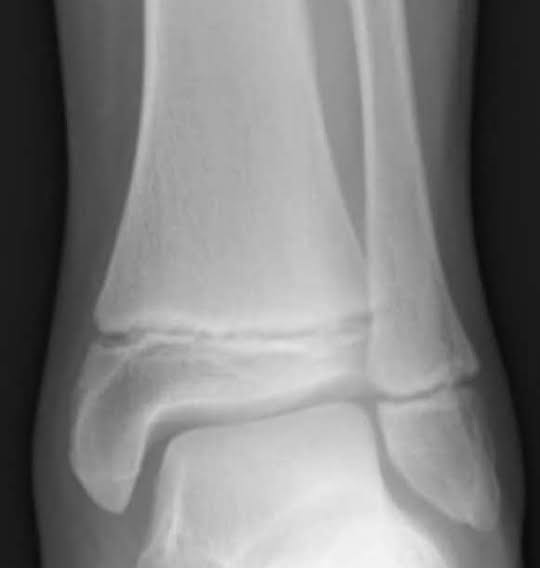
Epiphyseal Plate fracture
fracture that involves at least part of the epiphyseal plate; occurs only in children and young adults.
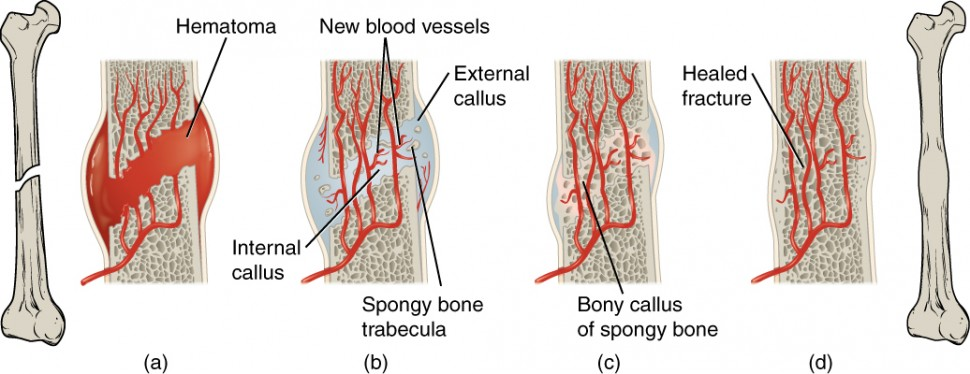
Fracture hematoma forms (blood clot)
Internal and external calli form (phagocytic cells start cleanup, fibroblasts release collagen, chondrocytes secrete cartilage = soft callous is formed)
Cartilage of calli is replaced by trabecular bone (osteoblasts turn the cartilage into spongy bone)
Remodeling occurs (spongy bone to normal bone)
Stages in fracture repair