Art History 3
 Call Kai
 Learn
 Practice Test
 Spaced Repetition
 Match
 Flashcards
 Knowt Play
1/34

There's no tags or description
Looks like no tags are added yet.
35 Terms
How did the view on art begin to change in 1750?
Rococo was seen as immoral and sexual and art needed to return to moral/virtues
saloon
First place where members of the public could come and see art for free (art is not just for elites)
Neoclassicism
Return to classical antiquity + interest in antiquity from a scholarly standpoint

key work
A copy of ancient art in Rococo style: The Cupid Seller, 1763,Joseph-Marie Vien
Jacques-Louis Davis
Important Neoclassicism artist
spoke about the importance of art being public and contributing to civil good
points out how art was used for tyrants
Paints during french revolution (hard to paint in classical style and ends up painting idealized Napoleon)
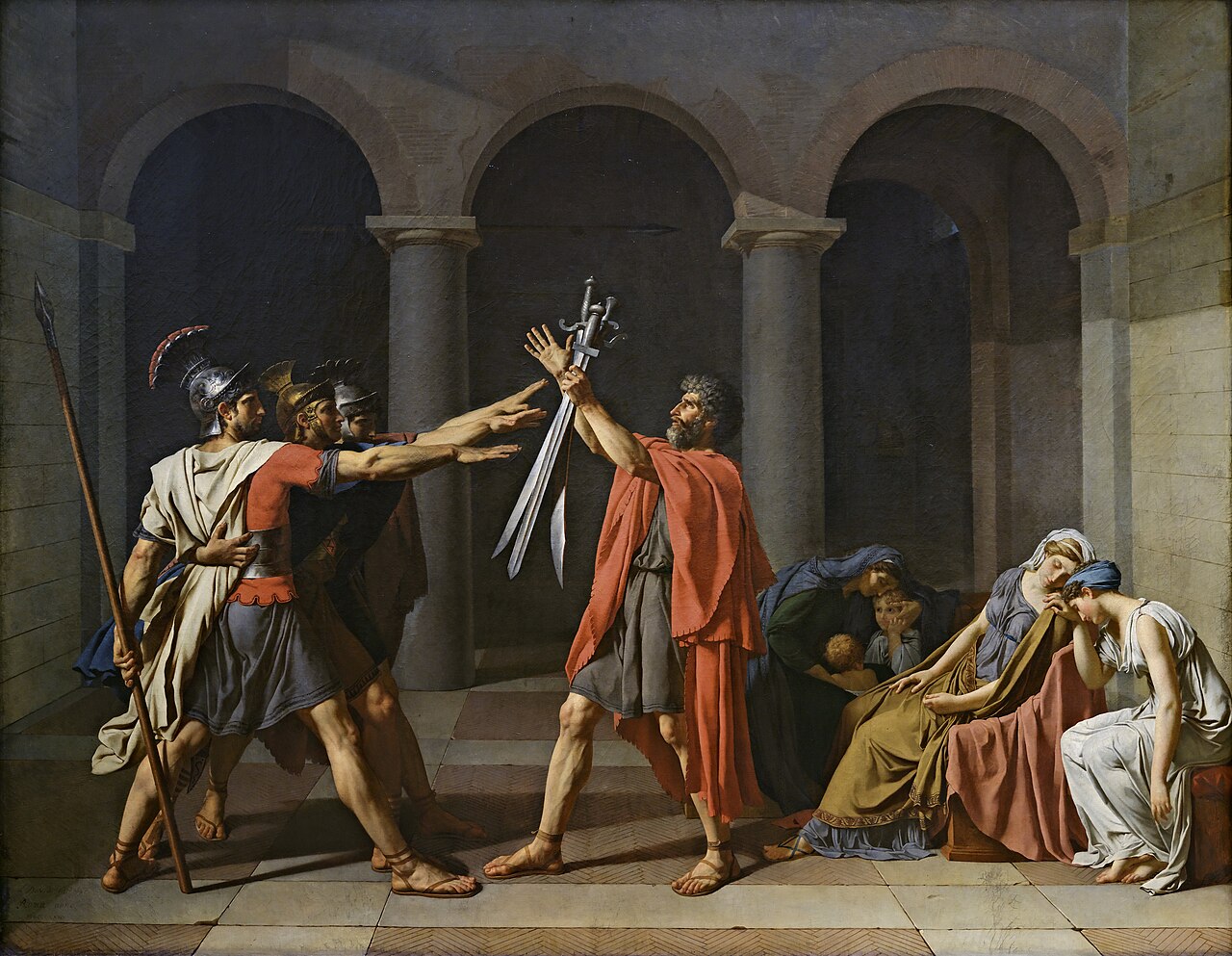
key work
Davis, Oath of The Horaii, 1785
call to civic duty where people should fight for good
Depiction of Roman war where 3 brothers take an oath to defend Rome
Contrast between brothers and emotional females (men were too focused on war vs. emotion) (radical separation between public and private)
Antiquity style
Francisco De Goya
Spain
Neoclassicism —> dark/disfigured artwork
Paints for the king of Spain
Side hustle of print making prints that critique society

key work
Goya, The Family of Carlos IV, 1800–01
realistic, not ideal picture of royal family
faces aren’t perfect
proving they are compatible with the enlightenment

key work
Goya, The Sleep of Reason Produces Monsters (Los Caprichos), 1799
two interpretations:
bad things will happen if we don’t use logic or reason
dreams can be productive for the artist (the monsters help)
Romanticism (1800-1850)
Rejection of neoclassicism (no classical beauty/symmetry)
emotion, imagination, dark
Not focused on logic/reason
Interest in nature/landscape
sublime
Scary/powerful things that move us
main motivation for romanticism
Theodore Gericault (1791-1824)
Early romantic artist
Disappointed with the French revolution

key work
Théodore Géricault, The Raft of the Medusa, 1818–1819
painting of scandal where unqualified captain sails ship into sandbar. The people are left to survive on rafts for over a week. Only 10 survived.
lower class not treated like humans
Depicts moment of false hope (is the ship in the distance going to see him?)
Casper David Friedrich (1774-1840)
landscape romantic artist
emotional responses to nature

key work
Friedrich, Wanderer above the Sea of Fog, 1818
Contemplating
shows power of nature
Joseph Mallard William Timer (1775-1851)
Landscape paintings as history paintings
Nature=protagonist

key work
JMW Turner, Snow Storm: Hannibal and his Army Crossing the Alps, 1812
Ancient history story painting
snowstorm=main subject instead of people
snow=protagonist
what was the motivation behind the invention of photography?
interest in finding another way to capture reality in a way that the human hand can’t
William Henry Fox Talbot
didn’t like the way that controlled drawing devices (like the camera Lucida) couldn’t capture the details of the scene, so in 1835 he events the first “photogenic drawing” onto a surface (produced by the camera obscera)
What do Louis Daguerre and Nicephore Niepce invent?
the daguerreotype (camera obscera permanently captured on a metal plate)

Key work
Daguerre, Still Life, 1837
first known daguerreotype
advanced tech, not advanced art
optical realism
What innovations in art begin in 1848?
Industrial Revolution shifts wealth (capitalism)
In France, the saloon allows anyone to submit art
Realism ideas begin
Realism in France
Movement in France where political radicalism is represented in art
Gustave Courbet (1819-1877)
Starts Realism in France with political messages in art
brings controversial work to saloon in 1850
Avant-Garde
military term: foremost part of an advancing army
Artist who is experimenting and introducing new ideas (usually ideas that aren’t initially accepted by society)
Courbet calls himself this because he had to make his own art exhibition (his art was rejected)

key work
Courbet, The Stonebreakers, 1848
work he submits to the saloon
poor, rural laborers who pave roads (which allows for capitalization)
humble subject matter on a monumental scale
trapped in poverty: younger and older generation, packed lunch
Painted in a rough manner
Controversial because it’s not a typical biblical historical painting, but it instead shows the ugliness in rural life
Begins Realism movement
The Pre-Raphaelite Brotherhood (1848-1853)
In England
Think art should return to it’s pure ways (before Raphael)
Bright colors +simple
Reject idealism

key work
John Everett Millais, Christ in House of Parents, c. 1849
Carpenter shop of Christ’s father
not idealized
Wood shavings are realistic
What life would look like at the time
People have wrinkles, not perfect
Controversial because it’s too realistic and ugly
form of realism
Haussmannization 1853
the massive 19th-century urban renewal of Paris directed by Baron Georges-Eugène Haussmann
open Paris up
Make surveillance easier
underground sewage (better sanitation)
Smoother streets
Allow for capitalism
Modernity
Lot of new changes before your eyes
Artist want to capture changing world
Flaneur
someone who spends their time observing modern life while staying anonymous
Manet
Flaneur
made controversial art work about what capitalism is doing to society

key work
Édouard Manet, Olympia, 1863
Not idealized
Woman looking at the viewer/acknowledging male gaze
Highlights capitalist world were you have to pay for services
Maid is wearing a costume, which suggests that it’s proving how paintings are artificial and for show
Impressionism (1874-1886)
Group of artists that organized their own exhibition
Represented the world honestly.
showed modernity
first women artists

key work
Mary Cassatt, In the Loge, 1878
impressionist
Woman controlling gaze (not man)