Week 2 Misinformation
 Call Kai
 Learn
 Practice Test
 Spaced Repetition
 Match
 Flashcards
 Knowt Play
1/6

There's no tags or description
Looks like no tags are added yet.
7 Terms
What are some origins of misinformation?
Rumours and Fiction - for example the State of Fear - misrepresented the science of global climate change but was nevertheless introduced as “scientific” evidence into a U.S. Senate Committee”
Media - the desire for balanced reporting may inadvertently lead to misinformation, media fractionation, wherein information can be selectively channelled to people
What are some Individual Cognitions influencing misinformation?
If the information feels ‘right’
Whether or not the information is easily accessible, it is easily recalled, people are more likely to think the information is ‘right’.
If the information is coherent,
is there a ’good story’ - juror data, when the story is presented in the chronological order, the account is more likely to be seen as factual.
If other people believe this information?
Can have two effects - Pluralistic Ignorance: divergence between the actual prevalence of a belief in a society and what people in that society think others believe and False Consensus: those in the minority thinking they are in the majority
What is the continued Influence effect?
Whether or not individuals remember the retraction or the initial report – most people will be more likely to remember the retraction, rather than the initial report. Paper supposes that this effect occurs as People’s Mental model is not full enough → lack of explanation to fill the gap. Retrieval Failure - The negation tag is lost over time, so the initial information is more salient. Fluency & Familiarity - repetition allows for INCREASE of false memory.
How can you reduce the impact of misinformation?
Warn first: pre-exposure warning
Skeptic: foster healthy skepticism
Facts first: emphasise the fact, not the myth
Simple: keep the rebuttal brief
Fill the gap: give an alternative account
Repeat: repeat the retraction
Mnemonic sentence: “Wise Sheep Find Simple Fixes, Repeatedly”
Wise = Warning (pre-exposure)
Sheep = Skepticism (healthy)
Find = Fact emphasis
Simple = Simple, brief rebuttal
Fixes = Fill the gap (alternative account)
Repeatedly = Repeated retractions
What is the influence of World View?
The paper introduces the worldview backfire effects – wherein, evidence that threatens a worldview may actually strengthen initially held beliefs.
Therefore, evidence should be framed to affirm worldviews/identities
E.g Carbon Offset vs. Tax = carbon offsets are more likely to be supposed compared to a tax, ACROSS the whole spectrum of politics (US-based tho)
An interesting consideration further discussed is the idea of whether or not knowing more or less science helps or hinders climate change education.
Does knowing more science help or hinder in getting the message across?

SCT = Science Comprehension Thesis, states that individuals with more science literacy should believe that the risk posed by climate change is higher than those who have less.
The study found that comparing the actual response, there is actually an inverted relationship, that is, the more science/numeracy literate you are, the lower your perceived risk.
What is the influence of message recipients according to the 2nd paper?
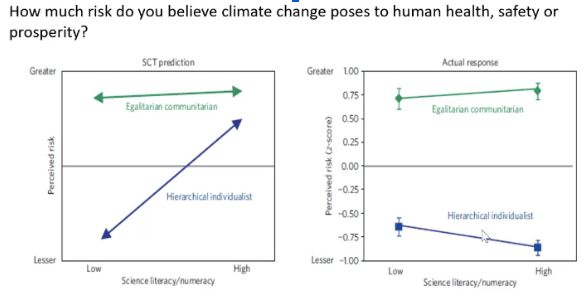
If you are Hierarchist Individualistic - prediction - if you have high science literacy you will be concerned
If you are Egalitarian Communistism - prediction - science literacy does not matter, Both predictions came true.
Therefore, Contrary to SCT’s predictions, highly science-literate and numerate hierarchical individualists are more sceptical, not less, of climate change risks.