6.5 - Periodic Trends
 Call Kai
 Learn
 Practice Test
 Spaced Repetition
 Match
 Flashcards
 Knowt Play
1/14

There's no tags or description
Looks like no tags are added yet.
15 Terms
Atomic Radii
Half the distance between nuclei in a molecule of identical atoms (S8, N2)
Increases down a group (vertical)
Larger n = larger size
Decreases across a period (left to right)

As Z (atomic number/# of protons) increases…
Electron-nucleus attraction increases
Outer electrons are “shielded” by inner electrons as increasing the number of electrons causes more e-e repulsion

Shielding and Penetration
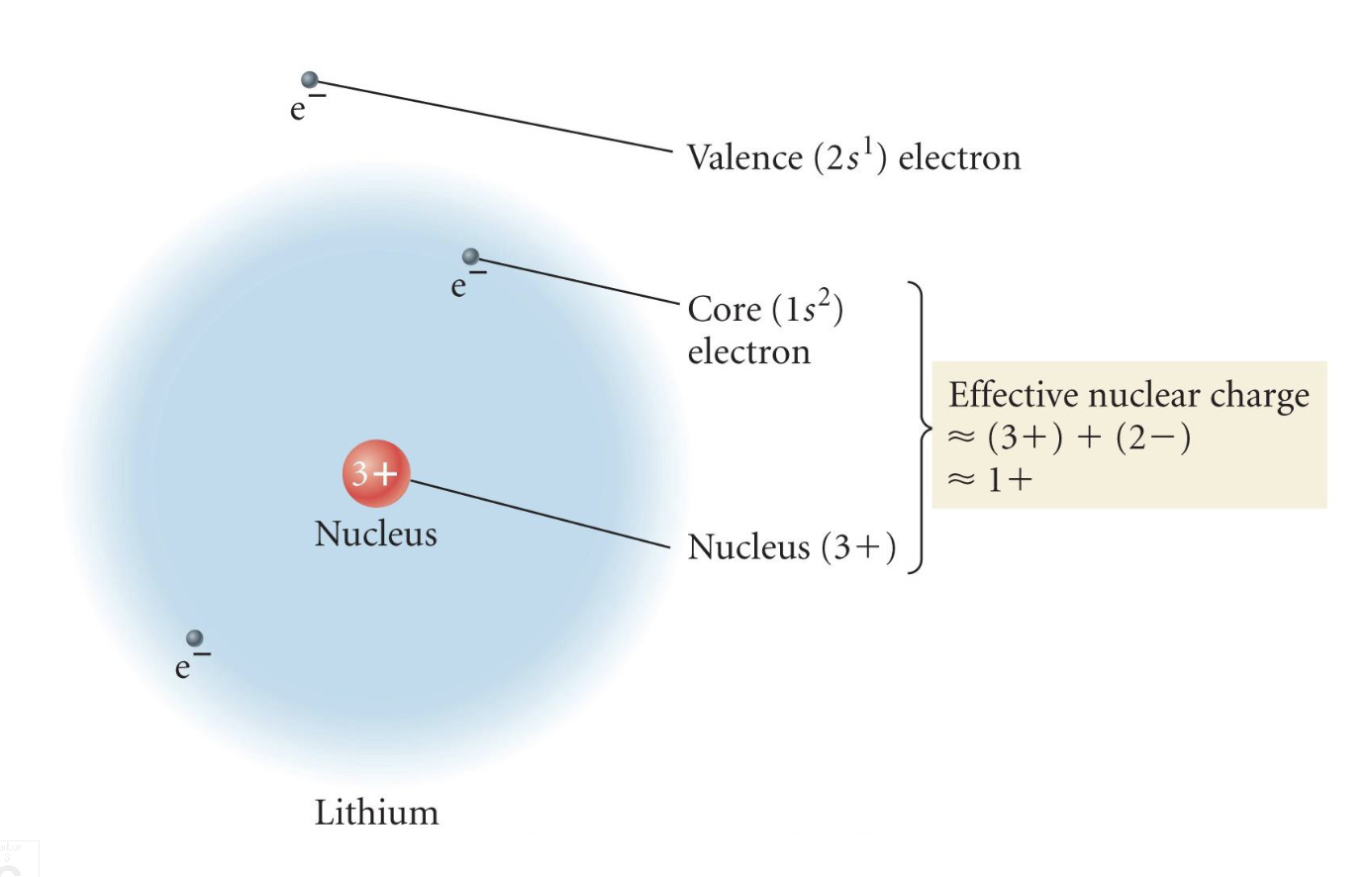
Shielding:The reduction of the attractive positive charge of the nucleus (called the nuclear charge or (Zeff) down to a smaller, net positive charge
Core electrons (inner shell electrons) sit closer to the positively charged nucleus and have the same negative charge as outer valence electrons. Because like charges repel, these inner electrons push outward on outer electrons and partially "block" or screen them from feeling the full pull of the nucleus.
Penetration: The relative probability that an electron in a given subshell can approach very close to the nucleus.
Because of the shapes of different atomic orbitals, some electrons have a small amount of electron density very close to the nucleus (inside the path of inner shell electrons).

Why is a 1s orbital lower in energy than a 7s?
1s electrons are closer to the nucleus
1s electrons experience no shielding
7s electrons have lower energy electrons between them and the nucleus
In which orbital do electrons have a greater probability of being closer to the nucleus, a 2s or 2p electron?
2p, even though its higher in energy
Exceptions
2s electrons are usually further from the nucleus than 2p but 2s electrons penetrate, moving close to the nucleus
2S ORBITAL HAS LOWER ENERGY OVERALL THAN 2P BECAUSE IT PENETRATES (THE SMALL PEAK)

Effective Nuclear Charge (Zeff)
The nuclear charge an electron feels considering shielding effects
core electrons electrons strongly shield valence electrons (allows valence electrons to have higher energies)
Valence electrons poorly shield each other
Zeff = Z-S
Z=nuclear charge, S=Number of lower energy electrons
How to calculate Zeff of every electron in an element
Zeff=Z−(Number of core electrons below that shell)
Group electrons by principle shell (n)
n = 1:1s2 (2 electrons)
n = 2: 2s 2p6 (8 electrons) n = 3:35 3p6 (8 electrons)
n = 4:4s2 (2 valence electrons)
There are no electrons inside the 1s shell (0 core electrons)

Radius of Ions Trend
Ionic radii also increase going down a group
Cations are smaller than its neutral atom (less e)
Anions are bigger than its neutral atom (more e)
Isoelectric Series Trend
Isoelectric = same number of electrons
Larger positive charge = smaller cation
Larger negative charge = larger anion

Ionization Energy
The energy required to remove an electron from an atom or ion/measures how strongly an atom holds its electrons
Removing an electron is always endothermic
Ionization Energy Trend
Increases up a group
Because valence electrons are closer to the nucleus (takes less energy to remove an electron farther from the nucleus)
Increases to the right as Zeff increases
The larger an electron’s Zeff, the more energy it takes to remove it

Ionization Energy Trend Exceptions
Which is easier to remove an electron from?
B vs Be
B
Be has its valence e in the 2s orbital while B has its outermost e in a 2p orbital
The 2p orbital is slightly higher in energy than the 2s orbital, meaning the 2p electron is further from the nucleus and less tightly bound.
The single 2p electron in boron is shielded by the inner 2s and 1s electrons, reducing the pull of the nucleus and making it easier to pull away.
N vs O
O
N has a stable, half filled 2p subshell with 3 unpaired e, O has one paired e in its 2p subshell
In oxygen, putting two electrons into the same 2p orbital creates electron-electron repulsion. This repulsion makes it easier to pull one of those paired electrons away,
Successive Ionization Energies
Outer electrons get closer to the nucleus and are harder to remove.
There is a smaller increase in energy for each
successive valence electron removal and a large increase for core electrons.

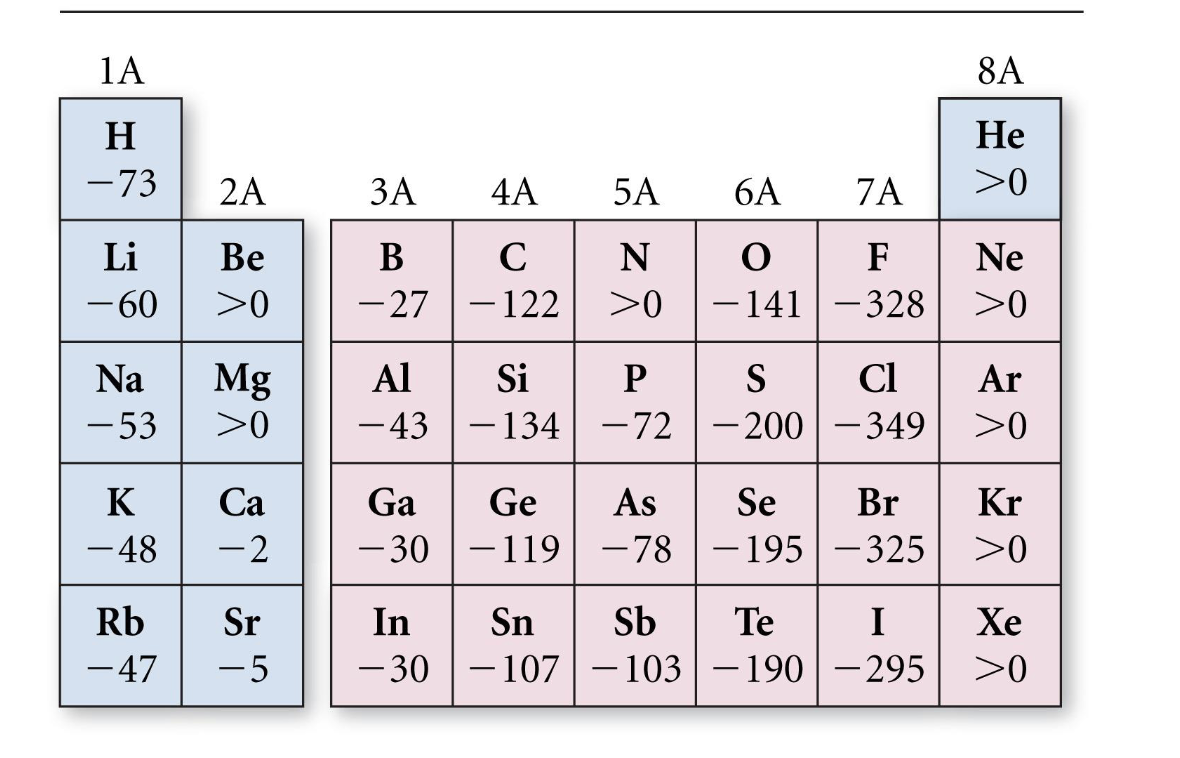
Electron Affinity (EA)
The energy change when an atom gains an electron
Usually exothermic, sometimes endothermic
No strong EA trend
Noble gases have the most endothermic EA
Halogens have the most exothermic EA