24 Eutocia and Induction of Parturition PW
 Call Kai
 Learn
 Practice Test
 Spaced Repetition
 Match
 Flashcards
 Knowt Play
1/45

There's no tags or description
Looks like no tags are added yet.
46 Terms
3-4 weeks prior to foaling
When should you open a caslicks?
4-6 weeks prior to foaling
When should you vaccinate the mare for EEE, WEE, tetanus, and clean the udder and legs prior to foaling?
1. udder formation: presence of colostrum, inc. milk Ca, change in milk pH, and inversion of milk Na/K (Na dec., K inc)
2. relaxation of cervix
3. gestational age over 330 days
What are some "readiness of birth predictors" in horses?
1. milk Ca test strip
2. taste electrolyte inversion: if salty, Na is high = not close. if sweet, K is high = close
What tests can you use to test the milk to see if a horse is close to foaling?
Cervical dilation favors a shorter delivery time
How is delivery time related to cervical dilation?
Intra-partum asphyxiation, longer time to stand/nurse, placental separation, dystocia
What complications might the foal have if the mare's cervix is not adequately relaxed?
2 days before birth
How long before birth do Na and K concentrations of milk invert, so the Na gets lower and K gets higher?
If greater than 200 ppm, there is a 98% chance she will foal in the next 72 hours = put her on FOAL WATCH when greater than 200 ppm
You take 1 cc of a prepartum mare's milk to test Ca on a test kit. What are you expecting this to tell you?
To predict when a mare is NOT ready to foal.
What is the best clinical use of the milk pH test in prepartum mares?
pH drops near foaling
What will happen to the mare's milk pH when she is near foaling?
Placental pathology, especially with twins
Why might precocious (early) mammary development and secretory electrolyte changes (such as an increase in milk Ca) occur in mares who are not close to delivery?
Stages I, II, and III
How many stages are there of equine parturition?
a. mild colic, restlessness, sweating
c. ends with rupture of chorioallantois
Select the signs of stage I parturition in mares:
a. mild colic, restlessness, sweating
b. forceful abdominal and uterine contractions
c. ends with rupture of chorioallantois
d. ends with expulsion of fetus
e. ends with passage of placenta
f. mare getting up and down
b. forceful abdominal and uterine contractions
d. ends with expulsion of fetus
f. mare getting up and down
Select the signs of stage II parturition in mares:
a. mild colic, restlessness, sweating
b. forceful abdominal and uterine contractions
c. ends with rupture of chorioallantois
d. ends with expulsion of fetus
e. ends with passage of placenta
f. mare getting up and down
e. ends with passage of placenta
Select the signs of stage III parturition in mares:
a. mild colic, restlessness, sweating
b. forceful abdominal and uterine contractions
c. ends with rupture of chorioallantois
d. ends with expulsion of fetus
e. ends with passage of placenta
f. mare getting up and down
Stage II ends with expulsion of fetus, meaning the mare is now in stage III until she expels the placenta
This marks the end of what stage of parturition in mares?

"red bag"
What is the layman's term for premature placental separation?
Will cause impaired gas exchange between the mare and fetus and compromise foal health via hypoxia
Why does "red bag" or premature placental separation cause issues in horses (requiring PROMPT ACTION)?
REQUIRES DIRE ACTION: premature placental separation, "red bag"
You see a mare, observing the chorion at the vulva with a reddened, velvet like appearance. Thoughts?
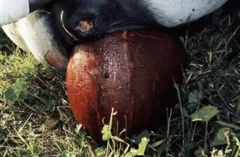
Fescue
What plant causes premature placental separation in horses?
Manual rupture ASAP
How do you treat premature placental separation in horses?
A = musculature more visible = UTERINE prolapse
B = smoother = PREMATURE PLACENTAL SEPARATION
What is the difference between these two pictures?

Hippomane = normal
What is this?

Hippomane = normal
What is this?
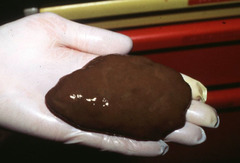
Induce parturition
Gestational abnormalities such as rupture of prepubic tendon and hydrops, mares with previous dystocias, and just plane convenience are reasons to do WHAT in mares?
Dystocia, premature placental separation, fetal hypoxia, dysmaturity
What might some negative side effects be of inducing parturition in mares?
Endometrial cups appear around 35-40 days of gestation. If you terminate a pregnancy with prostaglandin F2alpha before this period (after 5 days, but before 30 days), the mare will return to heat in 5-7 days. But, if you terminate a pregnancy after day 35, the mare will not return to estrus until the endometrial cups regress, 100-120 days of gestation.
Why are endometrial cups relevant to terminating a pregnancy in mares?
Oxytocin
What is the drug most commonly used for mare induction of parturition? (most foalings occur in 60 mins)
Inside out
After delivery, what happens to the placenta in mares? Is it inside out or rightside out?
1. clean of debris
2. spread into Y shape
3. examine both allantoic and chorionic surfaces (often turned inside out after delivery)
How should you examine the placenta after it is delivered in horses?
FOAL SIDE = normal allantoic side, where you can see vessels
What surface of the placenta is this?

The horn is slightly thicker where the foal is = this is NORMAL
What is this telling you about the pregnant horns?

Chorionic side = would be facing the mare inside the body = NORMAL
What surface of the placenta is this?

Allantoic side
The placenta is normally expelled inside out in mares. So, which side will you see?
Placenta is normally 11% of the foals weight
What is the weight of the placenta as a percentage of the foal's weight?
1. cervical star
2. tips of horns where uterotubal junction is located
3. opposite of endometrial cups
4. folding of placenta where large vessels "pull"
5. uterine cysts
6. apposition to twin placenta
Some normal avillous areas can be in the mare placenta. What are some of these areas?
a. cervical star
c. opposite of endometrial cups
d. folding of placenta where large vessels "pull"
e. tips of horn where uterotubal junction is located
Select some of the places that are normally avillous for the placenta in mares:
a. cervical star
b. chorioallantoic process
c. opposite of endometrial cups
d. folding of placenta where large vessels "pull"
e. tips of horn where uterotubal junction is located
f. where the hippomane compresses the placenta
If it is over 80 cm
At what length is the umbilical cord more likely to torse?
Umbilical cord torsion
What is this?

White where the placenta is budded up to endometrial cups
Describe this avillous area

Cervical star
Describe this avillous area

RUPTURE at the cervical star
Describe this avillous area

Blood vessels with linear avillous areas
Describe this avillous area

Avillous area associated with placentitis, an infection created avillous area where the placenta is not attached to the uterus
Describe this avillous area

Mineralized and thickened, associated with mycotic infection
Describe this placenta
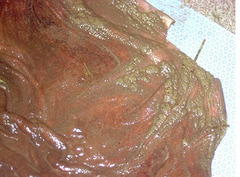
TRUE
TRUE OR FALSE: normal amnion on a placenta should be thin and see through