PSYCH 202: Intro to the Hippocampus
 Call Kai
 Learn
 Practice Test
 Spaced Repetition
 Match
 Flashcards
 Knowt Play
1/62

There's no tags or description
Looks like no tags are added yet.
63 Terms
What cognitive processes is the hippocampus associated with
Spatial navigation
Long-term memory (episodic + semantic)
Future imagination
Creativity (generating novel ideas)
Language
Working memory
How are memory and navigation related in the hippocampal function
The hippocampus supports navigation because it stores and uses memories of environments, allowing individuals to navigate through space
Where is the hippocampus located
Medial Temporal Lobe (MTL)
What structures make up the parahippocampus gyrus
Amygdala
Perirhinal cortex
Entorhinal cortex
Hippocampus
Parahippocampal cortex
Etorhinal cortex function
A MTL structure that serves as a major gateway between the cortex and hippocampus
What is significant about the connectivity of the hippocampus and surrounding regions
Extra-hippocampal regions are highly interconnected and play important roles in navigation and cognition
How does the MTL compare across mammalian species
Its structure is highly conserved across mammals, suggesting conservation of function as well
Why are rodents commonly used to study hippocampal function
Because the structure of the MTL is highly conserved between rodents and humans
How does the hippocampal size differ between rodents and humans
The hippocampus occupies a relatively larger proportion of the brain in rodents, wheras humans have proportionally larger cortical regions
What characterises hippocampal subfields
Different cell types
Extensive interconnectivity between subfields
Describe the major flow of information into the hippocampus
Cortex —> Entorhinal Cortex —> Hippocampus
What recording technique has been critical for understanding hippocampal function in animals
Implanting electrodes that allow animals to freely explore while researchers measure
when neurons fire
where the animal is
the direction the animal is facing
Place Cells
Neurons that fire when an animal occupies a specific location within the environment
John O’Keefe (1971)
Place Cells: what is a place field
The specific area of an environment where a place cell fires most strongly
Place Cells: location
hippocampal subfields
CA1
CA2
CA3
Dentate gyrus
Place Cells: what happens to place cells when an environment changes
They undergo remapping (reorganisation)
Place Cells: what is an example of place cell remapping
Changing an enviro from a white room to a black room causes place cells to develop different place fields
Place Cells: what does place cell remapping suggest
place cells encode the specific context of an enviro, not just physical location
Grid Cells
Neurons that fire in a regular, periodic pattern as an animal moves through space
Edvard Moser and May-Britt Moser in 2005.
Grid Cells: location
Entorhinal cortex
Grid Cells: what pattern do grid cells produce
A repeating hexagonal tessellation across the environment
• Structure of firing structures form hexagons

Grid Cells: How do grid cells respond to environmental changes compared to place cells?
Grid cells remain relatively stable and show little evidence of substantial remapping.
Grid Cells: What navigation function might grid cells provide?
A coordinate system for measuring position and distance within space.
Head Direction Cells
Neurons that fire when an animal points its head in a particular allocentric direction
allocentric = world-centred; independent of the individual’s current positon
Head Direction Cells: primary function
they act as an internal compass
Head Direction Cells: location
within the MTL
subiculum
entorhinal cortex
Head Direction Cells: what determines whether a head direction cell fires
Head orientation, not the animal’s location
Head Direction Cells: how does a single head direction cell respond to different locations
It fires maximally at one preferred direction (e.g., North, Southeast)
Head Direction Cells: what is a tuning curve
A graded firing response that decreases as the head moves away from the preferred direction
Head Direction Cells: how is full directional coverage achieved
Different head direction cells are tuned to different angles, collectively covering 360°
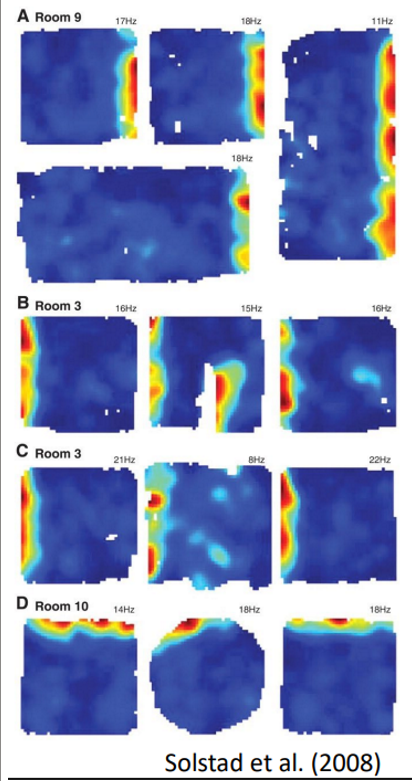
Boundary Cells
Neurons that respons to environmental boundaries

Boundary Cells: location
subiculum
entorhinal cortex
Boundary Cells: what feature of the enviro do they encode
The presence of boundaries such as walls or edges
Cognitive Map
Allocentric representations of spatial environments that can model space in 2 different ways
egocentric coding
allocentric coding
What provides the neural basis for cognitive maps
The interaction between the different hippocampal cell types (place, grid, head direction, boundary) and the surrounding regions of the hippocampus
Cognitive Maps: egocentric coding
Representing locations relative to oneself
e.g., the object is to my left
Cognitive Maps: allocentric coding
Representing relationships between objects independently of one’s own position
Which type of spatial coding is most associated with the hippocampus
Allocentric coding
How did Tolman challenge behaviourist explanations of learning
He demonstrated that rats form internal representations of environments rather than merely learning stimulus-response associations (Skinner)
Tolman’s maze study: group 1 rats
Received rewards immediately and gradually improved at finding the exit
Tolman’s maze study: group 2 rats
they explored without rewards for 10 days and then received rewards on day 11
Tolman’s maze study: what happened when group 2 rats were finally rewarded
they found the exit faster than the trained rats
Tolman’s maze study: what concept do group 2’s performance support
Latent learning and cognitive maps
Tolman’s maze study: implications
It provided strong evidence against radical behaviourist theories such as those proposed by BF Skinner
Time Cells
Neurons that fire during specific moments within a delay period
Time Cells location
Hippocampus
Entorhinal cortex
Time Cells linked cognitive processes
Processing event sequences, which is important for memory
Time Cells importance for memory
they help encode the temporal order of events
Time Cells what does a delay period provide in time-cell experiments
A future target in time that the animal must anticipate
Time Cells describe a typical time-cell experiment
Train mouse to associate objects with a stimulus they would be presented with after a delay to get a treat
e.g. associate green item with a smell —> must perform behaviour to get reward
Placed in waiting dock after learning rule
Measure how certain cells are responding during delay period
some neurons fire early, while some fire later during this delay period
Time Cells How do different time cells behave during a delay period?
Some fire early, while others fire later in the delay.
Time Cells what pattern emerges when time cells are ordered according to firing time
Sequential activation spanning the entire delay period
Time Cells what does sequential firing represent
the passage of time during an event sequence
Concept Cells
Neurons that respond to abstract semantic concepts rather than specific sensory features
Concept Cells Why are they considered unique
Unique to human MTL (medial temporal lobe)
Concept Cells how were they discovered
Using intracranial EEG recordings from epillepsy patients
Concept Cells What does intracranial EEG measure?
neural activity through electrodes implanted in the brain, including local field potentials and spiking activity
Concept Cells location
Hippocampus
Entorhinal cortex
amygdala
Concept Cells what kind of stimuli were used to identify them
images of famous people
written names
spoken names
—> they respond across multiple sensory modalities
Concept Cells why are they considered abstract
They respond to the meaning of a concept rather than its visual, auditory, or sensory characteristics
Concept Cells What famous example is commonly used to demonstrate concept cells?
A neuron that responds selectively to "Yoda" whether Yoda is presented as:
A picture
Written text
Spoken name
Concept Cells What do concept cells reveal about human cognition?
The brain contains highly abstract representations of people, objects, and concepts.
What is the overall conclusion about hippocampal function?
The hippocampus and surrounding medial temporal lobe structures contain specialised cells that represent:
Space (place, grid, head direction, boundary cells)
Time (time cells)
Abstract concepts (concept cells)
Together, these systems help explain the hippocampus' role in navigation, memory, imagination, creativity, and other higher cognitive functions.