Case 3: Ali Khan - Cerebral Palsy + GI Conditions
 Call Kai
 Learn
Learn Practice Test
 Spaced Repetition
 Match
Match Flashcards
 Knowt Play
1/76

There's no tags or description
Looks like no tags are added yet.
Name | Mastery | Learn | Test | Matching | Spaced | Call with Kai | Chat |
|---|
No analytics yet
Send a link to your students to track their progress
77 Terms
GI Tract
Mouth/oral cavity
Esophagus
Stomach
Small intestine
Large intestine
Rectum + anal canal
Mouth/Oral Cavity: Palate
Hard: Anterior 2/3
Soft: Posterior 1/3
Mechanical digestion

Mouth/Oral Cavity: Teeth
Mechanical digestion

Mouth/Oral Cavity: Tongue
Skeletal muscle
Intrinsic: Control shape
Innervation: CN XII
Extrinsic: Control mobility
Innervation: CN XII + X
Mechanical digestion
Papillae: Contain taste buds
Mouth/Oral Cavity: Salivary Glands
Small in mucosa
Large:
Paired
Sublingual
Submandibular
Parotid
PSNS innervation only: CN VII + IX
Secrete saliva
Contain a-amylase + lysozymes
Chemical digestion

Esophagus: Muscles
Skeletal: Upper 1/3
Innervation: CN IX + X
Smooth: Lower 2/3
Innervation: CN X
Peristalsis

Esophagus: Sphincters
Upper esophageal sphincter (UES)
Lower esophageal sphincter (LES)
Esophagus: UES
Skeletal muscle
Function:
Normally contracted = Prevent air entering esophagus
Relaxed during swallowing = Food enter esophagus
Innervation: CN X
Factors Hindering:
Neurological disorders
Age → Muscular atrophy
Muscle fibrosis + hypertrophy
Anticholinergics

Esophagus: LES
Smooth muscle
Function: Physiologic sphincter
Normally contracted = Prevent stomach contents entering esophagus
Relaxes during swallowing = Food enter stomach
Innervation: CN X + spinal nerves
Factors Hindering:
Inhibitory neuron loss in myenteric plexus = Impaired relaxation + Increased muscle tone
Achalasia
Autoimmune destruction
Viral-mediated destruction
Muscle fibrosis + hypertrophy
Medications
Anticholinergics
Opioids
CCBs
TCA

Stomach
Muscular sack
Store + mix bolus → Chyme
Stomach: Mucosa
Contain secretory cells
Parietal: HCl + intrinsic factor
Chief: Pepsinogen
G: Gastrin
Mucous: Mucus, HCO3-, pepsinogen
Stomach: Curvature
Lesser: Attached to lesser omentum (peritoneum)
Greater: Attached to greater omentum
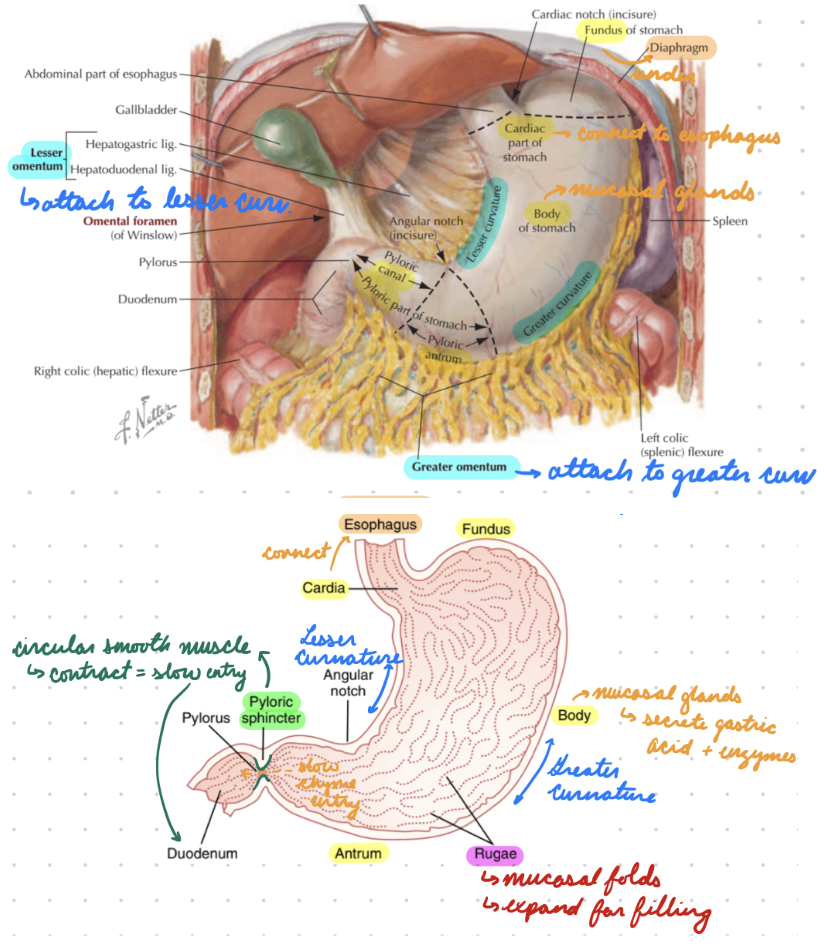
Stomach: Regions
Cardiac: Connect to esophagus
Fundus: Superior portion under left diaphragm
Body: Contain mucosal gastric glands
Pyloric:
Antrum: Proximal
Canal: Distal
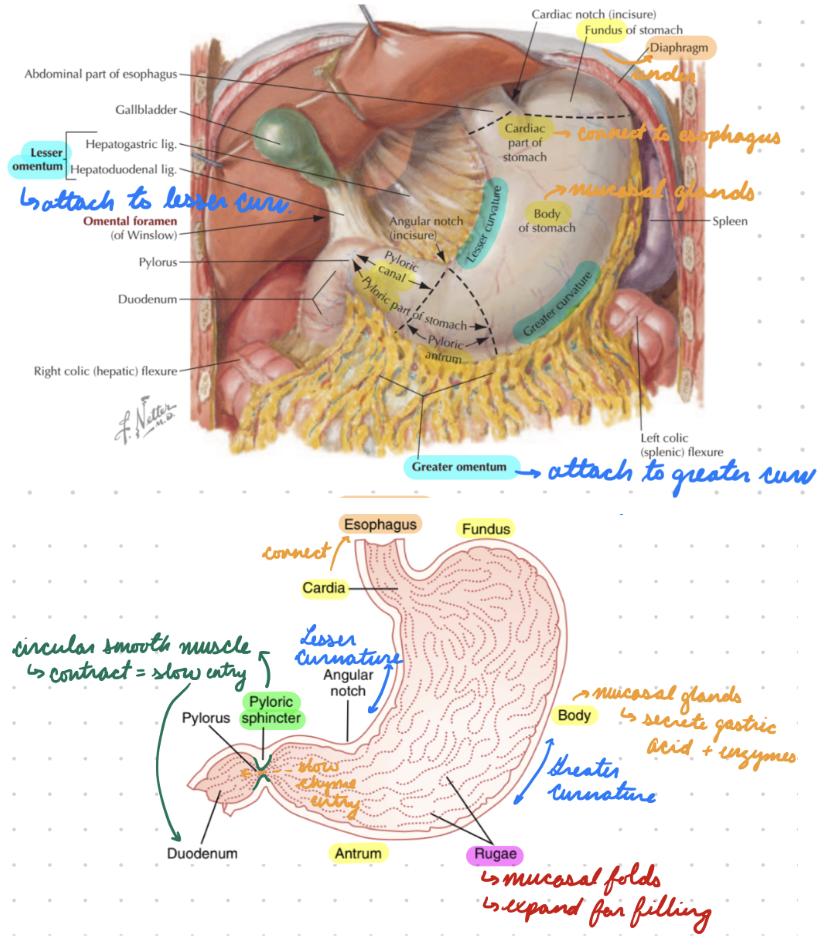
Stomach: Pyloric Sphincter
Circular smooth muscle
Function: Normally contracted = Slow chyme emptying into duodenum
Innervation: CN X
Factors Hindering:
Neurological dysfunction
Decreased inhibitory NTs
Muscle fibrosis + hypertrophy
Medications
Anticholinergics
Opioids

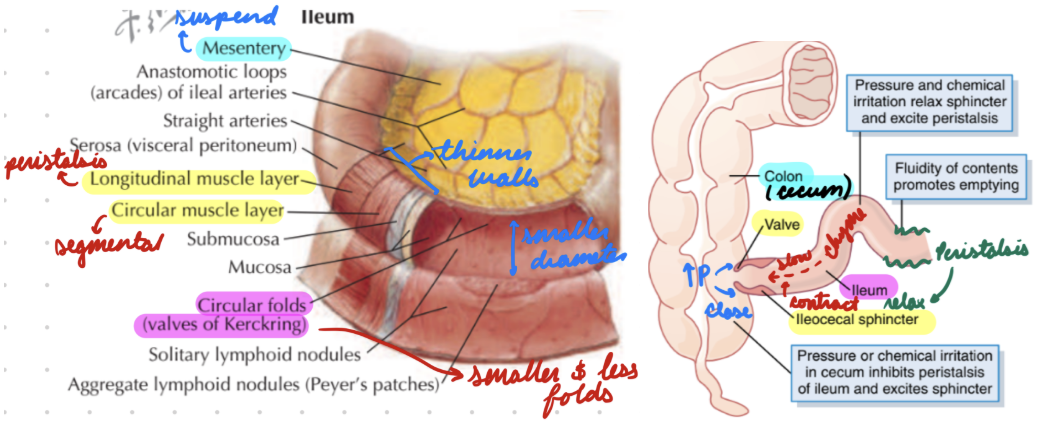
Small Intestine: Smooth Muscle
Inner: Circular layer
Thicker
Folds of Kerckring: Mucosal folds = Increase SA = Increase absorption
Outer: Longitudinal layer
Thinner
Contract = Peristalsis
Small Intestine: Villi
Finger-like projections from folds of Kerckring
Microvilli: Project off villi
Increase SA = Increase absorption
Absorb water throughout
Intestinal Crypts of Lieberkuhn: Between villi
Capillaries: In vasa recta

Villi: Intestinal Crypts
Walls:
Enterocytes: Secrete + reabsorb nutrients + electrolytes
Goblet Cells: Secrete mucus
Protect epithelium
Base:
Paneth Cells:
Secrete antimicrobial proteins, lysozymes, phospholipase A2
Regulate microbiome + sterility = Innate immune defense
Secrete growth factors
Regulate crypt stem cell mitosis
Stem Cells: Differentiate into cells → Base to tips

Small Intestine: Duodenum
Shortest
Absorb:
Fat-soluble vitamins
Minerals
Simple carbs
Amino acids

Small Intestine: Jejunum
Large diameter + thicker walls
Smaller + less folds of Kerckring
Absorb:
Macronutrients
Water-soluble vitamins (B9/folate)

Small Intestine: Ileum
Longest
Small diameter + thinner walls
Larger + deep folds of Kerckring
Absorb:
Water-soluble vitamins (B12)
Bile salts
Ileocecal Valve: Smooth muscle sphincter connecting to cecum
Ileocecal Sphincter: Normally contracted = Slow contents entering cecum
Opened by peristalsis
Large Intestine: Smooth Muscle
Inner: Circular layer
Increase absorption
Outer: Longitudinal layer
Teniae Coli: 3 bands → Bunch into haustra
Peristalsis
Large Intestine: Cecum
Connect ileum + ascending colon
Appendix: Lymphoid tissue
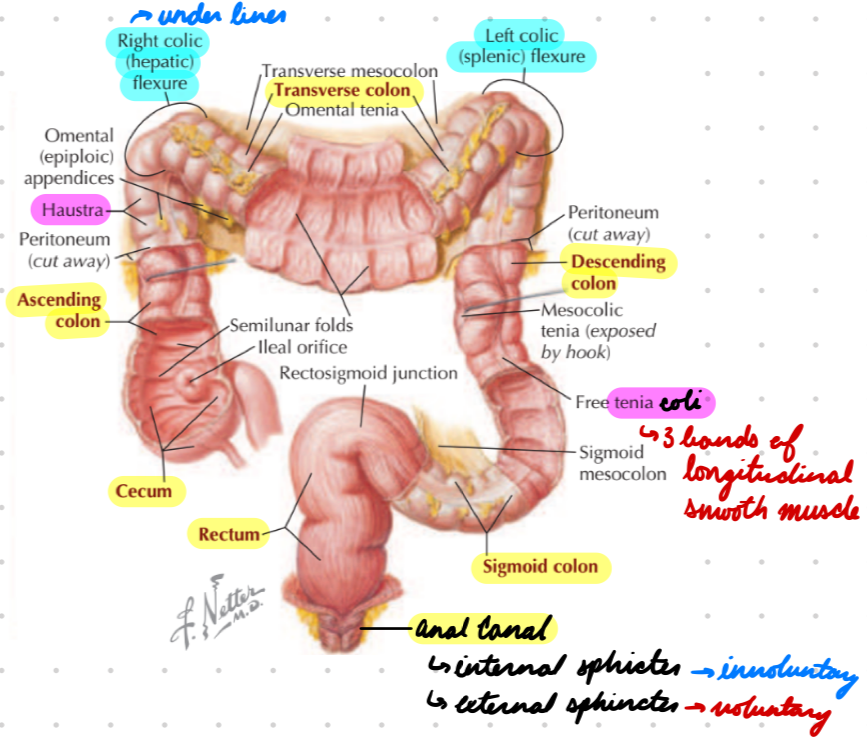
Large Intestine: Colon
Segments:
Ascending Colon: Right
Liver → Right colic/hepatic flexure
Transverse Colon: Right hepatic flexure → Left colic/splenic flexure
Descending Colon: Left
Descend to groin
Sigmoid Colon
Function:
Absorb water, electrolyte, vitamins
Proximal ½
Produce + store feces
Distal ½

Rectum + Anal Canal
Connect to anus
Internal Anal Sphincter: Involuntary control
Continuous with circular smooth muscle
Normally contracted
External Anal Sphincter: Voluntary control
Skeletal muscle

Rectum + Anal Canal: Defacation
Stool storage = Rectal distention
Threshold distension = Stretch receptors signal brain = Anal sphincters relax
Stool pass through
Enteric Nervous System: Description
Afferent + efferent nerve fibres controlling GI secretion + motility
Independent from brian + spinal cord
Modulated by SNS + PSNS
Enteric Nervous System: Contents
Enteric ganglia
Interstitial cells of Cajal (ICCs)
Enteric Nervous System: Enteric Ganglia Plexuses
Submucosal Plexus: Meissner plexus
In submucosa
Myenteric Plexus: Auerbach plexus
In muscularis propria (between circular + longitudinal muscle layers)
Enteric Nervous System: Enteric Ganglia NT
ACh
Dopamine
Serotonin
Enteric Nervous System: Enteric Ganglia Input
SNS:
Prevertebral ganglia (celiac, superior mesenteric, inferior mesenteric)
Splanchnic, hypogastric, colonic nerves
PSNS:
Vagus nerve
Spinal nerves (S2-4)
Enteric Nervous System: Enteric Ganglia Function
SNS Activation:
Decrease peristalsis + secretions
Constrict sphincters
PSNS Activation:
Increase peristalsis + secretion
Relax sphincters
Enteric Nervous System: ICCs
In intestine walls
Function: Pacemaker cells = Generate spontaneous electrical waves = Rhythmic smooth muscle contractions = Peristalsis
Swallowing Phases
Phase 1: Voluntary
Tongue push food → Pharynx (bolus)
Phase 2: Pharyngeal
Bolus in pharynx = Activate epithelial swallowing receptors = Initiate autonomic peristaltic pharyngeal muscle contractions
UES relax = Bolus → Esophagus
Phase 3: Esophageal
Continue peristalsis = Relax LES = Bolus → Stomach

GI Pathologies: Delayed Gastric Emptying
Gastroparesis
Delayed Gastric Emptying: Etiology
Idiopathic (most common)
Poor glycemic control (diabetes)
Neurological disorders
Parkinson
MS
Connective tissue disorders
Scleroderma
Medications:
Opioids
TCAs
CCBs
Lithium
GLP-1 receptor agonists
Pramlintide
Amylin analog
Insulin therapy adjunct
Delayed Gastric Emptying: Pathophysiology
Impaired stomach relaxation during eating (accommodation)
Abnormal nerve conduction
Electrical dysrhythmias
Vagal nerve injury
Pyloric dysfunction
Visceral sensation
Delayed Gastric Emptying: Clinical Presentation
Nausea/vomiting
Bloating
Upper abdo pain + distension
Decreased appetite
Early satiety
Postprandial fullness
Delayed Gastric Emptying: Treatment/Management
Dietary modifications
Pharmacological
Treat underlying conditions
Delayed Gastric Emptying Treatment: Pharmacological
Prokinetics
Antiemetics
Prokinetics
MOA: Dopamine receptor antagonist = Smooth muscle contraction = Increase gastric contraction + motility and decrease sphincter tone
Ex:
Metoclopramide: First-line
Adverse Effects: Tardive dyskinesia (long-term)
Erythromycin: First-line
Prucalopride: Second-line
NOT for IBD + megacolon
Antiemetics
5-HT3 antagonists
Ex: Ondansetron
NK1 antagonists
Ex: Aprepitant
GI Pathologies: Abnormal Autonomic Control
Enteric nervous system dysfunction
Abnormal Autonomic Control: Etiology
Stroke
Parkinsonism
MS
Diabetic neuropathy
Abnormal Autonomic Control: Pathophysiology
PSNS dysfunction (enteric neuron loss in plexuses + decreased ICCs) = Decreased peristalsis + secretions = Decreased defecation
Abnormal Autonomic Control: Clinical Presentation
Dysphagia
Constipation
Diarrhea
Fecal incontinence
Abnormal Autonomic Control: Treatment/Management
Treat underlying condition
GI Pathologies: Immobilization Pathophysiology
Inactivity = Decreased colonic mass propulsion through descending + sigmoid colon = Decreased defecation
Immobilization: Clinical Presentation
Constipation
Fecal impaction
Immobilization: Treatment/Management
Mobilization
GI Pathologies: Inadequate Oral Intake Etiology
Malnutrition
Anorexia
Dysphagia
Polypharmacy
Opioids
Anticholinergics
Inadequate Oral Intake: Pathophysiology
Decrease fibre + vitamin (fat-soluble + B) + fluid intake = Decreased stool bulk + slow gastric transit
Inadequate Oral Intake: Clinical Presentation
Weight loss
Constipation
Inadequate Oral Intake: Treatment/Management
Nutrient replacement
GI Pathologies: Prolonged Colonic Transit
Secondary constipation
Prolonged Colonic Transit: Etiology
Older age
Reduced mobility
GI
Diverticulosis + diverticulitis
Colon cancer
Neurological
Stroke
Neuropathy
Diabetic
B12 deficiency
Hirschsprung disease
Heritable disorder
No neural crest cell migration to distal colon
Metabolic
Hypokalmeia
Hypothyroidism
Hyperparathyroidism
DM
Polypharmacy
Fe supplements
Ca2+ supplements
CCBs
Opioids
Anticholinergics
Prolonged Colonic Transit: Pathophysiology
Altered Stool Consistency:
Lack of exercise, decreased fluid + fibre intake, colon changes = Slow stool passage
Prolong water absorption = Dry + hard stool = Irregular bowel emptying = Constipation
Altered Bowel Motility:
Drugs, endocrine abnormalities, neurological pathologies = Ineffective peristalsis
Difficulty passing stool (independent of consistency) = Irregular bowel emptying = Constipation
Prolonged Colonic Transit: Clinical Presentation
Abdo pain
Bloating
Constipation
Straining
Incomplete defecation sensation
Hard stool
Prolonged Colonic Transit: Treatment/Management
Nonpharmacological
High-fibre diet
Hydration
Physical activity
Pharmacological
Laxatives
Intestinal secretagogues
Laxative Classes
Bulk-forming (fibre)
Osmotic
Stimulant/secretory
Stool softener (emollient)
Laxatives: Bulk-Forming
Ex: Methylcellulose, psyllium husks, polycarbophil
Indications: First-line (diet modifications)
MOA: Increase water absorption = Stretch bowel walls = Stimulate peristalsis
Adverse Effects:
Bloating
Diarrhea
Worsen constipation
Laxatives: Osmotic
Ex: Polyethylene glucose (PEG), lactulose, sorbitol, Mg2+ salts
Indications: First-line
MOA: Draw water into intestinal lumen = Stimulate peristalsis
Adverse Effects:
Hypokalemia
Metabolic alkalosis
Dehydration
Bloating
Diarrhea
Laxatives: Stimulant/Secretory
Ex: Senna, bisacodyl, Na+ picosulfate
Indications: + if persisting symptoms (short course)
MOA: Increase electrolyte secretion = Gastric neural depolarization = Stimulate peristalsis
Adverse Effects:
Diarrhea
Melanosis coli
Colonic hyperpigementation
Laxatives: Stool Softener
Ex: Docusate
Not recommended
MOA: Soften stool = Easier passage
Adverse Effects: Abdo pain + cramps
Intestinal Secretagogues
Ex:
Linaclotide
Lubiprostone
Plecanatide
Indications: Persisting symptoms
MOA: Increase water, HCO3-, Cl- secretion = Decrease colonic transit time
Adverse Effects:
Diarrhea
Nausea
Seizure: Description
Excessive + hypersynchronous activity in cortical neurons → Transient symptoms
Seizure: Classification
Focal
Generalized
Motor
Nonmotor
Focal Seizures
In 1 hemisphere
Symptoms:
Motor
Nonmotor
Awareness:
Aware
Impaired awareness
Generalized Seizures
In both hemispheres
Motor:
Tonic-Clonic: Loss of consciousness + rhythmic muscle contractions
Clonic: Muscle jerking
Tonic: Muscle stiffening
Myoclonic: Brief + involuntary muscle twitches
Atonic: Muscle tone loss/reduction
Nonmotor: Absent seizures
Typical: Brief nonconvulsive seizure
Atypical: Longer nonconvulsive seizure
Seizures: Treatment/Management
Treat underlying cause
Hypoglycemia
Hyperthermia
Electrolyte imbalances
Alcohol withdrawal
Meningitis
Pharmacological
Nonpharmacological
Seizure Treatment: Pharmacological
Lamotrigine
Valproic acid/valproate
Ethosuximide
Phenobarbital
Carbamazepine/oxacarbazepine
Levetiracetam
Phenytoin
Topiramate
Gabapentinoids
Pregabalin
Gabapentin
Seizure Treatment: Lamotrigine
Indications:
First-line
Focal
Pregnancy
Second-line: Generalized
MOA: Inhibit voltage-gated Na+ channels = Decrease glutamate release
Adverse Effects:
Stevens-Johnson syndrome
Immune reaction causing skin blistering + epidermal detachment
GI symptoms
Dizziness
Seizure Treatment: Valproic Acid/Valproate
Indications:
First-line
Tonic-clonic
Myoclonic
Atonic
Atypical absence
Alternative: Typical absence
MOA:
Inhibit GABA transaminase = Increase GABA
Inactivate Na+ and Ca2+ channels
Adverse Effects:
Tremor
Alopecia
Teratogenic
Seizure Treatment: Ethosuximide
Indications:
First-line: Typical absence
MOA: Inhibit voltage-gated Ca2+ channels in thalamus
Adverse Effects:
GI symptoms
Skin allergy (Stevens-Johnson syndrome)
Fatigue
Headache + dizziness
Seizure Treatment: Phenobarbital
Indications:
First-line: Children
MOA: GABA agonist
Adverse Effects:
Sedation
Resp depression
Induce CYP450 synthesis
Seizure Treatment: Carbamazepine/Oxacarbazepine
Indications:
Alternative: Focal
MOA: Inhibit voltage-gated Na+ channels
Adverse Effects:
SIADH
Stevens-Johnson syndrome
Induce CYP450 synthesis
Teratogenic
Seizure Treatment: Levetiracetam
Indications:
Alternative: Focal
MOA: Modulate GABA + glutamate release and inhibit voltage-gated Ca2+ channels
Adverse Effects:
Fatigue
Nausea
Sedation
Seizure Treatment: Phenytoin
Indications:
Alternative: Tonic-clonic
MOA: Inhibit voltage-gated Na+ channels
Adverse Effects:
Hirsutism