Multiple Tube Fermentation Test & Eosin Methylene Blue (EMB) Agar
 Call Kai
 Learn
 Practice Test
 Spaced Repetition
 Match
 Flashcards
 Knowt Play
1/22

Earn XP
Description and Tags
Vocabulary practice flashcards covering Multiple Tube Fermentation methods (LTB, BGLB, EC broths), coliform characteristics, and Eosin Methylene Blue (EMB) agar differential and selective properties.
23 Terms
Multiple Tube Fermentation Test (Purpose)
A test designed to presumptively identify coliform bacteria in a water sample.
Selective Media
Culture media that inhibits the growth of certain microbes in order to select for specific microbes.
Differential Media
Culture media designed to differentiate between microbes based on their biochemical activity.
Lauryl Tryptose Broth (LTB)
A medium used in presumptive coliform identification containing tryptose for general growth, lactose as a fermentable sugar, and sodium lauryl sulfate as a selective agent.
Sodium Lauryl Sulfate
A detergent component in LTB that acts as a selective agent by inhibiting the growth of Gram-positive cells.
Positive LTB Result
Appearance of turbidity and a gas bubble inside the Durham tube, indicating presumptive coliform presence.
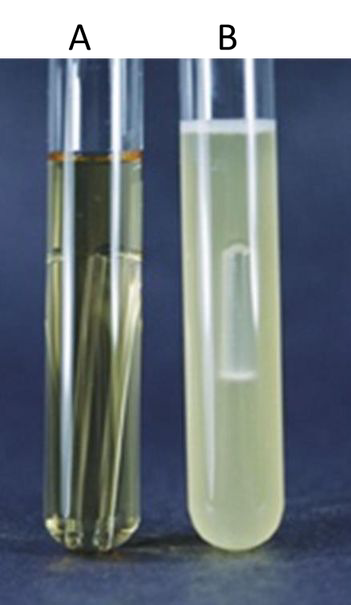
LTB Broth Test Tubes (A vs. B)
Tube A is negative (clear without gas); Tube B is a positive presumptive coliform result showing turbidity and gas accumulated in the Durham tube.
Brilliant Green Lactose Bile (BGLB) Broth
A medium composed of peptones for general growth, lactose as a differential fermentable sugar, and brilliant green with bile salts as selective agents.
BGLB Selective Agents
Brilliant green and bile salts, which inhibit the growth of Gram-positive organisms.
Positive BGLB Result
Turbidity accompanied by a gas bubble in the Durham tube, indicating presumptive coliform presence.
EC (Escherichia coli) Broth
A medium containing pancreatic digest of casein for general growth, lactose for differentiation, and bile salts incubated at 45∘C to select for Escherichia coli.
EC Broth Selective Conditions
Bile salts combined with an incubation temperature of 45∘C, which inhibit the growth of Gram-positive cells and coliforms other than Escherichia coli.
Positive EC Broth Result
Turbidity and a gas bubble inside the Durham tube, confirming that Escherichia coli is present.
Coliform
Gram-negative, bacilli-shaped bacteria that ferment lactose using the enzyme beta-galactosidase and produce gas detectable in a Durham tube; used as an indicator of fecal contamination.
Beta-Galactosidase
The endoenzyme utilized by coliform bacteria to ferment lactose into acid and gas.
Coliform Bacteria (Examples)
Escherichia coli, Enterobacter aerogenes, Citrobacter freundii, and Klebsiella pneumoniae.
Eosin Methylene Blue (EMB) Agar (Purpose)
A medium used to differentiate between possible and probable fecal coliforms.
Eosin and Methylene Blue (Roles)
Dyes that function selectively by inhibiting Gram-positive bacteria, and differentially as color indicators that reveal lactose fermentation.
EMB Result: Metallic Green Sheen or Dark Purple
Indicates a probable coliform and lactose fermenter producing the endoenzyme beta-galactosidase.
EMB Result: Pink Growth
Indicates a possible coliform and lactose fermenter producing the enzyme beta-galactosidase.
EMB Result: Colorless Growth
Indicates a non-lactose fermenter and non-coliform organism.
EMB Result: No Growth
Indicates Gram-positive bacteria whose growth is inhibited by the dyes eosin and methylene blue.

EMB Agar Plate Interpretations (A, B, C, D)
A: Colorless growth (non-coliform, non-lactose fermenter); B: Dark purple (probable coliform, lactose fermenter); C: Metallic green sheen (probable coliform, lactose fermenter); D: No growth (Gram-positive bacteria).