Unit 3 Biodiversity BIOL 101
 Call Kai
 Learn
 Practice Test
 Spaced Repetition
 Match
 Flashcards
 Knowt Play
1/102

There's no tags or description
Looks like no tags are added yet.
103 Terms
Biological diversity
the variety of all living things on Earth encompassing genetic differences, indivdidual species, and entire ecosystems
How many species inhabit Earth
2.16 million species measured (underestimate)
Estimates range from 5 million to 1 trillion
Why is measured species an underestimate of the total number of species
Lack of universally accepted definition for species
Largely unexplored regions of the planet (deep oceans, remote tropical canopies, etc.)
Microscopic organisms are difficult to isolate and ID and many species require expensive DNA testing to distinguish from lookalikes
There are new species constantly evolving
Too few taxonomists to name millions of species of unknown organisms before they face extinction
Levels of diversity
Genetic diversity, species diversity, and ecosystem diversity
Genetic diversity
Genetic variation (alleles) within a population (individuals not identical)
Helps populations adapt to changing environmental conditions
Makes it less likely that all individuals susceptible to the same disease
Preserves genetic variation needed to respond to future challenges
Maintains evolutionary potential
Species diversity
number of species and their relative abundances
Ecosystem biodiversity
the variety of habitats, biological communities, and ecological processes occurring across the biosphere
Carolus Linnaeus
1758
recognized species as fundamental unit of life
grouped similar species together in ever increasing hierarchy of classification
described Homo sapiens without designating a holotype
prior to 1959 was lectotype for Homo sapiens
remains in Sweden’s Uppsals Cathedral
Binomial nomenclature
unique two part name for every species

Important parts of measuring biodiversity
mathematical metics
geographic scale
sampling methods
How do we measure biodiversity
We count
Mathematical metrics for measuring diversity
Species richness (S) and Species evenness (E)
diversity indices: shannon index, and simpson diversity index
Species richness (S)
number of different species in an area
Species evenness (E)
how evenly individuals are distributed across species
Diversity indices
Combine species richness and evenness to calculate diversity
Simpson diversity index and shannon index
Simpson diversity index
emphasizes the dominance of common species
Shannon index
gives more weight to the diversity contributed by less common species
Geographic scales of diversity
Alpha, beta, and gamma diversity
Alpha (α) diversity
diversity within a single specific local area or ecosystem
e.g. the number of species in one pond
beta (β) diversity
difference in species composition between two different areas
based on concept measuring community composition change from place to place
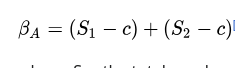
Additive species turnover
Beta diversity calculated by counting the unique species
where S is total species at a site and c is the number of species shared between sites
Whittaker’s classic formula (ratio method)
it measures beta diversity by comparing regional diveristy to local diversity
where B is beta diveristy, Y is gamma diversity, and a is alpha diversity

Gamma (γ) diversity
Overall regional biodiversity across a landscape hosting multiple ecosystems
Number of unique species across entire ecosystem
Why does geographical diversity matter for conservation?
Sites with similar alpha diversity may contain different species
High beta diversity means that different sites contribute unique species to the region
Protecting multiple habitats can maintain a greater regional biodiversity
Conservation needs to consider the entire landscape not just individual sites but also genetic diversity
Sampling methods
Quadrants and transact sampling, canopy fogging and netting, environmental DNA (eDNA), and satellite and acoustic monitoring
Quadrant sampling
placing physical square frames across a habitat to count every plant, insect, or slow moving organism in that boundary
Transact sampling
running long lines across a habitat to count every plant, insect, or slow moving organism in that boundary
Canopy fogging
Using safe temporary knockdown mists to collect tree dwelling insects
Netting
Using fine mist nets to safely capture ,count, and release birds, bats, and aquatic life
Environmental DNA (eDNA)
Collecting water, soil, or snow samples and sequencing the genetic material left behind by local wildlife, revealing what organisms live nearby without ever needing to see them
Satellite imagery
Using satellite imagery to track changes in broad forest canopies
Acoustic monitoring
deploying microphone grids to record and identify bird calls, frog croaks, and bat clicks
why do sampling methods matter?
Different methods detect different species
sampling can favor certain species or habitats
consistent methods enable reliable comparisons between sites
rare or hidden species may be overlooked
accurate sampling helps identify biodiversity hotspots and prioritize conservation
Biodiversity hotspots
areas with exceptionally high biodiversity and many unique species
36 hotspots recognized worldwide support nearly 60% of the world’s plant, bird, mammal, reptile, and amphibian species
Ex. Brazil’s Atlantic Rainforest, and Africa’s Cape Floristic Region
How much have wildlife populations declined since 1970
73%
Criticisms of species decline metrics
analyses estimate an average decline of more than 50% driven by fewer than 3% of populations
extreme declines affect about 1% of populations and disproportionately involve larger animals
Global averages hide important differences among populations and regions
Extreme declines skew the average
Mass extinctions
when minimally 75% of species go extinct in a geologically short period of time
5 mass extinctions recognized in Earth’s history (End Ordovocian, Late Devonian, End Permian, End Triassic, End Cretaceous)
Systematics
the study of relationships of organisms
Taxonomy
classifying and categorizing organisms with the goal of communication and identification
in past 50 years has shifted towards a tool to describe evolution
Taxon (taxa pl.)
group of related organisms
How do you make a new species
be named according to the Code of Zoological Nomenclature
Taxon names must be unique and italicized
be published and illustrated with a diagnosis and description
designated one or more types
Principle of priority
The first validly published name has priority
Type
the representative or name bearer of the group
Each class has type order, each genus has type species, and each species must have one or more type individuals
Holotype
the single physical example of an organism used when a species was formally described
Edward D. Cope
Proposed Homo sapien type specimen in 1990s by Louie Psihoyos and Robert Bakker
Due to degenrative veneral disease was anatomically unsuitable to serve as ideal baseline benchmark for humanity
Ernst Mayr Species definition
An array of populations which are actually or potentially interbreeding and which are reproductively isolated from other such arrays under natural conditions (1942)
Limitations of biological species concept
asexual reproduction, fossil record, natural hybridization, geographic isolation, and horizontal gene transfer
Biological species concept issue: Asexual reproduction
in bacteria, archaea, and self replicating plants interbreeeding never occurs
Biological species concept issue: fossil record
no behavioral data or reproduction
Biological species concept issue: natural hybridization
fertile hybrid zones (coywolves)
Biological species concept issue: geographic isolation
populations separated by immense distance aren’t naturally tested, introducing guesswork into species assignment
Biological species concept issue: horizontal gene transfer
transfer of genetic material between organisms besides reproduction
Methods to group organisms
phenetic taxonomy, cladistic approach
Phenetic taxonomy
measuring, plotting and statistically grouping species based on morphology
Cladistic approach
classifying by branching points and shared derived traits
Cladistic categories
monophyletic clade, paraphyletic group, polyphyletic group
Monophyletic clade
A taxonomic group descendant from one ancestor containing all its descendants
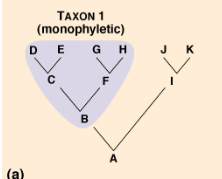
Paraphyletic group
groups in a taxonomic group of descendants from one ancestor but not including all descendants

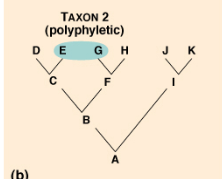
Polyphyletic
a taxonomic group of descendants from more than one ancestor
phylogeny
evolutionary history and relationships among organisms
all phylogenies are hypotheses
Homologous structures
structures that may have different function but derive from common ancestry
useful for reconstructing phylogeny
Analogous structures
structures in different organisms that may have the same function but different ancestral origin
result of evolutionary convergence
useless in reconstructing phylogenies
Cladistics
a method of reconstructing phylogenetic relationships using shared derived traits
clade (monophyletic group)
the common ancestor and all its descendants
synapomorphy
a homologous trait that evolved in a common ancestor and is shared by its descendants
cladogram
a simplified phylogenetic tree that lacks a scale of time
Branches
at the ends of which we list groups
nodes
where one branch splits into two groups due to evolution of new characters/traits
sister taxa
share an immediate common ancestor
polytomy
when three or more taxonomic groups arise from one node
shows unclear evolutionary history among descendant taxa
Root
base of tree that represents last common ancestor of all taxa in tree
What does cladistic analysis rely on
correctly distinguishing inherited characters from derived characters across all taxa in study
Pleisomorphic characters
inherited characters
apomorphic characters
derived characters
synapomorphies
apomorphic characters that are inherited
The principle of parsimony
simplest hypothesis most likely to be true (Occam’s razor)
cladogram with fewest steps most likely to be correct
Limits of phylogenetic trees
we cannot assume that branch sequence indicates actual ages of particular species (unless tree is calibrated to time or genetic change)
E.g can only say most recent common ancestor of wolf and otter lived before most recent common ancestor of wolf and coyote
Relative dating
Three domain system
Bacteria, Archaea, and Eukarya
baseline standard in biology
Horizontal Gene Transfer
Transfer of genes between organisms other than through parent to offspring inheritance
common in bacteria and archaea but also occurs in Eukarya
Can occur across evolutionary lineages making “tree” of life more like web
transformation, transduction, conjugation
Eukaryote evolution
evolved from a community of prokaryotes rather than one ancestor
Prokaryote contributions to Eukarya
bacterial ancestors became mitochondria and cyanobacterial ancestors became chloroplasts
Prokaryotes
10,500 species published (<1% of what’s out there)
unicellular
small cells (.5-5 μm in diameter)
lack membrane-bound nucleus, mitochondria, and chloroplasts
typically have a circular chromosome and reproduce asexually through binary fission
Why are prokaryotes so successful
small size
rapid reproduction (ex. E. coli divide approximately every 20 minutes)
long evolutionary history (3.5 billion years)
large population means high mutation potential
diverse adaptation enables them to live in many different environments
rapid evolution gives them diverse metabolic and structural adaptations
Bacterial shapes
cocci, bacilli, spirilla, and spirochetes
Cocci
spherical or round

Bacillia
rod shaped

spirilla
rigid spiral shaped

Spirochete
thin flexible spiral shaped

capsule
sticky outer layer of polysaccharides or proteins surrounding the cell wall
helps cells adhere to surfaces and to one another creating colonies or biofilms
protects against dehydration
Appendages
Fimbriae, pili, and flagella
Fimbriae
numerous short hair-like structures used for attachment
pili
help bring bacterial cells together for gene transfer
Flagella
used for movement
Bacterial species
a group of closely related bacteria defined primarily through genetic and evolutionary similarity
Bacterial strain
A particular genetic variant within a bacterial species
Different strains of the same species may differ in genes, characteristics and ability to cause disease
ex. E. coli variants some live harmlessly in gut while others cause disease
Transformation
The uptake of naked foreign DNA from the environment
living cells bind cell free DNA released from dead donor cells then specialized surface proteins pull foreign DNA inside
DNA segments are incorporated into hosts DNA

Natural competence
naturally competent species can take up extracellular DNA under certain conditions
Regulated competence
develops only at a particular growth stage or in response to environmental signals
Noncompetent species
lack the natural ability for DNA uptake
Artificial competence
induced competence in a lab setting (chemical treatment or electroporation)