S&B Shape, substance
 Call Kai
 Learn
Learn Practice Test
 Spaced Repetition
 Match
Match Flashcards
 Knowt Play
1/41

There's no tags or description
Looks like no tags are added yet.
Name | Mastery | Learn | Test | Matching | Spaced | Call with Kai | Chat |
|---|
No analytics yet
Send a link to your students to track their progress
42 Terms
Name of the shape + bond angle where there are 2 bonding regions and no lone pairs on the central atom
Linear 180°
Name of the shape + bond angle where there are 3 bonding regions and no lone pairs on the central atom
Trigonal planar 120°
Name of the shape + bond angle where there are 4 bonding regions and no lone pairs on the central atom
Tetrahedral 109.5°
Name of the shape + bond angle where there are 2 bonding regions and 1 lone pair on the central atom
Bent 120°
Name of the shape + bond angle where there are 3 bonding regions and 1 lone pair on the central atom
Trigonal pyramid 109.5°
Structure and bonding of a molecular solid
Molecules held in a 3D lattice by weak intermolecular forces
Structure and bonding of a metallic solid
Metal cations and delocalised valence electrons held in a 3D lattice by metallic bonding
Structure and bonding of an ionic solid
Cations and anions held in fixed positions in a 3D lattice by ionic bonds
Structure and bonding of graphite
Covalent network; each carbon bonded to 3 others in a trigonal planar arrangement forming sheets with weak forces between layers; one electron per atom is delocalised
Structure and bonding of diamond
Each carbon atom covalently bonded to 4 others in a tetrahedral 3D network
Structure and bonding of silicon dioxide
Si and O atoms covalently bonded in fixed positions in a giant 3D network
What is electron density?
Regions of negative charge
What causes an atom to sit in fixed positions?
Covalent bonds
Each electron cloud will repel other _____
Electron clouds
What does a molecule's shape describe?
The exact positions of all the atoms in space
What is used to predict the molecule's shape?
VSEPR
Electron density around an atom will repel each other as far away as possible to _____
Minimise repulsion and become more stable
What are examples of electron density?
Bonds and lone pairs
What are attractions?
Forces that occur between particles
Angle for bent with 2 lone pairs
109.5°
How many electron clouds does 2 bonds and 2 lone pairs have?
4
What are bond angles determined by?
Regions of electron density around the central atom
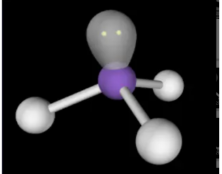
What shape is this
what electron arrangement and what angle?
3 bonding regions, 1 lone pair
Shape: Trigonal pyramidal
Electron arrangement: Tetrahedral
Bond angle: 109.5°

What shape is this
what electron arrangement and what angle?
2 bonding regions, 2 lone pairs
Shape: Bent (V-shape)
Electron arrangement: Tetrahedral
Bond angle: 109.5°

What shape is this
what electron arrangement and what angle?
3 bonding regions, 0 lone pairs
Shape: Trigonal planar
Electron arrangement: Trigonal planar
Bond angle: 120°

What shape is this
what electron arrangement and what angle?
2 bonding regions, 1 lone pair
Shape: Bent (V-shape)
Electron arrangement: Trigonal planar
Bond angle: 120°
What molecule shapes are asymmetrical?
Trigonal pyramidal and bent (V-shape)
Describe the general structure and bonding of a molecular solid
Individual particles are molecules and weak intermolecular forces exist between nearby molecules holding the molecules in fixed positions in a 3D lattice
How many valence electrons are shared in a double bond?
4
A molecule's shape describes the exact positions of all atoms in space. How is it predicted?
Using VSEPR
Each electron cloud will repel other electron density. Why?
Regions of electron density are negatively charged and repel each other
What properties do ionic substances have?
High melting and boiling points; brittle; conduct electricity when melted or dissolved
What properties do molecular substances have?
Low melting and boiling points due to weak intermolecular forces; often gases or liquids at room temperature; do not conduct electricity
What properties do covalent network solids have?
Very high melting and boiling points; extremely hard (except graphite); generally poor electrical conductors (except graphite)
What properties do metallic solids have?
Malleable; ductile; good heat and electrical conductors; mostly solid at room temperature
What type of particles does silicon dioxide (SiO₂) have?
Silicon and oxygen atoms
Name of the shape + bond angle where there are 2 bonding regions and 2 lone pairs on the central atom
Bent 109.5°
Describe the general structure and bonding of a metallic solid
Individual particles are metal cations and delocalised valence electrons. Metallic bonds are the electrostatic attraction between metal cations and nearby delocalised valence electrons. These hold the cations in fixed positions in a 3D lattice.
Describe the general structure and bonding of an ionic solid
Individual particles are positive and negative ions. Ionic bonds are the electrostatic attraction between oppositely charged ions. These hold the ions in fixed positions in a 3D lattice where each positive ion is surrounded by negative ions and vice versa.
Describe the general structure and bonding of graphite
Covalent network made of carbon atoms. Each carbon atom uses only 3 of its 4 valence electrons to covalently bond to 3 other atoms in a trigonal planar arrangement. This forms flat sheets of carbon atoms that stack on top of each other and there are weak attractions between the sheets. The unbonded valence electron of each atom is delocalised.
Describe the general structure and bonding of diamond
Individual particles are carbon atoms. Each carbon atom is covalently bonded to 4 others in a tetrahedral arrangement. The covalent bonds hold the atoms in fixed positions in a giant 3D structure.
Describe the general structure and bonding of silicon dioxide
Individual particles are silicon and oxygen atoms. The atoms are covalently bonded to each other. The covalent bonds hold the atoms in fixed positions in a giant 3D structure.