Biochemistry exam 3
 Call Kai
 Learn
 Practice Test
 Spaced Repetition
 Match
 Flashcards
 Knowt Play
1/42

There's no tags or description
Looks like no tags are added yet.
43 Terms
Functions of carbohydrates
Energy storage, structural support, signaling
How many carbons are in the ring of a furanose
5
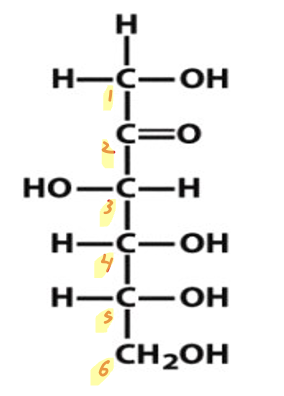
Draw the haworth diagram of this carb in alpha form

How many carbons are in the ring of a pyranose
6

Draw the haworth diagram of this carb in alpha form

Which carbon is the anomeric carbon
Carbon 1
Disaccharides can be recognized by which type of bond
Glycosidic bond
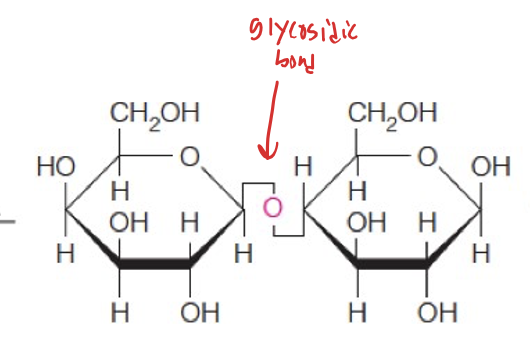
How many monosaccharide units are in oligosachharides
3-10 units
Similarity and difference between glycolipid and glycoprotein
Both involve oligosaccharides, one bonds to a lipid and the other bonds to a protein
Which amino acids can a carb connect to and create a glycoprotein
Ser, Thr, Tyr, Asp, Gln
How many monosaccharide units are in polysaccharides
10+ units
Definition of homopolysaccharides
Repeating uniform monomeric sugar
Definition of heteropolysaccharides
Contains 2 or more different repeating monomeric sugars
Characteristics of amylose (branching, water solubility, energy storage length)
Highly branched, water insoluble, long term energy storage
Characteristics of amylopectin (branching, water solubility, number of glucose units)
Branched (not as much as amylose), water soluble, 1 million glucose units, short term energy
Where is glucose stored
Mostly liver, some in skeletal muscle
Is glycogen used for short, medium, or long term energy storage
Short
Is amylopectin used for short, medium, or long term energy storage
Medium
Is amylose used for short, medium, or long term energy storage
Long
Purpose of cellulose
Structural support in plants
Are cellulose and chitin homo- or hetero- polysaccharides
Homo-
Purpose of chitin
Structural support
Water solubility of chitin
Water insoluble
Where does glycolysis take place in
Cytosol
Chemical logic of Glucose to G6P in hydrolysis
More glucose enters cell due to concentration being low, Adding phosphate makes G6P and traps Glucose in cell, Increased G6P concentration pushes reaction forward, Sets up higher energy intermediate
Chemical logic of G6P to F6P
Makes more symmetrical molecule, OH on carbon 1 is easier to phosphorylate when out of ring
Chemical logic of F6P to F1,6bP
Rate limiting, Makes most symmetrical molecule, Push reversible forward
Chemical logic of F1,6bP to DHAP + G3P
Doesnt waste DHAP
Chemical logic of G3P to 1,3 bPG
Makes a high energy phosphate containing intermediate to later make ATP
Chemical logic of 3 PG to 2 PG
Makes another high energy phosphate intermediate to later make ATP
Chemical logic of PEP to PYR
Keep PEP conc low to pull all reversibles forward
Draw Glucose, G6P, F6P, F16bp, PEP, and PYR
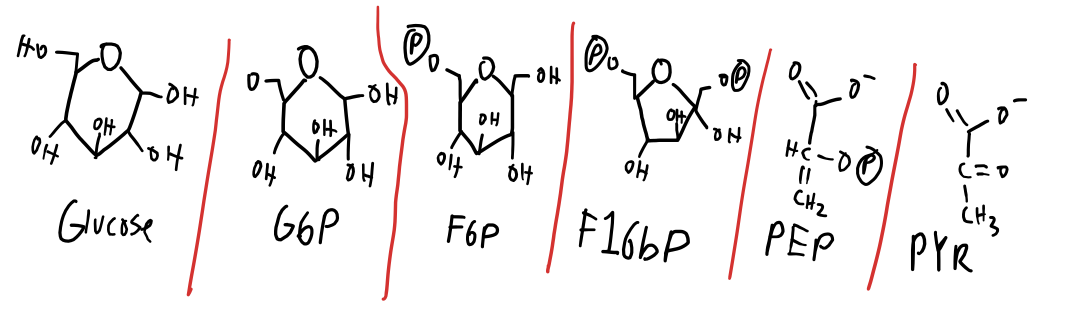
Draw Lactate and ATP

What is the structural difference between NAD+ and NADH
NADH has an O- on one of its phosphates
What can happen to the pyruvate that is generated in glycolysis
Enter PDC/TCA, Become lactic acid, or Become alanine
Difference between autotroph and heterotroph
Autotroph can make their own food, heterotroph cant
What is the net gain for ATP, NADH, and Pyr in glycolysis
2 ATP, 2 NADH, 2 Pyr
Why does the hydrolysis of ATP release energy
More entropy due to more products, better charge separation, more resonance than the reactants
Difference between organic and inorganic molecules
Organic molecules have C-H bonds
Are coenzymes organic or inorganic molecules
Organic
What does OIL RIG stand for
Oxidation Is Loss of electrons
Reduction Is Gain of electrons
Between NAD+ and NADH, which is more reduced and which is more oxidized
Nad+ is oxidized, NADH is reduced
Where does glucose come from to be used in glycolysis
Diet or from being stored in the liver