ENGR 210 Ch 10, 11 MCQs
 Call Kai
 Learn
 Practice Test
 Spaced Repetition
 Match
 Flashcards
 Knowt Play
1/35

There's no tags or description
Looks like no tags are added yet.
36 Terms
Name the first general stage that accompany a phase transformation.
Nucleation
Name the second general stage that accompany a phase transformation.
Growth
For many technologically important metal alloys, the usual state or microstructure is:
A metastable one
What element is the primary constituent of ferrous alloys?
Iron
All ferrous alloys have similar microstructures.
False
Which type of steel contains only residual amounts of alloying elements?
Plain carbon steel
Which of the following microconstituents/phases is (are) typically found in a low-carbon steel?
Pearlite and ferrite
What characteristics distinguishes stainless steels from other steel types?
They are more corrosion resistant
The strengths of typical low-carbon steels are often improved by heat treatment.
False
What is the typical carbon concentration range for medium-carbon steels?
0.25 wt% - 0.60 wt% C
Which type of steel has the designation 4330?
Alloy steel

Which four elements in the list below are alloyed with high-carbon steels to improve their hardnesses?
Tungsten, Molybdenum, Chromium, Vanadium

Which of the following microconstituents/phases are most commonly found in stainless steels?
Ferrite, Martensite, and Tempered martensite

Which of the following stainless steel types may be magnetized?
Ferritic and martensitic

Which of the following is the typical carbon concentration range for cast irons?
3.0 wt% - 4.5 wt% C

Which of the following microconstituents/phases is (are) most commonly found in gray cast irons?
Graphite, Pearlite, and Ferrite

Which of the following cast iron types is stronger and more ductile?
Nodular irons

Which of the following changes occur(s) when white cast irons are converted to malleable irons?
The ductility increases and the cementite is converted into graphite.
Most copper alloys may be hardened by heat treatment.
False

Which of the following elements, when alloyed with copper, results in an alloy that is precipitation hardenable?
Beryllium
On the basis of specific strength, aluminum alloys are stronger than steel alloys.
True
For which of the following reasons have magnesium alloys replaced engineered plastics with comparable densities?
Magnesium alloys are stiffer, more recyclable, and cheaper to produce.
What alloy is most suitable for high-temperature furnace elements that are used in oxidizing environments?
Platinum

In which of the following groups are all the metals refractory metals?
Niobium, molybdenum, tungsten, and tantalum
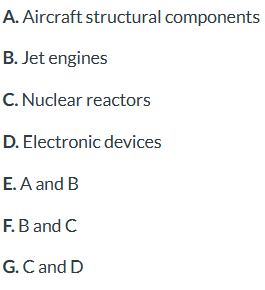
Superalloys are commonly used in which of the following applications?
Jet engines and nuclear reactors

Which of the following alloys is most suitable for a drill bit?
Tool steel
Hot working takes place at a temperature that is above a metal's:
Recrystallization temperature
Casting operations are only used for metals that have low ductilities such that hot or cold working would be difficult.
False

Which of the following may occur during an annealing heat treatment?
Stress may be relieved, ductility may increase, toughness may increase, and a specific microstructure may be produced.
Normalizing a ferrous alloy causes the average grain size to
Decrease
A normalizing heat treatment is terminated by cooling in
air (outside a furnace)

Which of the following influences the hardenability of a steel?
Its composition
The rate of heat transfer from the specimen during a Jominy end-quench test is nearly independent of composition.
True

Which of the three quenching media is most commonly used for alloy steels?
Oil
For precipitation hardening, the solution heat treatment consists of (1) heating the alloy to a temperature such that all solute atoms are dissolved to form a single-phase solid solution, and (2) quenching to produce a nonequilibrium supersaturated solid solution.
True
An alloy that has been precipitation hardened may be used at elevated temperatures without compromising its hardness and strength.
False