solid oral dosage forms pt 2
 Call Kai
 Learn
 Practice Test
 Spaced Repetition
 Match
 Flashcards
 Knowt Play
1/114

There's no tags or description
Looks like no tags are added yet.
115 Terms
What is the key difference between conventional and disintegrating tablets?
Disintegration → dissolution → absorption
What are disintegrating tablets?
Conventional or plain tablets
What steps follow disintegration in tablet drug release?
Dissolution then absorption
What can be rate-limiting for bioavailability in tablets?
Disintegration, dissolution, or absorption
What must occur before absorption from a chewable tablet?
Disintegration in mouth but drug must be swallowed before absorption can happen
How do chewable tablets contribute to onset of action?
Rapid onset
Who are chewable tablets useful for?
Difficulty swallowing tablets
What is generally not included in chewable tablet formulations?
Disintegrants
. What excipients are often needed in chewable tablets?
Flavouring agents
What gas is released in effervescent tablets?
CO₂ during dissolution in water
How is CO₂ generated in effervescent tablets?
Carbonate + weak acid
What effect do effervescent tablets have on onset?
Rapid drug action
How does sodium bicarbonate affect gastric emptying?
Lowers stomach pH, increases emptying —> can lead to side effects
What are generally not needed in effervescent tablets?
Binders
What formulation aid is commonly needed in effervescent tablets?
Flavourings
What packaging consideration is important for effervescent tablets?
Moisture protection
How are compressed lozenges dissolved?
Slowly in mouth
Where does drug dissolve from a compressed lozenge?
In saliva
What is generally not required in compressed lozenges?
Disintegrants
What extra formulation considerations do compressed lozenges need?
Flavouring and colouring
What properties should fillers/binders have in lozenges?
Water-soluble, pleasant taste
Give an example filler for compressed lozenges.
Sugar
Where does drug release and absorption occur for sublingual/buccal tablets?
Mouth
How do sublingual/buccal tablets avoid first-pass metabolism?
Direct systemic absorption
What is the main advantage of sublingual/buccal delivery?
Rapid systemic effect - porous to facilitate disintegration
Why are mucoadhesive polymers used in buccal tablets?
Prolong residence time
How can hydrophilic polymers provide controlled release buccally?
High MW hydrophilic polymers attract water to form gum —> controlled release
What is modified release drug delivery?
Controlled drug release
What is the aim of modified-release systems?
Deliver API at desired rate/place (specific points in GI)/time
What therapeutic benefit can modified release provide overnight?
Maintain concentration in therapeutic range
How can modified-release systems affect dosing?
Reduce dosing frequency - chronotherapy
How can modified-release systems affect side effects and adherence?
Fewer side effects, better adherence
Where in the body can modified-release systems target drug release?
Specific GI tract locations
What are the two main approaches to modified release?
release modifying ingredients added to matrix
or application of modified release coating
What are other names for prolonged-release tablets?
slow release, extended release, sustained release, controlled release
What goal do prolonged-release tablets achieve?
Longer drug action
What duration is typically aimed for with prolonged release?
Over 12 hours-24hr

What blood concentration profile is characteristic of prolonged release?
Therapeutic level maintained longer
Which drugs are most suitable for prolonged release?
BCS class I
. What type of matrices are used in hydrophilic matrix systems?
Swellable soluble matrices

What happens when hydrophilic polymers contact water?
Form gel
. What are advantages of hydrophilic matrix systems?
Good safety and drug loading
What problem can occur with hydrophilic matrices?
Dose dumping - food effects can be an issue (taken on full stomach, empty stomach etc)
How does an insoluble polymer matrix control release?
Drug trapped in inert polymer

How is drug released from insoluble matrices?
Through pores in matrix
Matrix remained intact throughout GI tract
What controls release rate in insoluble matrices?
Pore size and tortuosity
What happens to release rate as drug content falls in matrix systems?
Release decreases
What is the rate-limiting step in diffusion-controlled systems?
Drug diffusion
What is diffusion based matrix system?
pores present in matrix

What membrane feature controls release in reservoir systems?
Thin, water insoluble membrane
What happens in diffusion controlled release system?
Liquid penetrate dosage form, dissolving drug, drug diffuses our of dosage form
What factors affect diffusion rate in membrane-controlled systems?
Area, distance, diffusion coefficient
What is the rate-limiting step in dissolution-controlled systems?
Drug dissolution
Which drugs are suited to dissolution-controlled release?
Poorly soluble drugs
How can water-soluble drugs be modified for dissolution control?
Water soluble drugs can be modified into poorly soluble salts or coating drug particles
How can multiple release rates (pulsatile) be achieved by coatings?
Different thickness/solubility
. Why are dissolution-controlled systems used in delayed-release tablets?
GR Coating dissolves at higher pH
What controls release in erosion-controlled systems?
Rate limiting step: Matrix erosion
What happens when erosion-controlled matrix material is removed?
Matrix material liberated from surface of tablet, leading to exposure of drug to GI fluids
What Kinetic is erosion controlled release?
0 order
. Which polymers are commonly used in erosion-controlled systems matrix?
Matrix lipid, waxes, gelatine polymers
What is the rate-limiting step in osmotic systems?
Water influx
Rate limiting step is flow of liquid into dosage unit, driven by difference in osmotic pressure
What drives water entry into osmotic systems?
Osmotic pressure difference
What membrane is used in osmotic-release systems?
Semipermeable membrane
How does drug leave an osmotic-release device?
Osmotic transport of liquid in allows dissolution of drug, which leaves through single orifice/pores via connective transport
Why are gastroretentive formulations used?
Dosage form retained in stomach —> absorption in upper GI tract maximised
What are the 3 types of gastrorentention systems?
Mucoadhesion
Floating
Size increasing systems

Where is a gastroretentive dosage form retained?
Stomach
What triggers gastro-resistant delayed release?
Predetermined pH - membrane dissolves/disintegrates then
Where is drug released from gastro-resistant systems?
Small intestine
What is the aim of colonic drug delivery?
pH responsive polymers to target colon
What is one colonic-trigger mechanism?
Gut bacteria degradation
(e.g resistant starch), more reproducible, still experimental
What polymer type may be used for colonic delivery
: pH-responsive polymers
Which drug became the first FDA-approved 3D printed tablet in 2015?
Spritam (levetiracetam)

. What advantage does 3D printing provide for medicines?
Adjustable design and dose and shape
. How can 3D printing control release profiles?
Layer-by-layer printing
What tests are commonly performed on tablets?
Content uniformity, disintegration, dissolution, strength
Compare disintegration and dissolution testing.
Disintegration testing | Dissolution testing |
Mimics disintegration of tablets after oral administration | Release of drug and factors that will affect bioavailability |
Agitation of tablets in aqueous medium at set temp | Cumulative drug release measured against time |
Time to reach end point measured (tablet no longer visible) | Tablet placed in chamber w/ appropriate dissolution medium (varied depending on intended action) |
Not aiming to find in vivo correlation w/ absorption | Stirred vessel - rotating basket method and paddle method |
Used in formulation development | Continuous flow methods, arguably most accurate |
What is meant by a friable tablett?
Easily eroded during handling
What can friability cause in tablets?
Weight loss and appearance changes
What tablet defect is also checked during friability testing?
Capping
. How is friability assessed?
Weight loss and visual inspection
What weight loss is acceptable in friability testing?
Less than 1%
What is the purpose of fracture resistance testing?
Determine force needed to fracture
What type of compression is used in fracture resistance testing?
Diametral compression
What other name is given to fracture resistance testing?
Crushing strength/hardness testing
. What may different fracture patterns indicate?
Reasons for failure
What are the two parts of a hard capsule?
Cap and body
What materials are used to make hard capsules?
Gelatin/hypromellose, water, colourant
What holds a hard capsule together?
Cap and body indentations
What polymer properties are required for hard capsules?
Non-toxic, soluble, film-forming
For uniformity of weight, what is the percentage deviation for something:
More more than 80mg
More than 80mg but less than 250mg
250mg or more

Give examples of non-azo dyes used as colourants.
Erythrosine (E127)
indigo carmine (E132)
quinolone yellow (E104)
Give examples of pigment colourants and their colours
Iron oxide (E172) - black, red, yellow
Titanium oxide (E171) - white

What happens at each step during tablet manufacturing?
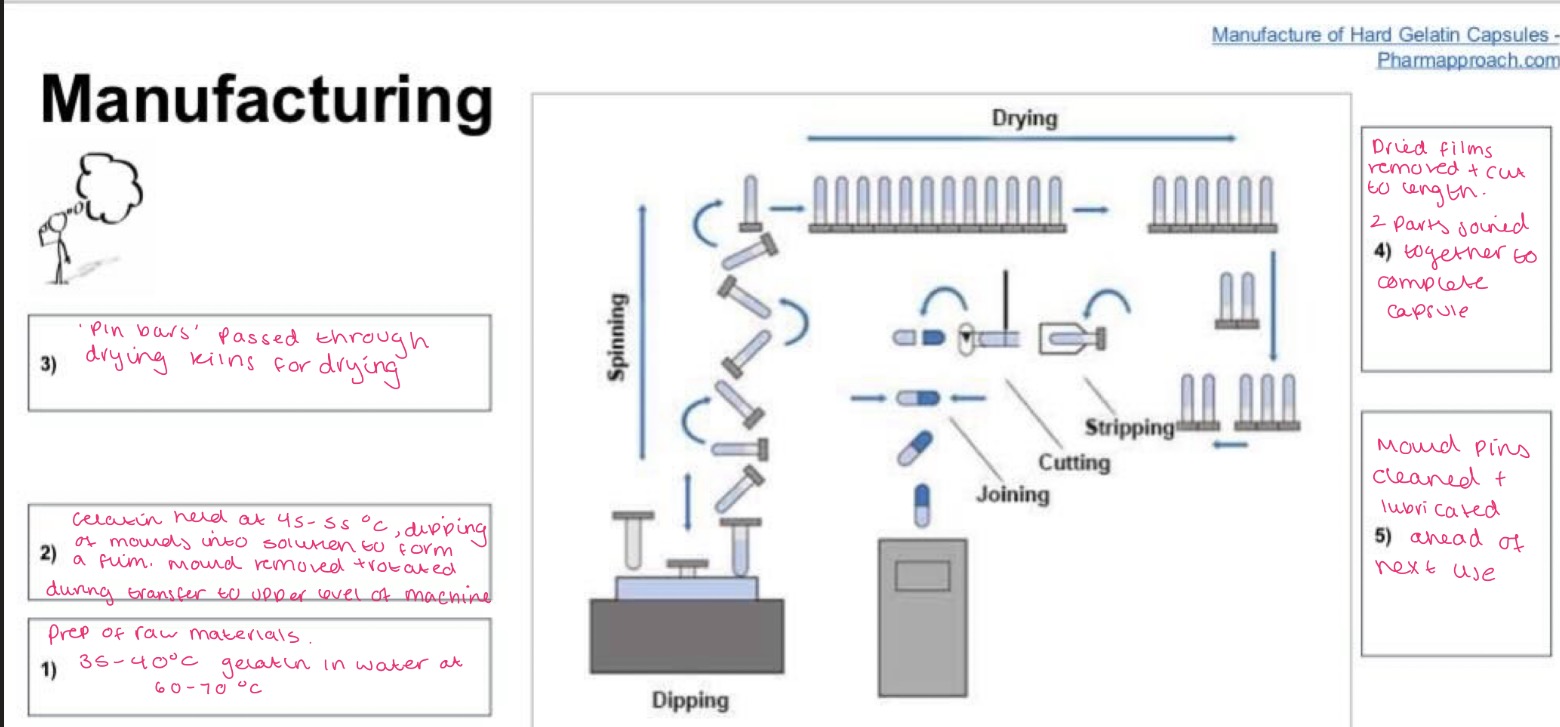
. How does dependent capsule filling work?
Capsule body measures powder
. What must occur in dependent capsule filling?
Complete capsule filling
What device is used in dependent capsule filling?
Auger
How does independent capsule filling work?
Powder measured separately in measuring device
Can capsules be partially filled in independent filling?
Yes