Signal Transduction
 Call Kai
 Learn
Learn Practice Test
 Spaced Repetition
 Match
Match Flashcards
 Knowt Play
1/25

There's no tags or description
Looks like no tags are added yet.
Name | Mastery | Learn | Test | Matching | Spaced | Call with Kai | Chat |
|---|
No analytics yet
Send a link to your students to track their progress
26 Terms
Cascade is what
Series of events where small signal is amplified
Cascade steps
1) A single receptor can interact with multiple tranducer molecules
2) A tranducer can interact with multiple effector enzymes
3) Second messengers can activate many kinases
4) Kinases can phosphorylate many target molecules
Signal cascade to break down glycogen step 1
Primary messenger: Hormone signals to breakdown glycogen
Signal cascade to break down glycogen step 2
Receptor binds hormone. Signal is transmitted into the cell
Signal cascade to break down glycogen step 3
Signal Transducer
Signal cascade to break down glycogen step 4
Effector enzyme
G proteins inactive when
bound to GDP

G proteins active when
bound to GTP

G protein turning signal on
Activation occurs when the G-GDP interacts with a hormone receptor complex activating the G protein by:
1) replacement of GDP with GTP
2) conformational change in a subunit
3) dissociation of b and g subunits
G-GTP now propagates a signal by interacting with an effector protein

G protein turning signal off
The a subunit slowly hydrolyzes GTP to GDP, dissociating from the effector protein.
G-GDP associates with b and g subunits and is ready for another cycle of activation

Adenylyl Cyclase Activation pathway
Hormone binds to and activates a stimulatory receptor (Rs).
Rs activates a stimulatory G protein (Gas)-GTP.
Gas-GTP activates adenylyl cyclase which synthesizes cAMP(5’,3’ AMP).
cAMP binds protein kinase A (PKA); this releases C subunits from R subunits and PKA is activated.
PKA phosphorylates target proteins (transcription factors) at Ser Thr, activating them.

Adenylyl Cyclase inhibitory pathway
An inhibitory hormone binds a receptor Ri, which activates a (Gia) by stimulating exchange of GTP in place of GDP.
Gia -GTP inhibits adenylyl cyclase, and the subsequent activation steps are reversed.
cAMP Synthesis turning the signal on
Adenylyl cyclase: cyclizes ATP to cAMP
cAMP Synthesis turning the signal off
Cyclic nucleotide phosphodiesterase: inactivates cAMP producing AMP
cAMP activates…
protein kinase A (PKA)
Inositol-phospholipid signaling pathway step 1
A receptor R binds a ligand and this activates a G protein Gq.
Inositol-phospholipid signaling pathway step 2
Gq activates a membrane-bound phospholipase C enzyme (PLC).
Inositol-phospholipid signaling pathway step 3
PLC hydrolyzes phosphatidylinositol 4,5 bisphosphate (PIP2).
Inositol-phospholipid signaling pathway step 4
The products of that hydrolysis are IP3 and DAG
Inositol-phospholipid signaling pathway step 5
IP3 diffuses to endoplasmic reticulum where it binds to Ca+2 channels and this opens the channels, transiently allowing more Ca+2 into the cell.
Inositol-phospholipid signaling pathway step 6
Ca+2 activates Ca+2- dependent protein kinases.
Activity of Ca 2+ and DAG
Ca2+ and DAG activate Protein Kinase C (C for Calcium)
Ca2+ activates Calmodulin (CaM) dependent Protein Kinase

Receptor Tyr kinase is what type of receptor
Insulin receptor
Receptor Tyr kinase works by
The tyrosine kinase domains of the receptor in the inactive state are separated
Upon ligand binding, a conformational change brings them together forming a dimer
When kinases are close together inside cell there is autophosphorylation.
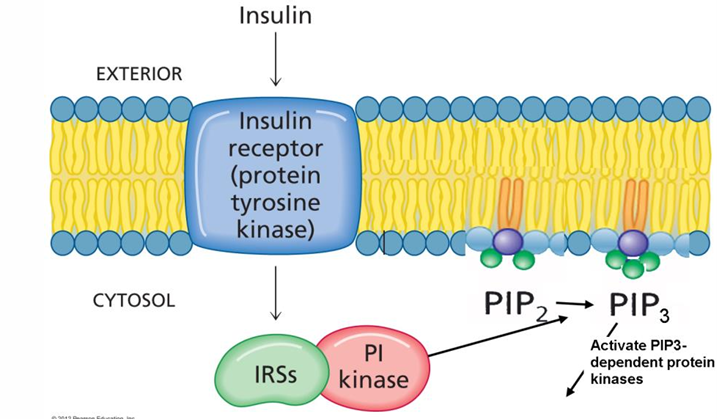
insulin tyrosine receptor kinase pathway
the insulin receptor phosphorylates insulin receptor substrates (IRSs); these activate a number of kinases involved in nutrient utilization.
One of the IRSs activates (PIP2) kinase.
PI kinase phosphorylates PIP2 to PIP3.
PIP3 activates PIP3-dependent protein kinases