PT 780 - Appraising evidence (Interventions)
 Call Kai
 Learn
 Practice Test
 Spaced Repetition
 Match
 Flashcards
 Knowt Play
1/40

There's no tags or description
Looks like no tags are added yet.
41 Terms
When considering an intervention for a patient you would look for what?
Rx options from an objectively tested point of view by incorporating best available evidence
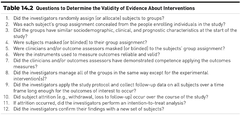
Overview of 12 questions to ask to assess study credibility by intervention.
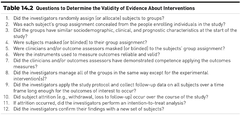
What does, did investigators randomly assign (allocate) subjects to group, address?
Addresses balance distribution of subject characteristics among groups in the study

What does, was each subjects group assignment concealed from the people enrolling individuals in the study, address?
Potential interference with group assignment process
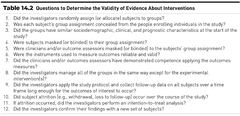
What does, did the groups have similar sociodemographic, clinical, and prognostic characteristics at the start of the study, address?
Potential differences among the groups that may influence study's results
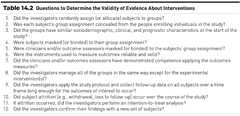
What does, were subjects, clinicians, and outcome assessors masked to the subjects' group assignment, address?
Potential changes in behavior by subjects, clinicians, and/or outcome assessors as a result of prior knowledge about the group to which subject is assigned (compensatory rivalry, resentful demoralization)

What does, were the instruments used to measure outcomes reliable and valid, address?
Ability to accurately capture a treatment effect if it exist

What does, did clinicians and/or outcomes assessors have demonstrated competence applying the outcomes measure, address?
Ability to accurately capture a treatment effect if it exist
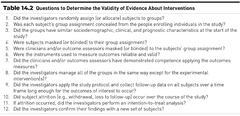
What does, did the investigators manage all of the groups in the same way except for the experimental intervention, address?
Potential influence upon study's results that may occur if groups are dealt with differently (ex. timing of intervention application, environment, instructions)

What does, did the investigators apply the study protocol and collect follow up data on all subjects over a time long enough for the outcomes of interest to occur, address?
Potential bias in the results due to insufficient time for the outcome of interest to occur
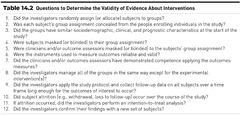
What does, did subject attrition (dropout) occur over the course of the study, address?
Potential loss of statistical power as well as the potential for differences to be created between (among) groups that are unrelated to the experimental intervention
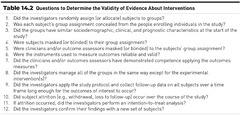
What does, if attrition occurred, did the investigators perform an intention-to-treat analysis, address?
Potential bias in results due to subject non-compliance with protocol for group they were assigned (preserves random allocation process and sample size)
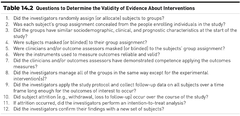
What does, was the study repeated on a second set of subjects, address?
Reproducibility of the results (often not included due to funding reasons or lack of subjects)

What are some additional considerations when assessing the study credibility of an intervention?
Is there a detailed description of:
- Setting
- Inclusion criteria
- Exclusion criteria
- Protocol for intervention

Which study design is the best for controlling bias, but may overshadow clinical relevance if excessively controlled?
Experimental (RCTs)

Which study design is more vulnerable to bias, but may be more clinically relevant?
Quasi-experimental

Which study design is most vulnerable to bias, but may be most clinically relevant?
Non-experimental (observational)
Test of differences can vary by?
Parametric or nonparametric
Level of measurements
Number of groups
Adjustment of covariates (ANCOVA)
Multiple DVs (MANOVA)
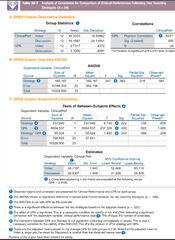
An ANCOVA test provides what information?
Interaction effect between two variables

In the study pictured, determine the significance of each variable and if the interaction effect is significant.
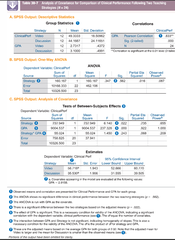
Explain the graph pictured.

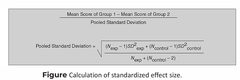
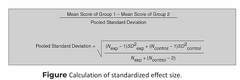
What is the difference between effect size and effect size index (Standardized ES)?
Effect size is the difference between the means of two groups
Effect size index is a unitless measure of effect size allowing comparison across groups
Effect size for dichotomous variables can be classified in which two ways?
Whether the outcome is beneficial (Benefit Increase) or harmful to subject (Risk Reduction)

What is a benefit increase?
By how much does the intervention increase a desirable event
What are the two different ways benefit increase can be measured?
Absolute benefit increase (ABI)
Relative benefit increase (RBI)

What is the formula for ABI?
% of therapy group w/ outcome
Minus
% of control group w/ outcome

What is the formula for RBI?
(% of therapy group w/ outcome
Minus
% of controls w/ outcome)
Divided by
% of controls w/ outcome
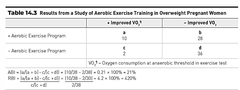
What is risk reduction?
By how much does the intervention reduce an unwanted event (ex. injury)

What are the two types of risk reduction?
Absolute risk reduction (ARR)
Relative risk reduction (RRR)
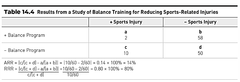
What is the formula for ARR?
% of controls w/ problem
Minus
% of therapy group with problem
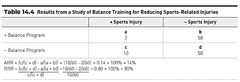
What is the formula for RRR?
(% of controls w/ problem
Minus
% of therapy group w/ problem)
Divided by
% of controls w/ problem

What is number needed to treat (NNT)?
Number of subjects that must receive an intervention in order for one subject to increase their benefit (or reduce risk)
(ex. out of every 5 you treat one gets better)

What are the formulas for NNT?
1/ABI
OR
1/ARR

An ideal NNT is close to which number?
Closer to 1 = better

As treatment effect increases what happens to NNT?
It decreases

Can NNT ever contain a decimal?
No it is rounded to nearest whole number since you cannot treat a decimal of a person
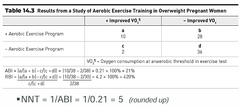
How do you interpret an NNT of 5 for a study on aerobic exercise training in overweight pregnant women?
You need to treat five overweight pregnant women to improve submaximal cardiorespiratory capacity in one woman

How do you interpret an NNT of 8 for a study of balance training for reducing sports-related injuries?
You need to treat eight patients to prevent sports-related injury in one patient

What is the clinical significance of an effect size with confidence intervals?
If 95% CI includes 0 then not sig
If ES > SEM sig
If ES > MCID clinically sig
NNT

What questions should you ask before using evidence?
Is study high quality?
Are results important?
Is intervention available, practical and safe?
Was patient represented in study?
How should patient or client values and preferences be incorporated before using evidence?
Is their a risk of injury?
Do benefits outweigh risks?
Is cost worth it (time, money)
Is patient confident in PT and intervention?
Do they believe in the science?
Do they have previous experiences?