Chapter 8: Metabolism and Energy
 Call Kai
 Learn
Learn Practice Test
 Spaced Repetition
 Match
Match Flashcards
 Knowt Play
1/65

There's no tags or description
Looks like no tags are added yet.
Name | Mastery | Learn | Test | Matching | Spaced | Call with Kai | Chat |
|---|
No analytics yet
Send a link to your students to track their progress
66 Terms
Metabolism
Total system of all chemical reactions in a living being
Metabolic Pathway
A specific molecule goes through step-by-step changes to make a final product
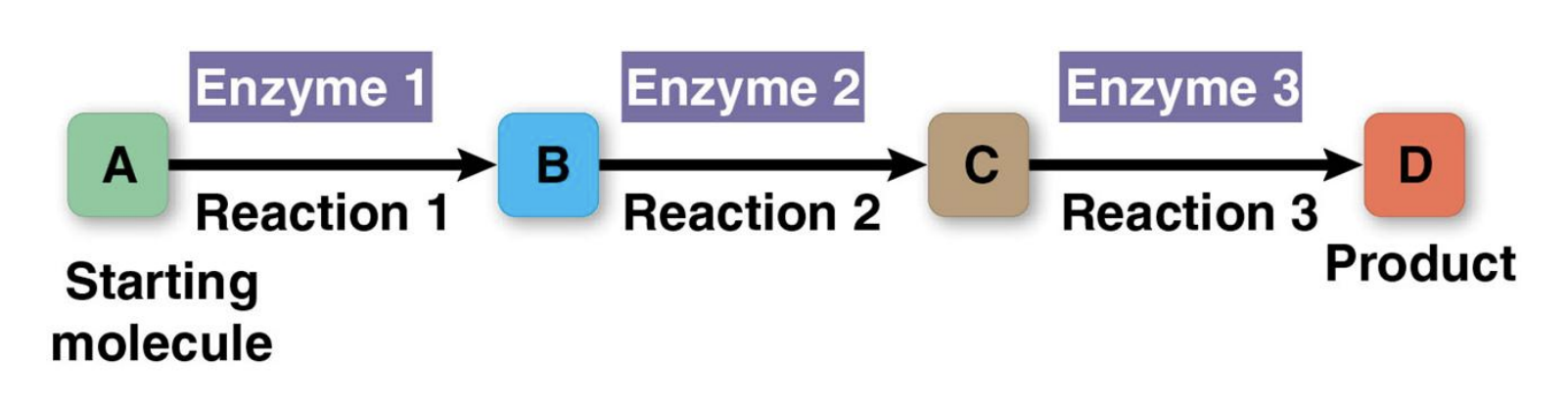
What allows for metabolic pathways to be completed?
Enzymes that catalyze at each step
Catabolic Pathways
Complex molecules are broken down into simple compounds, releasing energy in the process
Anabolic Pathways
Simple compounds are built into complex molecules, consuming energy in the process
Which type of reaction is consider downhill and up? Uphill?
Catabolic Pathways → downhill
Anabolic Pathways → uphill
T or F: Anabolic Pathways are used to power Catabolic Pathways
F, Catabolic Pathways (downhill) reactions release energy which is used to power the Anabolic Pathways (uphill)
Energy
Capacity of a system to cause change in its surroundings, and can exist in various forms
Work
The process of moving matter against opposing forces
What powers work?
Energy
Bioenergetics
The study of how energy flows through and is used by living beings
Kinetic Energy
Energy of motion
Thermal Energy
Kinetic energy at the atomic level
Heat
Released when transferred from one object to another
Potential Energy
Energy of location and structure
Chemical Energy
Potential energy stored in chemical bonds
How is Chemical Energy released?
Through chemical reactions
Thermodynamics
The study of how a system transforms and exchanges energy with surroundings
What are the 2 different types of systems in terms of energy?
Isolated and Closed Systems
Isolated System
No energy or matter exchange with the surroundings
Open System
Energy transformation and exchange between the system and surroundings
First Law of Thermodynamics
Energy can be transferred or transformed, but never created or destroyed
What is another name for the First Law of Thermodynamics
Principle of Conservation of Energy
Second Law of Thermodynamics
During energy transfer or transformation, some energy is converted to thermal energy and lost as heat
T or F: Heat cannot be used to do work
T
Entropy
Measure of how disordered a system is
How much energy in the system cannot be used to do work
How is Entropy increased?
Every transfer and transformation of energy
Spontaneous vs. Nonspontaneous Processes
Spontaneous → Processes that increase the entropy of the universe (no energy)
Nonspontaneous → Processes that can decrease entropy (need energy)
Increasing Order vs. Increasing Disorder
Increasing Order → Forming complex, organized structures
Increasing Disorder → Breaking down organized matter and releasing heat

Free Energy (G)
The measure of how much energy in a system can do work
What is the equation for Free Energy (G)?
ΔG = G final state - G initial state
What does negative ΔG for a chemical reaction imply?
No energy input
Spontaneous
System loses free energy becoming more stable
T or F: There is a direct relationship between Free Energy and stability
F, It’s an inverse relationship (more G = more unstable)
What does positive ΔG for a chemical reaction imply?
Energy needed
Nonspontaneous
T or F: Systems tend to move towards lower G (energy stability)
T
Equilibrium
The state of maximum stability, where forward and reverse reactions occur at same rate
How do systems move in terms of Equilibrium?
Spontaneously moves towards Equilibrium but never away from it
Which type of system reaches Equilibrium with no change in Free Energy?
Isolated Systems
What keeps Open Systems from reaching Equilibrium? How?
Metabolic pathways which provide energy
Exergonic Reaction (in terms of free energy)
Free Energy is released to surroundings
Negative ΔG

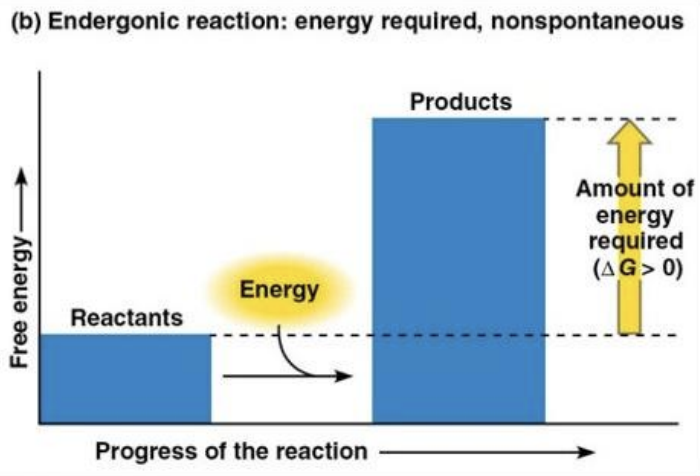
Endergonic Reaction (in terms of free energy)
Free Energy is taken in from surroundings
Positive ΔG
Products store less G than reactants

Compare the Spontaneity of Endergonic and Exergonic Reactions
Endergonic Reaction → nonspontaneous
Exergonic Reaction → spontaneous
Which chemical reaction type is energetically favorable for reactants and why?
Exergonic → allows a system to move towards a state of lower G (higher stability)

What is the relationship between Free Energy and work that can be done?
The greater the decrease in free energy, the greater the amount of work that can be done through that chemical reaction
Which chemical reaction type is energetically unfavorable for reactants and why?
Endergonic → allows a system to move towards a state of higher G (lesser stability)
What are the 3 types of Work cells perform?
Chemical Work
Transport Work
Mechanical Work
Chemical Work
Pushes endergonic chemical reactions forward
Transport Work
Pushes substances against their concentration gradient, across membranes
Mechanical Work
Movement of internal structures
What is ATP composed of?
Ribose (sugar)
Adenine (nitrogenous base)
3 Phosphate groups
When is the energy in ATP released?
When the terminal phosphate bond is broken by hydrolysis
What is the role of Potential Energy in ATP (using repulsion)?
Potential Energy is stored in the phosphate groups
The repulsion between negative charges of phosphate groups wants each to push away but are held in place
Phosphorylation
ATP transfers a phosphate group to another molecule
Phosphorylated Intermediate
A temporary molecule that has a phosphate group attached to it during a chemical reaction
How do Phosphorylated Intermediates compare to their original form?
Higher free energy (less stable, more reactive) than their original form
What is ATP coupling and it’s steps?
Exergonic Breakdown: Breaking ATP into ADP and Phosphate releases free energy
Endergonic Driving: Cells use released energy to power reactions that require an energy input
Then a Phosphate is added to ADP

Catalyst
Chemical agents used to speed up reactions without being consumed in the process
Enzyme
Usually protein based catalysts that speed up specific reactions
What must happen for molecules to facilitate bond breakage and start a reaction?
Molecules will absorb energy and contort into unstable states
Activation Energy (EA)
The amount of energy a reactant molecule needs to absorb into order to break its bonds
Where does Activation Energy come from?
Thermal energy (heat) from the surrounding environment
Transition State (in terms of Activation Energy)
When a molecule is at it’s highest-energy, most unstable moment in a chemical reaction

What are the steps of a chemical reaction going through the Activation Energy barrier?
Start with a molecule
Molecule absorbs energy
Molecule then twists and destabilizes
a. Transition state
Reaction happens