E1/Sn1 vs. E2/Sn2
 Call Kai
 Learn
 Practice Test
 Spaced Repetition
 Match
 Flashcards
 Knowt Play
1/43

There's no tags or description
Looks like no tags are added yet.
44 Terms
rxns

E1 vs. E2
E1 vs. E2 - stepwise vs. concerted, unimolecular vs. bimolecular, same order of reactivity of particular substrates (3°>2°>1°)
E1 vs. E2
E1 vs. E2 & pH - for the E1 rxn, they occur under weakly basic conditions or even acidic conditions . . . for the E2 rxn, all must occur under strongly basic conditions (substrate is not all that acidic)
E1 vs. E2
E1 vs. E2 solvent - for the E1 rxn, we want a solvent that stabilizes the first ionization rxn (protic solvents - stabilize both anions and cations) . . . for the E2 rxn, we want a solvent that enhances the basicity of our base (solvent that won't stabilize an anion - polar aprotic solvent like DMSO, DMF, acetone, acetonitrile)
E1 vs. E2
E1 vs. E2 & temp - for both elimination rxn's, they are highly endothermic (sigma --> pi electrons) and both are much more efficient with higher temps
E1 vs. E2
E1 vs. E2 & [base] - in the E1 rxn the concentration of the base is irrelevant, while in the E2 rxn the concentration of the base is part of the rate equation (E2 requires high concentration of base)
E1 vs. E2
E1 vs. E2 & base - in the E1 rxn, the type of base we find is usually weak if not irrelevant (requires nothing more than an electron pair, pi-electrons of double bond) . . . in the E2 rxn, the type of base we find is either very strong or rendered by using appropriate solvent (non-nucleophilic in character like NaH or LDA, or made non-nucleophilic like EtO- in protic solvent)
E1 vs. E2

E1 vs. E2
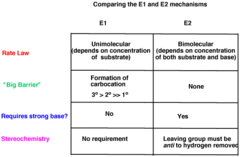
stepwise vs. concerted

Sn1 vs. Sn2
Sn1 vs. Sn2 - stepwise vs. concerted, unimolecular vs. bimolecular
Sn1 vs. Sn2
Sn1 vs. Sn2 rxn temp - both are substitution rxn's, so both are generally carried out at around room temperature (carrying out at lower temps reduces the amount of elimination byproduct that is generated)
Sn1 vs. Sn2
Sn1 vs. Sn2 [Nu] - for the Sn1 rxn, the concentration of the Nu is irrelevant becuase only the concentration of the substrate is involved in the rate equation . . . for the Sn2 rxn, the concentration of the Nu matters becuase it is in the transition state/rate equation (high concentration favors Sn2)
Sn1 vs. Sn2
Sn1 vs. Sn2 & solvent - for the Sn1 rxn, we are dealing with a carbocation intermediate so we must have a solvent that stabilizes it (protic solvent) . . . for the Sn2 rxn, we want to maximize the strength of the Nu (polar aprotic solvents are employed)
Sn1 vs. Sn2
Sn1 vs. Sn2 & order of reactivity of substrates - for Sn1, rxn order follows stability of carbocation: 3° > 2° > 1° > methyl (if we have a 3°, it will absolutely undergo Sn1) . . . for Sn2, rxn order follows ease of Nu backside approach: methyl > 1° > 2° > 3° (if we have methyl or 1°, it will absolutely undergo Sn2 . . . there are only a few intramolecular Sn2's that occur at 3° substrates) . . . secondary substrates require other factors which favor one route over the other (solvent and [Nu])
Sn1 vs. Sn2
Sn1 vs. Sn2 & LVG - both require good LVG (for the case of Sn2, because we use strong, negatively-charged Nu we usually get a negatively-charged LVG)
Sn1 vs. Sn2
Sn1 vs. Sn2 & Nu - in the Sn1 rxn, the strength and/or size of the Nu does not matter (carbocation intermediate = planar) . . . in the Sn2 rxn, the strength and/or size of the Nu matters (stronger Nu's are favored as well as smaller Nu's)
Sn1 vs. Sn2
Sn1 vs. Sn2 & pH - in the Sn1 rxn, the pH condition is usually neutral or slightly basic/acidic (this particular pH condition inhibits Sn2 and elimination) . . . in the Sn2 rxn, the pH condition is not as particular as it is in E2 rxns (in a majority of cases we'll see basic conditions, but there are many cases where neutral conditions can undergo Sn2 rxn)
Sn2
protic solvent & methyl substrate = Sn2 (can't do anything else)
Sn2
protic solvent & 1° substrate = Sn2 (1° provides good platform for Sn2)
Sn1/E1
protic solvent & 2° substrate = Sn1/E1 - protic solvent stabilizes carbocation that can rearrange to more stable carbocation and solvates Nu (if there is a Nu it will act as a base = elimination) . . . temp is ultimate determining factor
Sn1/E1
protic solvent & 3° = Sn1/E1 (protic solvent stabilizes 3° carbocation, depending on temp will result in either major product racemic mixture or major product alkene regioisomer mixture)
Sn2
aprotic solvent & methyl substrate = Sn2 (can't do anything else, fastest reaction)
Sn2
aprotic solvent & 1° substrate = Sn2 (aprotic solvent enhances Nu approach, 1° substrate offers good template for Sn2)
Sn2
aprotic solvent & 2° substrate = Sn2 (aprotic solvent enhances Nu, 2° substrate offers fair template for Sn2)
Sn1/E1
aprotic solvent & 3° substrate = Sn1/E1 (3° provides too much steric interference and does not allow Sn2, does not allow E2 because aprotic solvent enhances Nu, since 3° carbocation is stable that is what is formed)
Sn2
strong small base (like methoxide or hydroxide) & methyl substrate = Sn2 - can't do anything else
Sn2
strong small base (like methoxide or ethoxide) & 1° substrate = Sn2 (small strong base will attack the LVG rather than a beta hydrogen because there is little interference, temp dependent)
Sn2/E2
strong small base (like methoxide or hydroxide) & 2° substrate = Sn2/E2 (small strong base will attack an anti-beta hydrogen to the LVG because 2° provides enough steric interference to deter process ever so slightly . . . depends on solvent and temp)
E2
strong small base (like methoxide or ethoxide) & 3° substrate = E2 (small strong base will attack an anti-beta hydrogen to the LVG to produce more substituted alkene as major product - Zaitsev's product)
Sn2
strong large base (like tert-butoxide) & methyl substrate = Sn2 (can't do anything else)
E2
strong large base (like tert-butoxide) & 1° substrate = E2 (steric strain)
E2
strong large base (like tert-butoxide) & 2° substrate = E2 (steric strain)
E2
strong large base (like tert-butoxide) & 3° substrate = E2 (steric strain, will produce less-substituted alkene - Hofmann's product)
E2
proportion of alkene by E2 increases with strong bases (hard, non-polarizable, large, increasing base size), polar protic solvents (RNH, ROH, or H2O), increased reaction temp, and increased bulk around the carbon bearing the LVG
E2 vs. E1
E2 vs. E1 & concentration of base - only E2 is affected by the concentration of base (E1 is only affected by concentration of alkyl halide) - high base concentrations means E2 is favored
E2 vs. E1
E2 vs. E1 & base strength - strong bases favor E2 while weak bases favor E1 (anything can serve as a base for E1, like H2O and ROH)
E2 vs. E1
E2 vs. E1 & stability - E1 can only occur when a relatively stable carbocation can be formed (3° or stabilized by resonance), the more polar solvent favors E1 (because polar solvents can stabilize carbocation), and a better LVG favors E1 (can get a carbocation easier) . . . substrate reactivity trends remain the same for E2, but a stronger base is required (can occur in either protic or aprotic), E2 not as dependent on temp as E1 is
nucleophilicity vs. basicity
nucleophilicity vs. basicity - increase together, for RO- both nucleophility and basicity increases as R is less stabilizing to the charge and therefore RO- is more reactive/higher in energy - R (concerning reactivity) = Et > Me > H > Ph > Ac
weak base
weak base = substitution (at room temp) - if 3°, can form carbocation because weak base, like EtOH, stabilizes the formation of a carbocation, if not than Sn2
strong base
strong base = elimination - even if 3°, a strong base will attack a beta hydrogen, basic conditions are not conducive for the spontaneous disassembly of an alkyl halide or production of carbocation
acidic environment
acidic environment = protic -favors formation of carbocation, favors substituions, encourages Sn1/E1, solvates Nu-, encourages elimination if Nu- is in acidic solvent, encourages rearrangement (5-membered ring to 6-membered ring)
basic environment
basic environment - negatively charged species or lone-pair on nitrogen, favors formation of negative charge (if there's an acidic hydrogen), carbocation will never form!!! (even to rearrange shit), favors elimination, any conjugate acid (can either be nucleophilic or basic), encourages Nu- to go after an acidic hydrogen rather than an electrophilic center (Cl- & pyridine) conjugate base in parent acid solvent
intramolecular Sn1 vs. Sn2
intramolecular Sn1 vs. Sn2 . . . Sn1 - stable carbocation is generated from LVG leaving (maybe interact with a lewis acid...) generating electrophile and performing intramolecular Sn1 with nucleophile (usually pair of e-) . . . Sn2 - acidic hydrogen is deprotonated, and negative charge attacks a positively polar carbon, expelling the LVG