Biodegradation and Bioremediation Midterm Exam
 Call Kai
 Learn
 Practice Test
 Spaced Repetition
 Match
 Flashcards
 Knowt Play
1/67

There's no tags or description
Looks like no tags are added yet.
68 Terms
Define Bioremediation
A natural or managed process that utilizes microorganisms or other biological processes to degrade or transform environmental contaminants into less toxic or nontoxic forms, thereby reducing or eliminating contamination
Define co-metabolism
The transformation of a chemical that does not provide carbon and/or energy for the microorganism. Instead, another compound serves as the organism’s carbon and/or energy source
Define biodegradation
Biologically mediated simplification of a chemical’s structure, ultimately resulting in mineralization; however, in different circumstances it is used to indicate different extent of degradation, ranging from loss of compound to complete mineralization
Define mineralization
The conversion of an organic compound into its inorganic constituents. Under aerobic conditions, organic carbon is completely oxidized to CO2, whereas anaerobic degradation may produce CO2 and/or CH4, with H2 potentially formed during intermediate metabolic processes
Define biotransformation
Biologically mediated alteration of molecular structure of compound, can either increase or decrease the complexity of the compound, i.e. partial metabolism. It does not necessarily result in detoxification, as transformation products may be more toxic or persistent than the original compound
Define monitored natural attenuation
A remediation approach that relies on naturally occurring physical, chemical, and biological processes to reduce contaminant concentrations over time, while monitoring site conditions and contaminant trends to ensure that it is effective and protective of human health and the environment
Define biostimulation
Electron donors, electron acceptors, co-substrate and/or nutrients are added to contaminated environmental media (sediment, soil, groundwater) either in situ or ex situ to stimulate the growth and activity of indigenous bacteria
Define bioaugmentation
Microorganisms that are specifically adapted for degrading/transforming particular contaminants are added to the contaminated environmental material
Define stable isotope probing (SIP)
A molecular technique used to identify metabolically active microorganisms by tracking the incorporation of stable isotope-labeled substrates (e.g., 13C) into microbial biomass, such as DNA or RNA. The labeled nucleic acids can then be separated and analyzed to identify microorganisms assimilating the substrate
Define 16S rRNA
16S ribosomal RNA (16S rRNA) is a component of the small ribosomal subunit in bacteria and archaea. Its corresponding gene contains conserved and variable regions, making it useful as a molecular marker for identifying microorganisms and characterizing microbial community composition through sequence analysis
Define killed/sterile/autoclaved control
An experimental control in which microorganisms have been killed or inactivated to prevent biological activity. It is used to distinguish biologically mediated contaminant degradation from abiotic processes, such as chemical reactions, sorption, or volatilization
What should you look for when interpreting biodegradation graphs to determine an appropriate bioremediation approach?
Contaminant loss: Is the concentration decreasing over time?
Biological activity: Is degradation greater in live treatments than sterile controls?
Environmental conditions: Which redox conditions or amendments promote the greatest degradation?
Transformation products: Are daughter products accumulating, or is complete degradation occurring?
Remediation strategy: Do the results support natural attenuation, biostimulation, or potentially bioaugmentation?
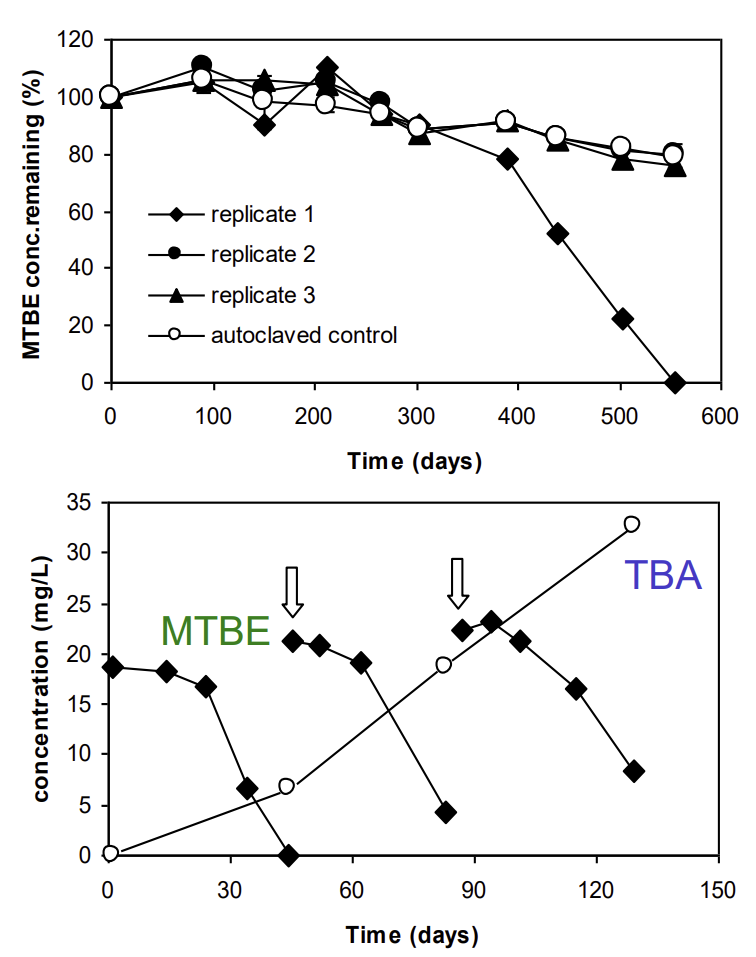
Interpret the biodegradation graph shown. What conclusions can you draw, and what are the implications for bioremediation?
The decrease in MTBE concentrations in an active culture compared with the autoclaved control supports microbial biodegradation. However, only one of three live replicates showed substantial degradation, suggesting that activity may be inconsistent or dependent on particular microbial populations or conditions. These results demonstrate anaerobic MTBE biodegradation potential, but additional investigation would be necessary before selecting a field-scale bioremediation approach.
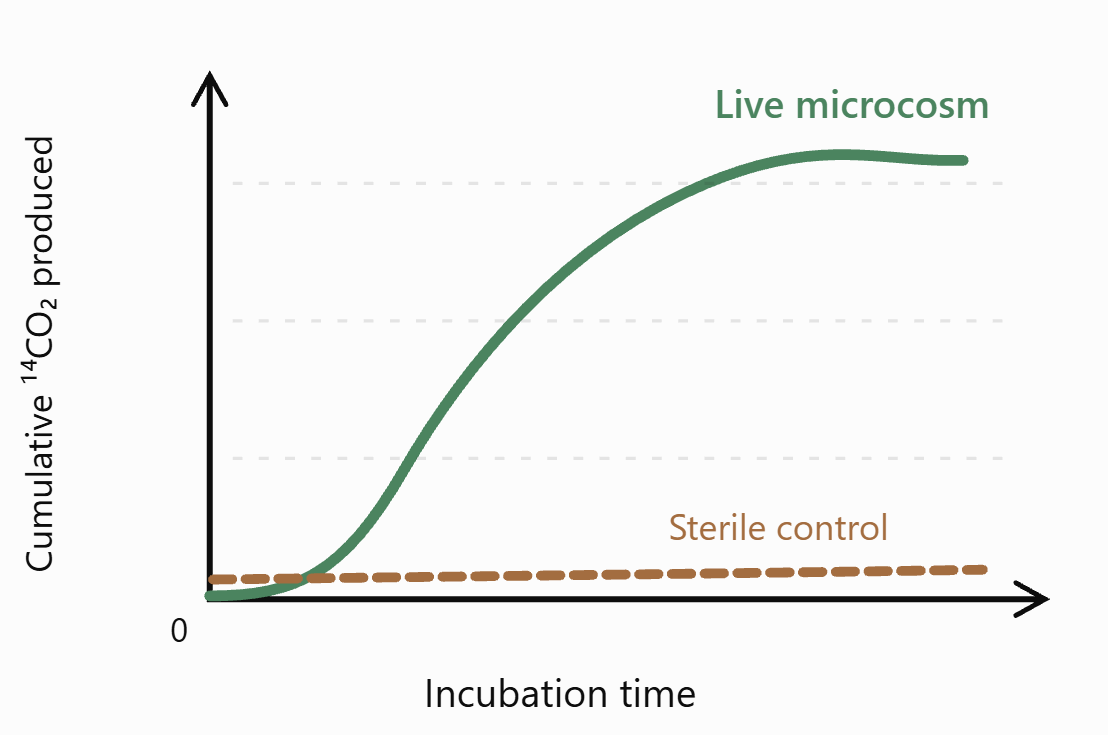
Describe how you could use a 14C based method to determine whether biodegradation of benzene is occurring in a laboratory microcosm (add a simple sketch of a graph that could result)
A laboratory microcosm containing contaminated sediment or groundwater can be amended with 14C-labeled benzene and incubated under conditions suitable for microbial activity. A killed or sterile control should also be prepared to distinguish biological from abiotic processes. Over time, the 14CO₂ produced can be collected in a CO₂ trap and quantified by measuring its radioactivity. An increase in 14CO₂ production in the live microcosm compared with the sterile control would provide evidence of microbial mineralization of benzene.
Describe how you could determine whether dehalogenation of a halogenated contaminant is occurring in situ at a field site (add a simple sketch of a graph that could result)
To determine whether in situ dehalogenation is occurring, groundwater samples can be collected from monitoring wells over time and analyzed for the parent halogenated contaminant and its potential degradation products. For example, reductive dechlorination of PCE can be evaluated by monitoring concentrations of PCE, TCE, DCE, vinyl chloride (VC), and ethene. A decrease in PCE concentrations accompanied by the formation of less chlorinated daughter products and eventually ethene would provide evidence of reductive dechlorination. Chloride release and reducing groundwater conditions could provide additional supporting evidence. Additional evidence, such as favorable anaerobic conditions or compound-specific isotope analysis (CSIA), could help support the conclusion that the transformation is biologically mediated

Describe a specific molecular technique that could be used to identify all the microbial community members at a contaminated site
16S rRNA gene sequencing can be used to identify microorganisms present at a contaminated site. DNA is extracted from environmental samples, such as soil, sediment, or groundwater, and the 16S rRNA gene is amplified using PCR. The amplified DNA is then sequenced, and the resulting sequences are compared with reference databases to identify microorganisms and characterize the microbial community composition
Describe a specific molecular method that could be used to identify specific microbes that are actively degrading a specific contaminant at a contaminated site.
Stable isotope probing (SIP) can be used to identify microorganisms actively utilizing a specific contaminant. Environmental samples, such as contaminated groundwater or soil, are incubated with a stable isotope-labeled contaminant (e.g., 13C-labeled MTBE). Microorganisms that assimilate carbon derived from the contaminant incorporate 13C into their DNA. The DNA is then extracted, and the heavier 13C-labeled DNA is separated from unlabeled DNA using density-gradient ultracentrifugation. The labeled DNA can subsequently be analyzed using 16S rRNA gene sequencing to identify microorganisms involved in contaminant utilization.
Below is a sketch of an aquifer system. The system has a surficial aquifer (A) and a semi-confined aquifer (B). Over the years the chlorinated solvent, tetrachloroethene (PCE), a DNAPL, and fuel containing benzene, an LNAPL, were disposed of in the unlined disposal pit.
Both contaminants would enter the subsurface by infiltrating downward from the unlined disposal pit through the vadose zone. The fuel containing benzene, as an LNAPL, would migrate downward until reaching the water table in the surficial aquifer, where it would accumulate and spread laterally because it is less dense than water. Some fuel would remain as residual saturation, while benzene would dissolve into groundwater and form a dissolved plume moving downgradient. In contrast, PCE, as a DNAPL, would continue sinking below the water table because it is denser than water. It would migrate downward through the surficial aquifer, pool on low-permeability layers, and possibly migrate into the semi-confined aquifer through permeable pathways or discontinuities. Dissolution of the DNAPL would produce a downgradient dissolved PCE plume.

Define rebound
Rebound is the increase in contaminant concentrations in groundwater after remediation has reduced them, particularly after treatment or groundwater pumping stops. It occurs when residual contaminants, such as NAPL trapped in pore spaces, fractures, or low-permeability formations, dissolve or diffuse back into groundwater
Why is rebound a problem in remediation?
Rebound is problematic because it can cause contaminant concentrations to exceed cleanup standards again, prolong remediation, and require additional treatment.
What would the primary electron-accepting process likely be in Aquifer A shown? What are the electron donors and what are the electron acceptors?
The primary electron-accepting process would likely be aerobic respiration, as the groundwater is oxygenated. Organic contaminants, such as benzene, can serve as electron donors and carbon sources for microorganisms, while dissolved oxygen (O2) serves as the terminal electron acceptor. Aerobic oxidation can result in mineralization of benzene to CO2 and H2O.
What would the primary electron-accepting process likely be in Aquifer B shown? What are the electron donors and what are the electron acceptors?
The primary electron-accepting process would likely be sulfate reduction, as the groundwater is anoxic but contains sulfate. Organic compounds, such as benzene or naturally occurring organic matter, can serve as electron donors, while sulfate (SO42-) serves as the terminal electron acceptor and is reduced to sulfide (e.g., HS- or H2S)
List at least four parameters that could be measured to help determine contaminant fate and/or biological processes.
Parameters that could be monitored over time include concentrations of PCE, benzene, and chlorinated degradation products (TCE, DCE, and vinyl chloride); dissolved oxygen (DO); sulfate and sulfide concentrations; oxidation-reduction potential (ORP); groundwater elevations and hydraulic gradients; and microbial community composition. These measurements could be collected from monitoring wells throughout both aquifers to evaluate contaminant transport, degradation, and microbial activity.
For each parameter, describe how it alone, or together with other data, informs us about the physical, chemical and/or biological processes affecting contaminant fate (PCE and benzene) occurring in the subsurface.
Contaminant concentrations (PCE, benzene, and degradation products)
Changes in contaminant concentrations over time can indicate contaminant transport, degradation, or accumulation. Decreasing PCE concentrations accompanied by increasing concentrations of TCE, DCE, vinyl chloride, and eventually ethene would support reductive dechlorination. Decreasing benzene concentrations may indicate biodegradation, although physical processes such as dilution, dispersion, and sorption must also be considered.
For each parameter, describe how it alone, or together with other data, informs us about the physical, chemical and/or biological processes affecting contaminant fate (PCE and benzene) occurring in the subsurface.
Dissolved oxygen (DO)
DO measurements indicate whether groundwater conditions favor aerobic biodegradation. In aquifer A, oxygenated groundwater could support aerobic benzene degradation, with benzene serving as the electron donor and oxygen as the terminal electron acceptor. Decreasing DO concentrations alongside benzene loss could support aerobic microbial activity, although oxygen consumption is not specific to benzene degradation.
For each parameter, describe how it alone, or together with other data, informs us about the physical, chemical and/or biological processes affecting contaminant fate (PCE and benzene) occurring in the subsurface.
Sulfate and sulfide concentrations
Decreasing sulfate concentrations accompanied by increasing sulfide concentrations would provide evidence of sulfate reduction, particularly in anoxic aquifer B. Sulfate-reducing microorganisms may use organic contaminants such as benzene as electron donors. These measurements help characterize anaerobic microbial processes but do not independently demonstrate that benzene is being degraded.
For each parameter, describe how it alone, or together with other data, informs us about the physical, chemical and/or biological processes affecting contaminant fate (PCE and benzene) occurring in the subsurface.
Oxidation-reduction potential (ORP)
ORP measurements help characterize groundwater redox conditions and determine which terminal electron-accepting processes may be favorable. More oxidizing conditions in aquifer A would generally support aerobic respiration, while more reducing conditions in aquifer B could favor sulfate reduction and potentially reductive dechlorination of PCE. ORP should be interpreted alongside other geochemical measurements.
For each parameter, describe how it alone, or together with other data, informs us about the physical, chemical and/or biological processes affecting contaminant fate (PCE and benzene) occurring in the subsurface.
Groundwater elevations and hydraulic gradients
Groundwater elevation measurements can be used to determine hydraulic gradients and groundwater flow directions, helping predict contaminant migration through the aquifers. When combined with contaminant concentration data, these measurements can help distinguish physical transport processes, such as advection and dispersion, from potential biodegradation.
For each parameter, describe how it alone, or together with other data, informs us about the physical, chemical and/or biological processes affecting contaminant fate (PCE and benzene) occurring in the subsurface.
Microbial community composition
Microbial community analysis can identify microorganisms capable of contaminant degradation. For example, detecting Dehalococcoides mccartyi could indicate the potential for reductive dechlorination of PCE. Techniques such as 16S rRNA gene sequencing and qPCR can characterize microbial populations, although detecting microorganisms or their genes does not necessarily demonstrate metabolic activity.
Define bioventing
Bioventing is an in situ bioremediation technique in which low-flow air or oxygen is introduced into the unsaturated (vadose) zone to stimulate aerobic microbial degradation of organic contaminants in soil. Air/oxygen is the primary additive
Sketch bioventing

Describe specific microbial bioremediation reactions that could be enhanced by bioventing and amendments.
Bioventing primarily enhances aerobic oxidation. Oxygen serves as the terminal electron acceptor, while organic contaminants, such as petroleum hydrocarbons, serve as electron donors and carbon sources for indigenous microorganisms.
What are two advantages of bioventing?
The advantages of bioventing include minimal site disturbance, as it treats contaminated soil in situ, reducing the need for extensive excavation or off-site treatment. Additionally, it enhances natural biodegradation by stimulating indigenous aerobic microorganisms to degrade contaminants
What are the two disadvantages of bioventing?
The disadvantages include its limited applicability to the unsaturated (vadose) zone and its dependence on soil permeability and effective oxygen distribution.
Define biosparging
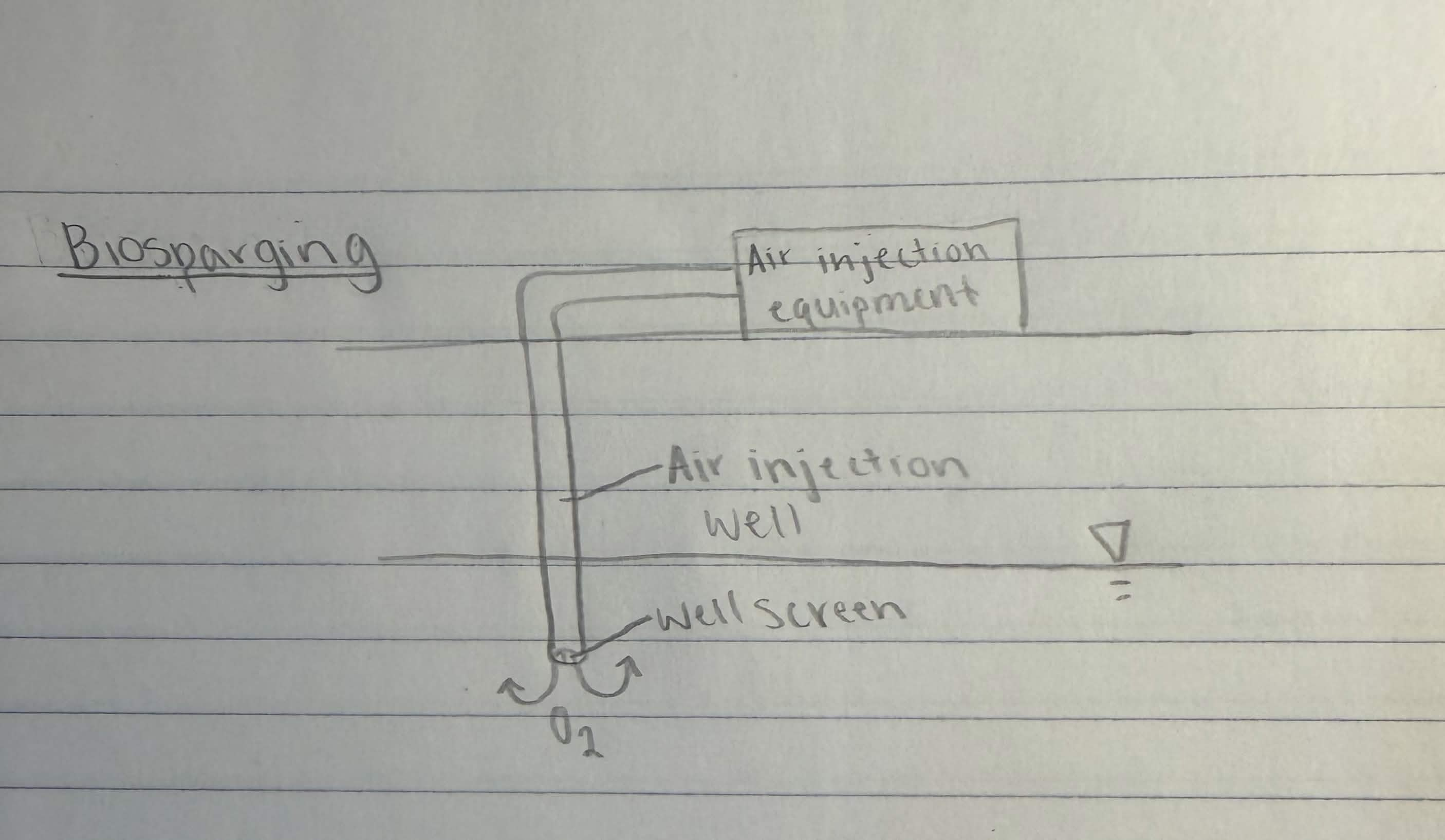
An in situ bioremediation technique in which air or oxygen is injected into the saturated zone below the groundwater table to increase dissolved oxygen availability and stimulate aerobic microbial degradation of organic contaminants in groundwater and saturated soils. Air/oxygen is the primary additive.
Sketch biosparging
Describe specific microbial bioremediation reactions that could be enhanced by biosparging and amendments.
Biosparging primarily enhances aerobic oxidation. Oxygen serves as the terminal electron acceptor, while organic contaminants, such as petroleum hydrocarbons, serve as electron donors and carbon sources for indigenous microorganisms. For example, aerobic microorganisms can oxidize benzene, ultimately mineralizing it to CO2 and H2O.
What are two advantages of biosparging?
The advantages of biosparging include minimal site disturbance, since it treats contaminated groundwater and saturated soil in situ, reducing the need for extensive excavation or off-site treatment, and enhanced aerobic biodegradation by increasing oxygen availability for indigenous microorganisms
What are two disadvantages of biosparging?
The disadvantages include its dependence on subsurface permeability and effective oxygen distribution, particularly in heterogeneous aquifers, and the potential for injected air to volatilize contaminants, resulting in vapor migration rather than biodegradation.
Define injection/extraction with subsurface recirculation
Injection/extraction with subsurface recirculation is an in-situ bioremediation technique in which contaminated groundwater is extracted through wells, amended with substances that promote microbial activity, and reinjected into the subsurface. This creates a circulation system that distributes amendments throughout the contaminated aquifer, stimulating microbial biodegradation.
What are the additives of injection/extraction with subsurface recirculation
The additives introduced through injection/extraction systems depend on the targeted microbial process. For aerobic biodegradation, oxygen or oxygen-releasing compounds such as calcium or magnesium peroxide may be added to stimulate microbial oxidation of contaminants. For anaerobic biodegradation, organic electron donors, such as lactate, may be introduced to promote reductive dechlorination of chlorinated contaminants. Nutrients and specialized microorganisms may also be added to enhance microbial activity.
Sketch injection/extraction with subsurface recirculation

Describe specific microbial bioremediation reactions that could be enhanced by biosparging and amendments.
It can enhance either aerobic or anaerobic microbial biodegradation, depending on the amendments introduced. Under aerobic conditions, oxygen is supplied as the terminal electron acceptor to stimulate microbial oxidation of organic contaminants, such as benzene, potentially resulting in mineralization to CO2 and H2O. Under anaerobic conditions, organic electron donors, such as lactate, may be added to stimulate reductive dechlorination of chlorinated solvents, such as PCE and TCE.
What are two advantages of injection/extraction with subsurface recirculation?
Improved distribution of amendments throughout the contaminated aquifer, enhancing contact between microorganisms, contaminants, and necessary nutrients or electron donors/acceptors. Additionally, the system can be adapted to stimulate either aerobic or anaerobic biodegradation depending on the amendments introduced.
What are two disadvantages of injection/extraction with subsurface recirculation?
The disadvantages include its dependence on subsurface permeability and hydraulic conductivity, as heterogeneous or low-permeability formations can limit effective amendment distribution, and the potential for biofouling or clogging of injection wells due to excessive microbial growth.
Define permeable reactive barrier.
An in-situ remediation technology consisting of a permeable zone containing reactive materials installed in the path of contaminated groundwater flow. As groundwater passes through the barrier, contaminants are removed or transformed through chemical and/or biological processes. It is installed perpendicular to the direction of groundwater flow so that contaminated groundwater passes through the reactive material. The barrier may contain organic matter to provide electron donors that stimulate anaerobic microbial degradation, zero-valent iron (ZVI) to promote chemical reduction of contaminants, or a combination of both materials.
Sketch a permeable reactive barrier

Describe specific microbial bioremediation reactions that could be enhanced by the permeable reactive barrier and amendments.
A permeable reactive barrier containing organic matter can enhance anaerobic reductive dechlorination of chlorinated contaminants, such as PCE and TCE. The organic matter undergoes microbial fermentation, producing hydrogen (H2), which serves as an electron donor for organohalide-respiring microorganisms. The chlorinated contaminants serve as electron acceptors and undergo sequential reductive dechlorination, potentially producing less chlorinated compounds and ultimately ethene.
What are two advantages of permeable reactive barrier?
The advantages of permeable reactive barriers include their ability to treat contaminated groundwater in situ, reducing the need for groundwater extraction and aboveground treatment, and their relatively low operating costs, as they function passively without requiring continuous pumping.
What are two disadvantages of permeable reactive barriers?
The disadvantages include the need for sufficient barrier thickness to ensure adequate residence time for contaminant treatment and their dependence on groundwater flow patterns, as changes in flow direction may cause contaminated groundwater to bypass the reactive barrier.
What are two advantages of pump and treat?
Hydraulic containment of contaminated groundwater, which helps prevent further plume migration, and the ability to treat extracted groundwater using established aboveground treatment technologies.
What are two disadvantages of pump and treat?
Contaminant rebound after pumping stops, as residual contaminants can dissolve or diffuse back into groundwater, and its limited effectiveness in removing contaminant sources, particularly residual NAPL and contaminants trapped in low-permeability formations.
What are two advantages of in situ chemical treatment?
Its ability to rapidly degrade or transform contaminants directly in the subsurface, reducing the need for excavation or groundwater extraction, and its effectiveness without relying on microbial activity or favorable conditions for biodegradation.
What are two disadvantages of in situ chemical treatment?
The disadvantages include difficulty distributing chemical amendments throughout heterogeneous or low-permeability formations, potentially leaving untreated areas, and the consumption of chemical reagents through reactions with naturally occurring subsurface materials, reducing their availability for contaminant treatment.
Discuss the pros- and cons of pump and treat versus use of in situ bioremediation for removing chlorinated solvents such as PCE and TCE from a contaminated aquifer.
Pump-and-treat
Pros: Hydraulic containment; established aboveground treatment.
Cons: Long-term costs; contaminant rebound from residual DNAPL; better at treating dissolved contaminants
In situ bioremediation
Pros: Treats contaminants directly in aquifer; can transform PCE/TCE to ethene.
Cons: Requires suitable microbial/redox conditions and amendment distribution; risk of VC accumulation
Describe Comprehensive Environmental Response, Compensation, and Liability Act (CERCLA)
CERCLA, also known as Superfund, is a federal law enacted in 1980 that established a framework for identifying, investigating, and cleaning up sites contaminated by hazardous waste. It authorizes the EPA to coordinate remediation, establishes the National Priorities List (NPL) for contaminated sites requiring federal attention, and identifies potentially responsible parties (PRPs) who may be held liable for cleanup costs. It also provides funding for remediation when responsible parties cannot be identified or will not contribute.
Define Resource Conservation and Recovery Act (RCRA)
RCRA is a federal law enacted in 1976 that regulates the generation, transportation, treatment, storage, and disposal of hazardous and solid waste to protect human health and the environment. It establishes a “cradle-to-grave” regulatory system, which tracks hazardous waste from its generation through its final disposal. The law also establishes waste classification standards, permitting and reporting requirements, and promotes waste reduction and resource conservation.
Define Site Remediation Reform Act (SRRA)
SRRA is a New Jersey state law enacted in 2009 that requires responsible parties to remediate contaminated sites in a timely manner. It established the Licensed Site Remediation Professional (LSRP) program, allowing licensed professionals to oversee and manage site remediation while ensuring compliance with environmental regulations and NJDEP guidance. Upon completion of remediation, the LSRP issues a Response Action Outcome (RAO) rather than the NJDEP issuing a No Further Action (NFA) letter.
Enzymes bio-catalyze reactions by....
Stabilizing intermediate states and changing the energy of activation.
Why do cells need nitrogen?
Nitrogen is one of the major constituents of proteins.
The anaerobic process where bacteria breath nitrate is called…
Nitrification
Archaea which produce methane breathe…
Carbon dioxide
True or false?:
All DNA sequencing technologies make labeled copies for determining the string of nucleotides.
False.
3rd generation approaches directly read the sequence of individual DNA molecules without labeling.
True or false?
The costs of various DNA sequencing machines are all relatively the same, making the cost for sequence analysis similar across platforms.
False.
Reagent costs are similar, but the sequencers can vary in price by >100-fold.
True or false?
The number of sequence reads generated by the MinION is correlated with the target molecule concentration.
True.
The top 100 OTUs from complex samples had correlation coefficients around 0.9.
True or false?
The MinION is a portable sequencing system that could be used to analyze samples from your study site in the field.
True.
Although the equipment needs are modest for the MinION (laptop and hard drive). There remains the need for basecalling and data analysis. FYI…Oxford Nanopore makes a separate unit for basecalling (MinIT) and a new model of MinION (MK1C) which has a touch screen and basecalling capability, eliminating the need for a laptop.
What is the general hierarchy of electron acceptors as conditions become more reducing?
O2 → NO3⁻ → Mn(IV) → Fe(III) → SO42⁻ → CO2 (methanogenesis). Processes can overlap.