[AMAERO] L2 | AERODROME DESIGN
 Call Kai
 Learn
Learn Practice Test
 Spaced Repetition
 Match
Match Flashcards
 Knowt Play
1/41

There's no tags or description
Looks like no tags are added yet.
Name | Mastery | Learn | Test | Matching | Spaced | Call with Kai | Chat |
|---|
No analytics yet
Send a link to your students to track their progress
42 Terms
FAA, EASA, CAAP and the ICAO.
[Airport Design Standards]
In order to provide assistance to airport designers and a reasonable amount of uniformity in the design of airport facilities for aircraft operations, design guidelines have been prepared by the (4)
United States
[Airport Design Standards]
The FAA design criteria provide uniformity at airport facilities in the ________ and serve as a guide to aircraft manufacturers and operators with regard to the facilities which may be expected to be available in the future.
The FAA design criteria
[Airport Design Standards]
provide uniformity at airport facilities in the United States and serve as a guide to aircraft manufacturers and operators with regard to the facilities which may be expected to be available in the future.
Advisory Circulars
[Airport Design Standards]
The FAA design standards are published in ________ which are revised periodically as the need arises
Convention on International Civil Aviation
[Airport Design Standards]
The ICAO strives toward uniformity and safety on an international level. Its standards, which are very similar to the FAA standards, apply to all member nations of the _______________________ and are published as Annex 14 to that convention
Airport
For design purposes, These are classified based on the aircraft they accommodate. While,at any ____, a wide variety of aircraft, from small general aviation piston-engine aircraft to heavy air transport aircraft, will use the airfield, This are designed based on a series of “critical” or “design” aircraft.
critical aircraft
[Airport Classification]
These aircraft are selected from the fleet using the airport as those most critical to airfield design. The FAA defines the term __________ as the aircraft most demanding on airport design that operates at least 500 annual itinerant operations at a given airport
Airport Reference Code
is a coding system used to relate the airport design criteria to the operational and physical characteristics of the aircraft intended to operate at the airport.
Airport Reference Code
is a two designator code referring to the aircraft approach category and the airplane design group for which the airport has been designed. It is based upon the aircraft approach category and the airplane design group to which the aircraft is assigned
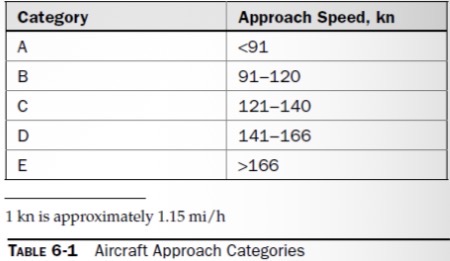
Aircraft Approach Category
is determined by the aircraft approach speed, which is defined as 1.3 times the stall speed in the landing configuration of aircraft at maximum certified landing weight.

Airplane Design Group (ADG)
is a grouping of aircraft based upon wingspan or tail height. An ___________ for a particular aircraft is assigned based on the greater (higher Roman numeral) of that associated with the aircraft’s wingspan or tail height
ICAO Aerodrome Reference Code
to classify the geometric design standards at an airport. The code elements consist of a numeric and alphabetic designator. The _________ numbers 1 through 4 classify the length of the runway available. Letters A through E classify the wingspan and outer main gear wheel span for the aircraft for which the airport has been designed
Aircraft Reference Field Length
which includes the runway length and, if present, the stopway and clearway. Is the approximate required runway takeoff length converted to an equivalent length at mean sea level, 15°C, and zero percent gradient
Utility Airports
is defined as one which has been designed, constructed, and maintained to accommodate approach category A and B aircraft.
Utility Airports
The specifications for __________ are grouped for small aircraft, those of maximum certified takeoff weights of 12,500 lb or less, and large aircraft, those with maximum certified takeoff weight in excess of 12,500 lb
Transport Airports
is defined as an airport which is designed, constructed, and maintained to accommodate aircraft in approach categories C, D, and E. The design specifications of this are based upon the airplane design group.
1. Single Runways
2. Parallel Runways
3. Intersecting Runways
4. Open-V Runways
Runway Configurations (4)
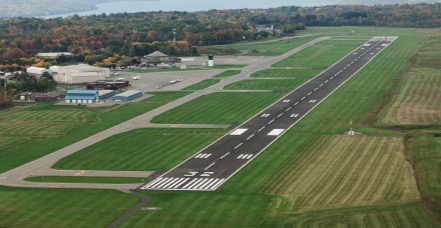
Single Runway
[Runway Configurations]
This is the simplest of the runway configurations. It has been estimated that the hourly capacity of a _________ in VFR conditions is somewhere between 50 and 100 operations per hour, while in IFR conditions this capacity is reduced to 50 to 70 operations per hour, depending on the composition of the aircraft mix and navigational aids available
VFR, IFR
[Runway Configurations]
It has been estimated that the hourly capacity of a single runway in ____ conditions is somewhere between 50 and 100 operations per hour, while in ___ conditions this capacity is reduced to 50 to 70 operations per hour, depending on the composition of the aircraft mix and navigational aids available.
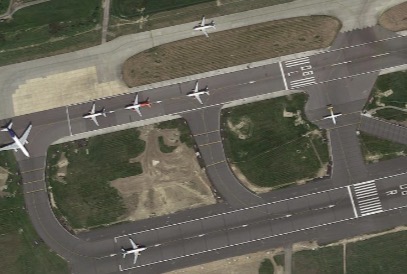
Parallel Runways
[Runway Configurations]
The capacities of this runway systems depend on the number of runways and on the spacing between the runways. Two, three, and four runways are common. The spacing between this runway varies widely. The spacing is classified as close, intermediate, and far, depending on the centerline separation between two of this runway
Close parallel runways
[Parallel Runways]
are spaced from a minimum of 700 ft (for air carrier airports) to less than 2500 ft.
Intermediate parallel runways
[Parallel Runways]
are spaced between 2500 ft to less than 4300 ft.
Far parallel runways
[Parallel Runways]
are spaced at least 4300 ft apart
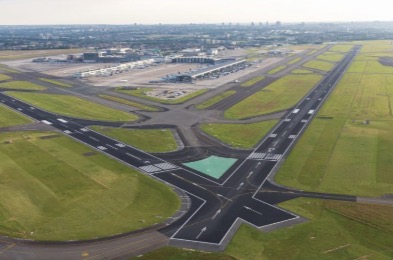
Intersecting Runways
[Runway Configurations]
Many airports have two or more runways in different directions crossing each other. These runways are necessary when relatively strong winds occur from more than one direction, resulting in excessive crosswinds when only one runway is provided. When the winds are strong, only one runway of a pair of ________ runways can be used, reducing the capacity of the airfield substantially. If the winds are relatively light, both runways can be used simultaneously

Open-V Runways
[Runway Configurations]
Runways in different directions which do not intersect. Like intersecting runways, this revert to a single runway when winds are strong from one direction. When the winds are light, both runways may be used simultaneously.
diverging pattern
The strategy which yields the highest capacity is when operations are away from the V and this is referred to as a ___________.
Structural Design of Airport Pavements: Airfield Pavements
is intended to provide a smooth and safe all weather riding surface that can support the weights of such heavy objects as aircraft on top of the natural ground base.
Structural Design of Airport Pavements: Airfield Pavements
are typically designed in layers, with each layer designed to a sufficient thickness to be adequate to ensure that the applied loads will not lead to distress or failure to support its imposed loads
Pavement Structure
is a structure consisting of one or more layers of processed materials.

flexible pavement
[Pavement Structure]
A pavement consisting of a mixture of bituminous material and aggregate placed on high quality granular materials

rigid pavement
[Pavement Structure]
When the pavement consists of a slab of Portland Cement Concrete (PCC)
pavement foundations
[Soil Investigation and Evaluation]
Accurate identification and evaluation of ___________ are essential to the proper design of the pavement structure. The subgrade supports the pavement and the loads placed upon the pavement surface.
pavement
[Soil Investigation and Evaluation]
The function of the _______ is to distribute the loads to the subgrade, and the greater the capability of the subgrade to support the loads, the less the required thickness of the pavement
Soil investigation
consists of a soil survey to determine the arrangement of the different layers of soil in relation to the subgrade elevation
Soil Investigation and Evaluation
A sampling and testing of the various layers of soil to determine the physical properties of the soil, and a survey to determine the availability and suitability of local materials for use in the construction of the subgrade and pavement
California Bearing Ratio (CBR) Test
is penetration test meant for the evaluation of subgrade strength of roads and pavements. The results obtained by these tests are used with the empirical curves to determine the thickness of pavement and its component layers.
California Bearing Ratio (CBR) Test
The resistance of the soil to penetration, expressed as a percentage of the resistance for a standard crushed limestone, is the ______ value for the soil
Plate Bearing Test
(or Plate Loading Test) is a load bearing test of soil used for determining the ultimate bearing capacity of the ground and the likely settlement under a given load. This test consists of applying loads by means of a hydraulic jack through a jacking frame on to a steel plate on the soil.
Young’s Modulus (E Value)
The most recent accepted method for determining the strength of subgrade by the FAA is based upon the elastic modulus of the subgrade, or E
“stiffness” or “elasticity.”
[Young’s Modulus (E Value)]
In general, a structure’s E value is its measure of “_________” or “________.” The greater the E value, the more stiff the material, and the less the material is susceptible to deformation under a given stress load
Airport Reference Code
is based upon the aircraft approach category.
Airplane Design Group (ADG)
is a grouping of aircraft based upon wingspan or tail height