BUSINESS 1.2
 Call Kai
 Learn
 Practice Test
 Spaced Repetition
 Match
 Flashcards
 Knowt Play
1/24

There's no tags or description
Looks like no tags are added yet.
25 Terms
What is demand and what is the law of demand?
Demand is the quantity of a good consumers are willing and able to purchase at a given price over a given period. As price increases, quantity demanded decreases, ceteris paribus.
What is the difference between a movement and a shift in demand?
A movement is caused by a change in the product's own price, whereas a shift is caused by a non-price determinant of demand.
What are the seven factors that shift demand?
Prices of substitutes and complementary goods
Consumer incomes
Fashions, tastes and preferences
Advertising and branding
Demographics
External shocks
Seasonality
How do substitutes and complementary goods affect demand?
Substitutes are goods used in place of one another. An increase in the price of Pepsi increases demand for Coca-Cola.
Complements are goods consumed together. An increase in the price of printers decreases demand for ink.
How do the other factors affect demand?
Factor | Impact on demand |
|---|---|
Consumer income | Rising incomes increase demand for normal goods. |
Fashions and tastes | Increased popularity increases demand. |
Advertising | Increases brand awareness and demand. |
Demographics | Population growth may increase demand. |
External shocks | A recession may decrease consumer confidence and demand. |
Seasonality | Demand for ice cream increases in summer. |
What is supply and what is the law of supply?
Supply is the quantity of a good producers are willing and able to sell at a given price over a given period. As price increases, quantity supplied generally increases, ceteris paribus.
What is the difference between a movement and a shift in supply?
A movement is caused by a change in the product's own price, whereas a shift is caused by a non-price determinant of supply.
What are the five factors that shift supply and how?
Factor | Impact on supply |
|---|---|
Higher production costs | Decrease profit margins, shifting supply left. |
New technology | Increases productivity and reduces unit costs, shifting supply right. |
Indirect taxes | Increase effective production costs, shifting supply left. |
Government subsidies | Reduce effective production costs, shifting supply right. |
External shocks | May disrupt production, shifting supply left. |
What is the difference between an indirect tax and a subsidy?
An indirect tax is a tax on expenditure on goods and services, such as VAT.
A subsidy is financial assistance provided by the government to support producers or encourage economic activity.
What is market equilibrium?
The point where quantity demanded equals quantity supplied, meaning there is no tendency for price to change.
What is excess demand and excess supply?
Excess demand occurs when quantity demanded exceeds quantity supplied, creating a shortage and upward pressure on price.
Excess supply occurs when quantity supplied exceeds quantity demanded, creating a surplus and downward pressure on price.
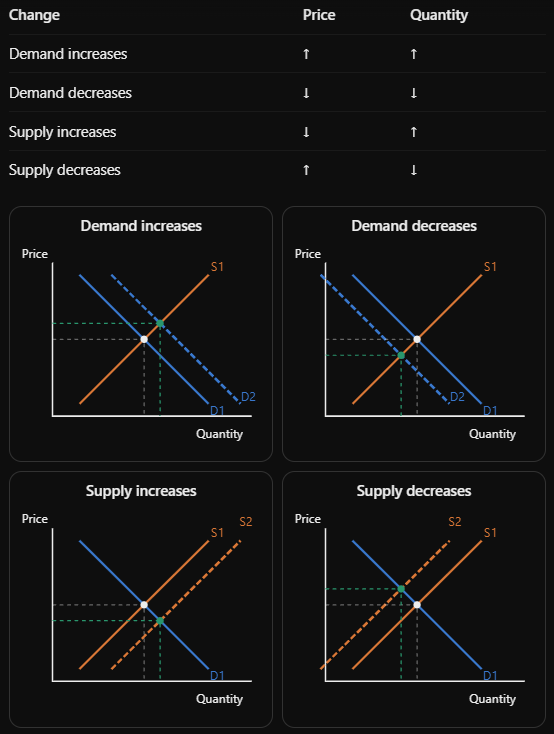
How do shifts in demand and supply affect equilibrium?
What is PED and its formula?

How do you interpret PED values?
Absolute PED value | Interpretation |
|---|---|
Greater than 1 | Price elastic |
Less than 1 | Price inelastic |
Exactly 1 | Unitary elastic |
0 | Perfectly inelastic |
Infinity | Perfectly elastic |
PED is usually negative due to the inverse relationship between price and quantity demanded.
What factors influence PED?
Substitutes – more substitutes make demand more elastic.
Brand loyalty – stronger loyalty makes demand more inelastic.
Necessities – tend to be inelastic.
Luxuries – tend to be elastic.
Time period – demand tends to become more elastic over time.
Proportion of income – expensive purchases tend to be more elastic.
What is the relationship between PED and total revenue?
Demand | Price increases | Price decreases |
|---|---|---|
Elastic | Revenue falls | Revenue rises |
Inelastic | Revenue rises | Revenue falls |
Unitary | Unchanged | Unchanged |
How do you calculate PED and total revenue?
Price increases from £10 to £12 and sales decrease from 100 to 90 units.
Price change = +20%
Quantity change = −10%
PED = −10 ÷ 20 = −0.5 (inelastic)
Original revenue = £10 × 100 = £1,000
New revenue = £12 × 90 = £1,080
Revenue increases by £80.
Why is PED useful to businesses?
It helps businesses determine appropriate pricing strategies to maximise revenue and forecast changes in sales.
What are the limitations of PED?
PED estimates may be inaccurate, consumer preferences may change and competitors may respond to price changes. Furthermore, increased revenue does not necessarily result in increased profit.
What is YED and its formula?
The responsiveness of quantity demanded to a change in consumer income.

How do you interpret YED values?
YED value | Interpretation |
|---|---|
Negative | Inferior good |
Positive | Normal good |
Between 0 and 1 | Income inelastic normal good |
Greater than 1 | Income elastic normal good |
Exactly 1 | Unitary income elastic |
0 | Perfectly income inelastic |
What factors influence YED?
Whether the product is a necessity or luxury, consumer income levels, consumer preferences and availability of preferred alternatives.
Necessities tend to be income inelastic, whereas luxuries tend to be income elastic.
How do you calculate YED?
The product is a normal, income elastic good.

Why is YED useful to businesses?
It helps businesses forecast demand, manage stock, plan production and adapt to economic conditions. During economic growth, demand for luxury goods may rise significantly, whereas during a recession, demand for inferior goods may increase.
What are the limitations of YED?
Income forecasts may be inaccurate, consumer preferences may change and income changes may affect different demographic groups differently, reducing the reliability of forecasts.