Skeletal Muscle Physiology Part II
 Call Kai
 Learn
Learn Practice Test
 Spaced Repetition
 Match
Match Flashcards
 Knowt Play
1/52

There's no tags or description
Looks like no tags are added yet.
Name | Mastery | Learn | Test | Matching | Spaced | Call with Kai | Chat |
|---|
No analytics yet
Send a link to your students to track their progress
53 Terms
What are the steps of muscle contraction?
a motor neuron releases ach, which binds to receptors in the motor end plate
this causes an AP to travel down the T-tubules
when the AP reaches the SR, it releases Ca2+
Ca2+ binds to troponin, which moves tropomyosin off binding sites
cross bridges form and contraction occurs
What are the steps of muscle relaxation?
AP ceases
Ca2+ is actively pumped back into the SR
AChE degrades all ach in the synaptic cleft
troponin relaxes, and tropomyosin covers actin sites again
What are the three different muscle fiber types?
Type I
Type IIa
Type IIx
Type I muscles
aka slow twitch (SO)
strengths: resistant to fatigue and can be used for endurance activities
weaknesses: contract slowly and do not produce a lot of force
appear dark in color due to increased capillary density
Type IIa muscles
aka fast twitch oxidative-glycolytic (FOG)
strengths: contract fast, can be used for longer activities, and semi-fatigue resistant
Type IIx muscles
aka fast twitch glycolytic (FG)
strengths: contract the fastest and produce the most amount of force
weaknesses: fatigue easily and can only be used for short events
appear white in color due to low blood flow
What muscle type has the largest motor neuron? Why does this make sense?
Type IIx muscles have the largest motor neuron
the larger the motor neuron = more muscle fibers recruited = more force produced
What muscle type has the highest mitochondrial density? Why does this make sense?
Type I muscles have the highest mitochondrial density.
the more mitochondria = the more ATP that can be produced oxidatively = the longer a moderate exercise can be maintained
What muscle type has the highest capillary density? Why does this make sense?
Type I muscles have the highest capillary density.
A greater capillary density = more oxygen delivered during exercise = supports aerobic energy pathways
What is the major fuel source of Type I, Type IIa, and Type IIx muscles?
Type I: triglycerides
Type IIa: PCr and glycogen
Type IIx: PCr and glycogen
Fiber types CANNOT change, but…
type II fibers can become more aerobic with endurance training
and type I fibers can become more anaerobic with resistance training
True or False: Type I and Type II fibers can be found in the same skeletal muscle. They are often spread out, not organized by type.
true

True or False: Everyone has the same ratio of skeletal muscle fibers in their muscles.
false, each person has different ratios
Synapse
a junction between two neurons or a neuron and a muscle
facilitates the transmission of nerve impulses
Neuromuscular junction
the site of communication between a neuron and a muscle
consists of a synapse between an alpha-motor neuron and muscle fiber
What does an alpha-motor neuron consist of?
a single motor neuron and all the muscle fibers it innervates
The more motor units recruited = ____ the contractile force
the higher
How can we increase force production?
by increasing the frequency (or how often) a muscle is stimulated to contract
by increasing motor unit recruitment
by making sure muscles are at an optimal length for contraction
Twitch
the smallest contractile response of a muscle fiber to a single stimulus

Summation
a series of twitches that occur one after the other
results in an increase in force production, b/c each twitch builds off the previous one

Tetanus
peak force of a muscle fiber (or motor unit) as a result of repeated APs

How does increasing motor unit recruitment result in greater force production?
recruiting more motor units that are bigger in size = greater force
Size Principle of motor unit recruitment:
the minimum number of motor units are recruited based on exercise intensity (recruited from small to large)
What is the order that motor units are recruited in?
smallest (Type I) motor units are recruited first
midsized (Type IIa) motor units are recruited second
large (Type IIx) motor units are recruited last

What does this graph tell us?
Type I muscles contract at the lowest stimulation (20% of contraction needs)
Type IIa muscles contract at a moderate stimulation (40% of contraction needs)
Type IIx muscles contract at the highest stimulation (70% contraction needs)
Length-tension relationship
suggests that muscles have an optimal overlap length of actin and myosin for force production
too little or too much overlap results in a decrease in force production
Functions of titan
scaffolding: provides structural support for the sarcomere
bidirectional molecular spring: prevents overstretching of myofibrils and provide recoil
passive force enhancement: as muscle length stretches in passive muscle, titan contracts
possible residual force enhancement: increases isometric force following an eccentric phase
modulator of contraction: assists with active contraction
Active tension
the force produced by a muscle during contraction
there is an optimal overlap length of actin and myosin —> that allows for maximal force production.

Passive tension
the force generated by a muscle when it is stretched
is activated when muscle length is stretched 60% or higher
caused by titan

Total tension
= active tension + passive tension


What are the takeaways from this graph?
there is an optimal overlap length for muscles with small and large PCSAs that allow them to produce maximal force
muscles with larger PCSAs produce more force / tension

What are the takeaways from this graph?
there is an optimal muscle length for tension
longer fibers can produce tension over a greater range of lengths
shorter fibers can produce tension over a shorter range of lengths
tension decreases as we move away from optimal muscle length
Eccentric contractions
the muscle lengthens while producing force
ex: lowering weight on a bicep curl / squat
Concentric contractions
a muscle shortens while producing force
ex: lifting weight during a bicep curl
Do eccentric or concentric muscle contractions produce the most force? Why?
eccentric muscle contractions produce the most force, because titan adds passive tension = greater total tension and force produced
What is the relationship between eccentric contraction force and velocity?
eccentric contractions produce maximal force at high velocities
What is the relationship between concentric contraction force and velocity?
concentric contractions produce maximal force at lower velocities
Why does force decrease as velocity increases during concentric contractions?
b/c some slow twitch fibers fall behind and can’t contribute to high velocity movements
All fiber types (Type I, IIa, IIx) contribute to slower velocity movements =
more force produced
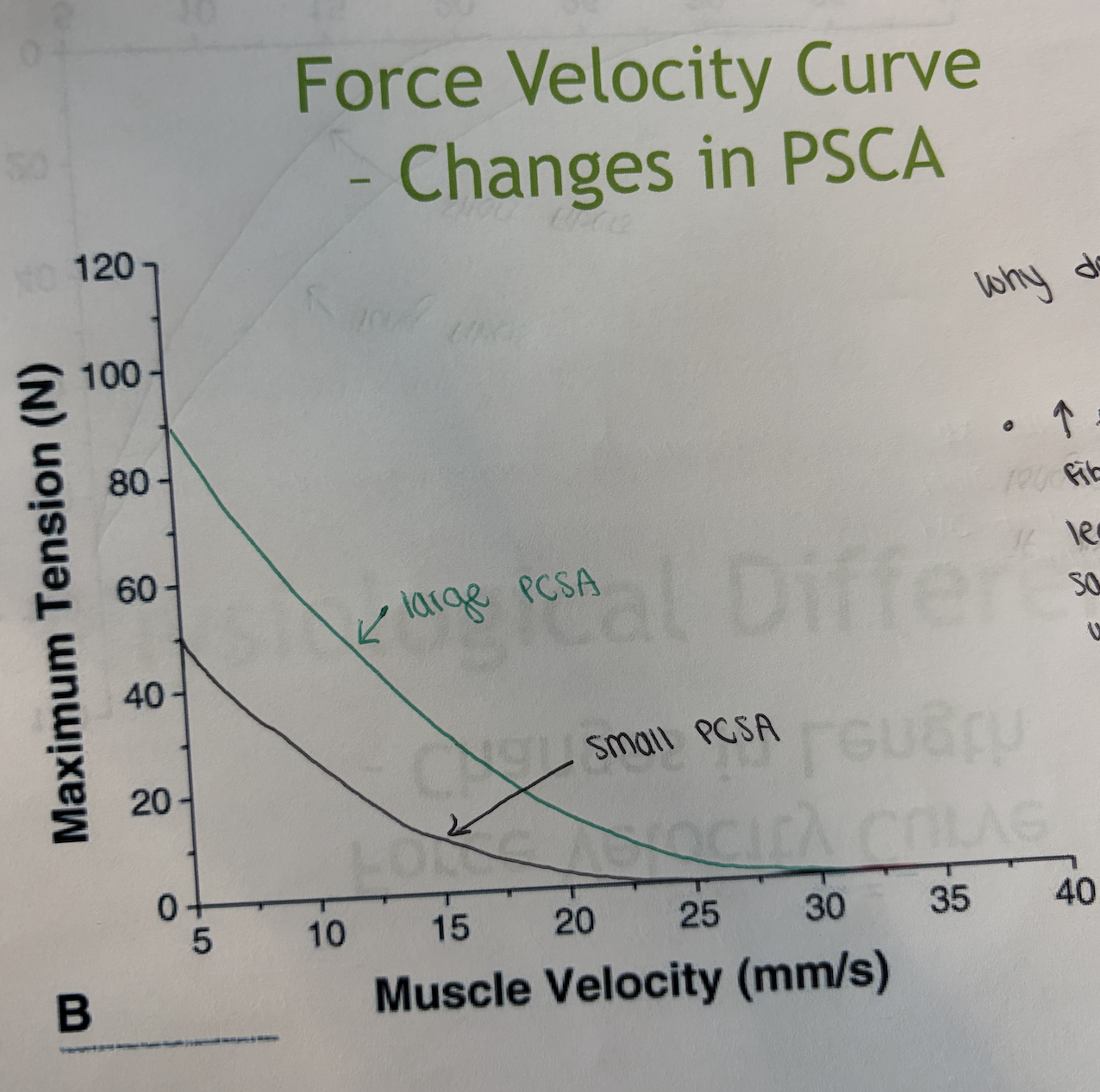
What is the relationship between force, velocity, and PCSA?
the higher the PCSA = the more fibers that can contribute to force production = greater force at slower velocities
the smaller the PCSA = fewer fibers available for force production = lower force at slower velocities

What is the relationship between force, velocity, and fiber length?
given that PCSA is constant, longer muscle fibers can produce more force at higher shortening velocities
On average, muscle strength differs between men and women. Why?
men have more muscle mass
No sex strength disparity exists when muscle is expressed per unit of…
CSA
How does strength change in children?
the older children get, the more muscle mass they have —> and the stronger they become
At what age does a woman have peak muscle mass?
around 20 years
At what age does a man have peak muscle mass?
around 25-30 years
__, __, and __ require myelination.
strength
power
skill
Why are children often uncoordinated and not-very strong?
b/c their neurons are still developing myelin, so signals sent to muscle may be slow or imprecise —> leading to slow rxn times and uncoordinated movements
Strength and neuromuscular function ___ with age, especially around 50-60 years old.
decrease
Decreases in muscle mass and strength as one ages can be combatted by ____.
resistance training
Strength trained men at 80 yrs. have the strength of an untrained ___ year old.
30
True or False: Both untrained and resistance trained adults lose strength as they age.
True, but untrained men lose strength at a faster rate
Resistance training benefits
increased bone density
more muscle mass
less fat