Lecture 3: Tissues and Integument
 Call Kai
 Learn
 Practice Test
 Spaced Repetition
 Match
 Flashcards
 Knowt Play
1/45

There's no tags or description
Looks like no tags are added yet.
Name | Mastery | Learn | Test | Matching | Spaced | Call with Kai | Chat |
|---|
No analytics yet
Send a link to your students to track their progress
46 Terms
Epithelial tissue function
Covers body surfaces, lines body cavities and organs, forms glands
Muscle tissue function
Movement (smooth, cardiac, skeletal)
Nervous tissue function
Control/communication
Connective tissue function
Binding and support
Protection against infection
Tissue repair
Insulation
Protection/cushioning
Why is epithelial tissue avascular?
Because it has a protective barrier role; it contained blood vessels, there would be constant bleeding and easy open pathways for bacteria/viruses to enter the body.
Instead, it is avascular (no blood cells), so it receives nutrient/oxygen via diffusing from underlying connective tissue.
Apical surface
Faces outside the body/lumen (exposed to open space, facing away from connective tissue).
Basal surface
Attached to underlying basement membrane, facing toward connective tissue (separates the epithelium from underlying connective tissue).
Extracellular matrix (ECM) in connective tissue is composed of ground substance and which three types of protein fibers?
Collagen (strong; resists stretching)
Elastic (stretches/recoils)
Reticular (forms supporting network)
Connective tissue: Function and types of connective tissue proper
Holds, supports, and links body parts (ex: tendons, ligaments)
Loose connective tissue (has lots of space between fibers and cells) → areolar, reticular, adipose.
Dense connective tissue (has lots of collagen fibers) → dense regular, dense irrgular, elastic
Connective tissue: Main cells and state of ground substance of connective tissue proper
Fibroblasts, adipocytes
Semifluid ground substance
Connective tissue: Function of cartilage
Support and cushioning; shock-absorber
Connective tissue: Main cells and state of ground substance of cartilage
Chrondrocytes
Stiff, gelatinous ground substance
Connective tissue: Function of bone
Support, protection, framework for body
Connective tissue: Main cells and state of ground substance of bone
Osteocytes
Calcified ground substance (makes bones strong)
Connective tissue: Function of blood and lymph
Fluid connective tissues (fluid ground substance) that circulate through the body to transport materials, maintain fluid balance, and defend against disease.
Lymph helps transport WBCs to various tissues of the body
What is the integumentary system?
The body’s outer covering (skin + accessory organs like hair, nails, glands).
Blue skin indicates?
Cyanosis indicates hypoxemia (inadequate oxygen in blood)
Yellow skin indicates?
Jaundice/icterus indicates liver dysfunction
What is erythema?
Red skin, caused by heat, inflammation from injury/infection, allergic reaction, vasodilation, etc.
What is pallor caused by?
White/pale skin can occur with shock, amenia, or peripheral vasoconstriction (reduced blood flow.
In darker skin tones → assess palms, nail beds, mucous membranes (inside cheeks, gums).
What is the epidermis?
Outer layer of skin
Psoriasis
Abnormally rapid skin cell growth (complete cell turnover in 7-10 days instead of 4-6 weeks)
What does the epidermis contain (i.e: major four major cell types)?
Keratinocytes, melanocytes, Langerhan’s cells, Merkel cells
What is the function of keratinocytes?
Produce keratin → protects against heat, abrasion, microbes, chemicals, water loss.
What is the function of melanocytes?
Produce melanin → hair/skin colour, protect cells from UV radiation, protects DNA of actively cells in basal layer.
Where are melanocytes found?
Stratum basale (deepest layer of epidermis)
What is the function of Langerhan’s cells?
Intraepidermal macrophages involved in immune defense by performing phagocytosis on pathgens.
Where are Langerhan’s cells found?
Stratum spinosum (thickest layer of epidermis)
What is the function of Merkel cells?
Detech touch by releasing NTs to sensory neurons to convey touch info to the nervous sytem.
Outermost layer of the epidermis
Stratum corneum
Layer of epidermis present only in thick skin
Stratum lucidum (palms of hands, soles of feet)
Epidermal layer that is the transition between living and dead cells
Stratum granulosum
“Spiny,” thickest epidermal layer
Stratum spinosum
Deepest layer of the epidermis
Stratum basale, containing actively dividing cells, melanocytes, and Merkel cells.
What is the purpose of epidermal ridges (epidermal pegs + dermal papillae)?
Increase surface area of contact between epidermis and dermis → improves grip/friction, helps withstand mechanical stress (too much pressure can cause blisters).
Two major forms of melanin
Eumelanin (brown/black)
Pheomelanin (yellow/red)
Skin colour is the expression of which three pigments?
Melanin (brown-black or yellow-red)
Carotene (yellow-orange)
Hemoglobin (red)
What is the purpose of melanin?
Protects DNA by absorbing UV radiation (people near equator have higher melanin pigmentation).
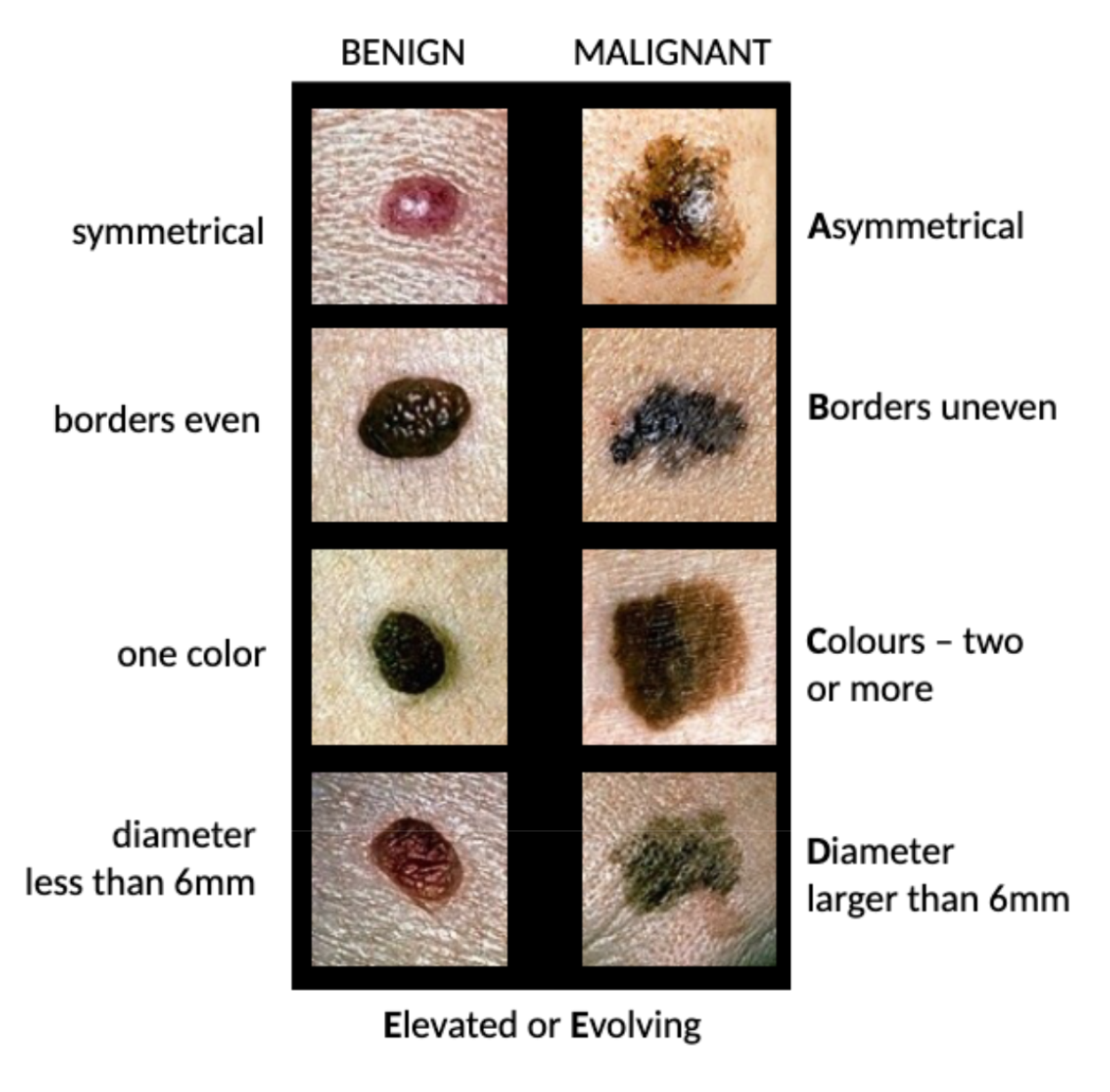
Where do malignant melanomas arise from?
Malignant transformation of melanocytes that develop from nevi (moles).
What is the ABCDE rule?
Asymmetry
Border (irregular)
Colour (multiple/uneven)
Diameter (>6 mm)
Evolving/elevation
Where is the dermis located?
Underneath the epidermis and above the hypodermis/subcutaneous later.
Two regions of the derims
Papillary region: thin, superficial top layer
Reticular region: thick, deep bottom layer
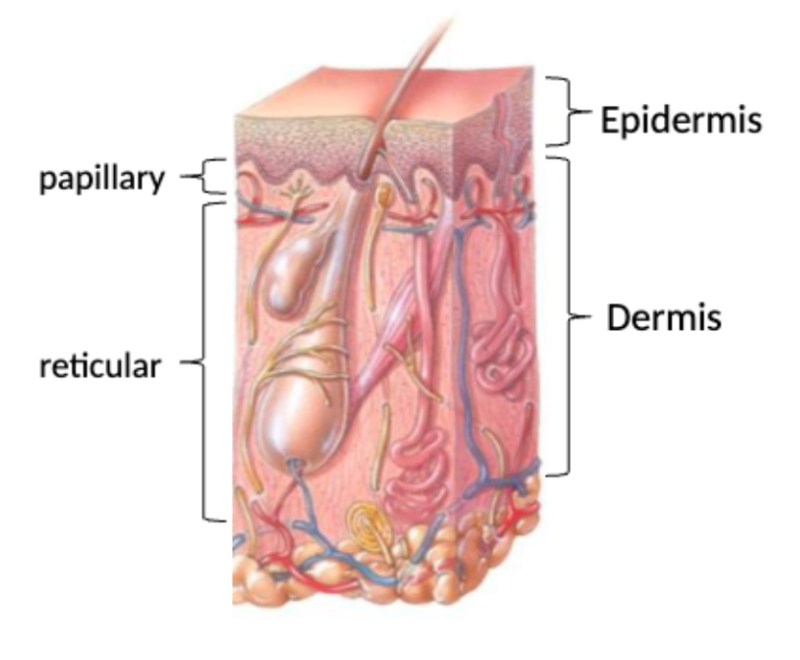
What does the dermis contain?
Collagen + elastic fibers, blood vessels, nerves, sensory receptors, hair follicles, glands.
What are the four types of skin glands and what do they produce?
Sebaceous glands → sebum, which has antimicrobial defensins (absent from palms/soles)
Apocrine glands → thicker, protein-rich sweat (body odour; puberty; SNS)
Eccrine glands → watery sweat (thermoregulation; SNS)
Ceruminous glands → earwax
What are the five functions of the skin?
Thermoregulation (vasodilation when hot and vasoconstriction when cold)
Blood reservoir
Protection from environment (chemical, physical, biological)
Cutaneous sensation
Metabolism (through vitamin D production)
Too much UV radiation causes
Uncontrolled melanocyte growth → possible melanoma