Kin 3346: Midterm: Lecs 5-7 (FOCUS)
 Call Kai
 Learn
 Practice Test
 Spaced Repetition
 Match
 Flashcards
 Knowt Play
1/174

There's no tags or description
Looks like no tags are added yet.
175 Terms
what is motor behaviour
how humans acquire, plan, and execute movements that require skill and coordination
observable changes in the learning and performance of a particular movement or motor skill
product of biological characteristics and environmental influence
how humans learn, control, and develop movement skills
motor behaviour consists of (3):
motor control
motor learning
motor development
1: motor control
underlying processes of movement
neural + physical + behavioural = optimizes skill acquisition
motor control: 3 main issues
degrees of freedom
serial order
peceptual-motor integration
1st issue in motor control: degrees of freedom
Number of independent elements that must be constrained to produce coordinated motion
coordination
coordination definition
Constraining the number of degrees of freedom to decrease the complexity of the movement task to produce a movement pattern and achieve a task goal
bringing parts into proper relationship with one another
increased coordination leads to a more positive task outcome
performing an activity more fluidly through practice
2nd issue in motor control: serial order
sequencign and order of movement behaviours
timing and order of an activity are critical for nearly every movement we produce
people prepare an action plan rather than planning and executing one thought at a time - much more efficient, but can lead to an action slip, due to thinking about the action rather than specifics of the task
serial order - coarticulation
when performing sequential movements, the execution of one movement can influence the next - more fluid and efficient performance
preparing for subsequent movements rather than completing one movement before preparing for the next
we preplan activities to move efficiently, ex. writing, grasping
3rd issue of motor control: perceptual-motor integration
how perception and motor control are integrated
perception and movement work together, continuously influencing one another
→ moving closer to something to see or hear it better; movement improves perception
→ altering grip based on perceived weight: perception improves movement
motor learning definiton
processes involved in the acuisition of a motor skill
factors that enhance or inhibit the ability to perform a motor skill
a direct result of practice
motor learning: actual definition
a relatively permanent change in the ability to execute a motor skill because of practice or experience rather than maturation or phyiological training
characteristics of motor learning (1-4)
a process is required to induce a change in the ability to perform skillfully
it must occur as a direct result of practice
it cannot be observed directly
assumed to produce positive, irrevesible effects in the capability for skilled behaviour
1st characteristic of ML: a process is required to induce a change in the ability to perform skillfully
process
sets of events or occurrences resulting in a change in the end product
ex. drills in sport are processes with the goal of improving the capability to perform skillfully
2nd characteristic of ML: it must occr as a direct result of practice
motor learning is not due to maturation or physiological training
a change that occurs because of maturation is a motor development change
→ learning to walk is motor development, not motor learning, because it is a motor skill that almost all humans acquire
learning to shoot a basketball requires practice and is due to motor learning
3rd characteristic of ML: it cannot be observed directly
it can only be assumed based on long-term performance changes
assumed to have occurred when realtively permanent changes in the capability of skilled behaviour are observed through performance changes
4th characteristic of ML: assumed to produce positive, irreversible effects in the capability for skilled behaviour
these changed are not temporary
“its like learning to ride a bicycle”
skill
ML: progression in skill from a novice who is first attempting a motor skill to a skillfull performer
skill = learned ability to bring about predetermined results with maximal certainty, often with a minimum outlay of time or energy
skillfull performer definition
achieved a criterion of excellence and is capable of performing at a high level most of the time
components of movement skills (3)
cognitive
perceptual
motor
cognitive skills
intellctual skills of the mover
enable a performer to make decisions and solve problems
EX. decision-making speed is critical for a quarterback in american football, who must make quick, effective decisions
perceptual skills
involve interpreting and integrating sensory info to determine the best movement outcome
attention and previous movement experiences affect perceptual skils
EX. a soccer player assesses the positon of defenders and teammates to determine whether to pass the ball to an open player or continue dribbling towards the goal - the speed and direction of athletes movements depend on the perceptual info she receives regarding the current situation
physical elements that enable movement (motor skills)
stability
locomotor skills
manipulation skills
the activity could not be completed without the learned ability to coordinate the limbs to produce the action
steps for learning a new motor skill (skills are classified according to:)
understand basic elements and sequence of movements
break activity down into basic skills
skills are classified according to:
movement precision
environmental predictability
time constraints
nature of the skill
1: movement precision
motor skills: can be classified by size of muscle groups being used to produce movement pattern and consequently, precision of movement
gross: large muscle groups produce movement
tend to be much larger, less precise movements
walking, running, jumping, squatting
fine: skills where precise movements are critical o perform w/ increased accuracy and control
use smaller muscle groups
dialing a phone number, playing piano, typing
2: skills classified by → environmental predictability
skills can also be classified according to the predictability of the environment
closed skills
open skills
closed skills
skills used in tasks that takes place in a stable environment in which objects or events are also stationary
goal is to perform movement correctly then replicate the action
a free throw in basketball
not constrained by time or space, environment is stable
shooter does not have to pay attention to defenders trying to steal or block
distance to hoop and height of hoop stable
open skills
occur in environment which objects, people, and events constantly changing
skills require moveer be more attentive to environment, constantly monitoring situation for changing conditions
a hockey slap shot
environmental precitability is a spectrum
a continuum
no skills are entirely closed
there are always some conditions that will change
pressure of a situation
motivation
time demands
predictability is always musch greater for closed skills than open skills
inertial variability
any change that occurs between trials
a skill with high inertial variability has aspects that change with every performance attempt
can be present in both closed and open skills
low inertial variability
batting in tee ball (closed skill)
the key to success is consistency
high inertial variability
batting in baseball (open skill)
each pitch is unique, requiring batter to adapt to changing conditions
3: time constraints
the difficulty of a task can be determined by its pacing
self paced tasks
externally paced tasks
self paced tasks
initated by the mover (golf, darts, archery)
basketball players shooting foul shots often engage in preliminary routines prior to shooting
they can adopt a routing because the shot is not constrained by time
accuracy is the key
externally paced tasks
the batters movements are externally paced tasks because she is responding to the pitched ball
she does not have the luxury of swinging whenever she desires
a pitcher determines when to initiate the pitche, so the pitch is self-paced
4: nature of the skill - discrete motor skills
beginning and end points are clearly defined
generally short in duration and have a distinct difference between their initiation and termination
a period that must elapse before subsequent movement must occur- ex. quarterback must ait to receive a ball before passing
ex. throwing, kicking, punching, shooting, catching
4: nature of the skill - continuous motor skills
do not have clearly defined beginning and end points
longer in duration and mover is in constant motion
movements are generally simple and continuously repeated
ex. running, swimming, cross-country skiing, cycling
4: nature of the skill - serial motor skills
series of dicrete skill that must occur in a specific sequence
if the order of movemens cna be altered, task would not be classified as a serial task
each component can be performed separately as a discrete skill, such as catching, dribbling, jumping, and shooting
serial skills require that the performer not only be skillful at the discrete skills independently, but also be able to transition from one movement to the next in the proper sequence
4: nature of skill - closed serial skill
the triple jump, consisting of an approach, hop, skip, and jump
if the sequence were altered to a hop, approach, jump, and skip, this combo would no longer be considered the triple jump
4: nature of skill - open serial skill
a basketball layup when performed in a game because defenders can alter the timing and position of the movement
stages of learning
learners progress through a series of stages when improving motor skill competence
several models address the behavioural features of these stages
Fitts and Posner 3 stage learning model
regardless of age or motor skill, all learned go though each of these stages when advancing from a novice level to an expert level
cognitive
associative
autonomous
cognitive stage
main goal is to understand the basic components of the motor skill movement pattern
learenrs require a considerable amount of mental activity to understand the movement pattern and appropriately coordinate their limbs
novice learners often mentally verbalize their movements
attending to ones movements is a neessary process in learning any skill, but it often causes movements to appear choppy and uncoordinated
cognitive stage steps
learners must attempt a number of techniques in a trial-and-error process until theyve achieved success
the use of verbal isntruction, feedback, modeling
verbal instruction combined with passive movements can be as effective in learning a new movement pattern as active movements
cognitive stage- the largest gains in learning occur
learners begin with very little knowledge of the motor skill and make rapid
roles in the cognitive stage

associative stage
once learners have a basic understanding of the task and have shown significant imporvement in the movement pattern, they haveprogressed to the associative stage of learning
the goal has shifted from learning how to solve the movement problem refining the movement
characteristics of associative stage
performance improvements are more gradual
learners perform more consistently and can focus on error detection and correction
dont have to focus as much on production of movement - can attend to other sources of info
the verbal component (self-talk) is no longer present in production of the movement pattern because its no longer necessary or beneficial
roles in associative stage
the role fo the instructor shifts from instructing to designing appropriate and effetive practice sessions
the learner understands the basic movement pattern but still benefits from instructor feedback regarding errors and fine-tuning the movements

autonomous stage
the highest skill level
to progress to final stage, learners must practice for extended period, often many years
most people do not make it to autonomous stage
performer is so skilled the movement appears automatic, may be able to perform an additional task at same time, like controlling ball while driving down the court and making play decisions
mover can focus on decision-making strats, which are critical for high level performance in open skills, like wrestling and rugby

fitts and posner, juggling example

best way to teach movement skills
practitioners lead learners through a progression of movements to perform an open skill proficiently
best to place learners in a closed environment where task can be simplified and controlled before progressing to a more challenging and adaptable open environment
steps for teaching a new skill (3)
simplify task by focusing on only 1 aspect of the movement at a time
begin with a stable task
as performer increases in competence, more difficulty can be added, like increased locomotion and manipulation of an implement
teaching kicking a ball ex. step by step progression
kick a stationary ball in to a goal while standing still
take a step and kick a stationary ball into a goal
run and kick a stationary ball into a goal
dribble the ball and kick into a goal
dribble ball and kick into a goal thats guarded
gentile’s taxonomy
classification system for gradual progressions from closed to open environments
useful for individualizing motor skill progressions
uses 2 main categories to assist in program development
environmental context
action requirements
gentiles taxonomy: environmental context
regulatory conditions: stationary or moving
inertial variability: consistent or variable

gentiles taxonomy: action requirements
manipulation: absent or present
body orientation: stability or body transport

gentiles taxonomy as a 16-category system for classifying MS
combines the 4 classifications for the environmental context with the 4 classifications of the action requirements, creating 16-category system for classifying motor skills
enables an instructor to implement a precise skill progression appropriately for learners of all developmental levels to enable them to progress to their desired level of difficulty
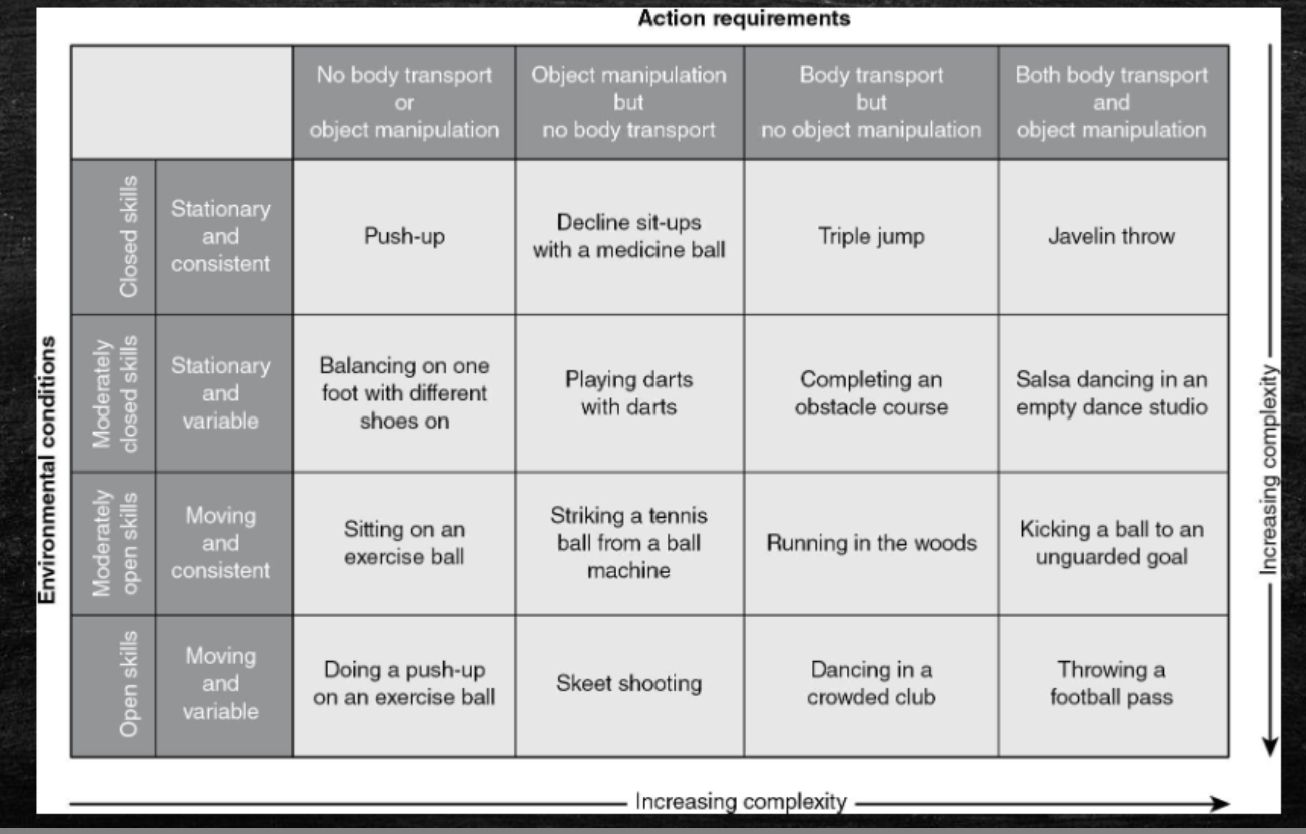
gentiles taxonomy: push up example
motor skills become increasingly complex from the upper-left quadrant to the lower-right quadrant
the push-up, in first quadrant, is the task lowest in complexity
little variability in performing a pushup from trial to trial
when performing successive pushups, performer simply needs to repeat the previous movement until reaching muscle failure or achieving a goal
no body transport or object manipulation is required
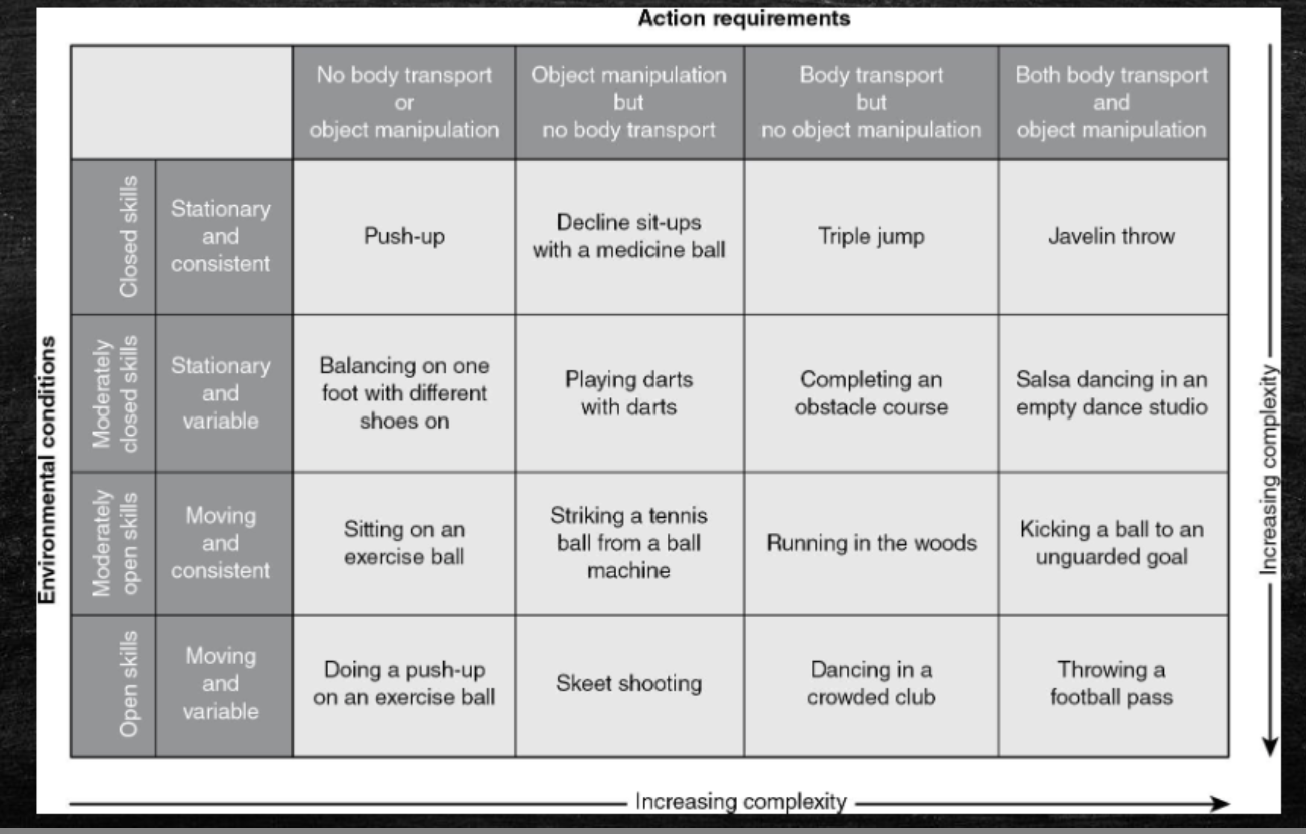
gentiles taxonomy: passing football ex
throwing a football pass, lower right quadrant, is complex
quarterback must be able to anticipate the receivers position and the time and location of the pass
must also be able to adapt to various environmental conditions with each performance attempt while transporting his body and manipulating the ball
how to USE gentiles taxonomy (tennis ex.)
depicts how taxonomy was designed to be used by practitioners
not expected that learners will move through each stage; rather, they will likely progress through several stages
allows for variety of options including more progressions for learners who may need slower progression to the whole motor skill in real time

motor development definition:
age related, successive changes in movement abilities that occur over the life span and he processes and factors affecting these changes
changes that occur during a short period that are not associated with practice or experience, such as a child throwing farther or running faster betwee ages of 2-3, would be due to motor development
motor development maps chronoligical age…
maps chronological age (age from birth ex.) to the emergence of a new motor milestone (ex. sitting, crawling, standing) or a new motor skill (ex. throwing, kicking, or galloping)
motor develope integrates which body systems
an expression of the integrationg of many body systems, each of hich has an important role in movement
musculoskeletal
sensory
cardiorespiratory
neurological
what is particularly important for young childrens development
interaction with the environment (behavioural aspect)
critical that young children develop a wide variety of movement patterns during their earlier years to provide a foundation for more complex movements
motor competence
measurement aspect of a movement
a minimal threshold of motor competence s deemed necessary to develop more complex skills
developing adequate levels of motor competence is associated with:
higher levels of PA participation
improved health and weight status
continued development of motor competence throughout an individuals life span
historical periods of growth and motor development
precursor period = 1787-1928
maturational period = 1928-1946
normative period = 1946-1970
process-oriented period = 1970-present
precursor period
1787-1928
based on descriptive observations
focus on the outcome of development
nature vs. nurture (darwin)
nature - genetic/internal
nurture = environmental
nature vs. nurture (maturationists vs. environmentalists)
nature - born with the underlying abilities to excel at certain sports; will eventually exhibit excellence in those sports
nurture - even basic skills must be developed through interaction with the environment
if nto given appropriate equipment or environment to learn, development will be delayed, or skills never materialize
gene x environment interaction (darwin)
Charles Darwin’s work was seminal in study of motor behaviour
provided insights into effect of environment on the animal
theorized how animals adapt to changing environments and discussed developmental sequences found across species
wrote about importance of studying both the product of the behaviour an the process
maturational period
1928-196
pioneered by Arnold Gesell
maturation is genertically predetermined; infant moves from oe developmental cycle to the next, in orderly fashion, regardless of practice, training, or effort
maturational period examples
infants don’t have to be taught how to walk- they do so once they reach a certain age
infants roll over at 5 months, si tup at 6 months, and stand at 8
maturationists assume that transitions are set and controlled by nature
children progress to the next step when they are ready
external influences are not included in these transitions
an “internal clock” determines precisely when the infanct will progress
maturational period: environment can influence transitions
a child who never lies on belly will crawl much later than baby who got regular tummy time
no belly time childs environment has delayed transition because infant wasnt given opportunity to strengthen arm, leg, and core muscles needed for crawling
children who are blind are significantly delayed reaching many milsetones
lack of visual stimuli would motivate them to reach objects of interest as well as help replicate actions seen from peers
normative period
focus on movement skills in school aged children and physical aspects of development
physical educators wanted to improve motor skill instruction through understanding changes in motor performance
focus on the processes of underlying performance changes when new simple motor skills are learned
process-oriented period
1970-present
hypothesis driven motor behavior research
3 theoretical concepts emerged:
information-processing theory
ecological approach
dynamic systems approach
information-processing theory
the brain receives, processes, and interprets info to send sinals to produce skilled coordinated movements, similar to how a computer functions
ecological approach
movement is much more complex than a simple input-output relay of info from the brain to the other systems
actions are determined by many internal factors (ex. goals and capabilities) and external factors (ex. what is available in the environment)
dynamic systems approach
movement does not occur because of a set of instructions but rather as the result of th inter-play of the task, the environment, and the individual
movement is softly assembled, meaning that it emerges because of these 3 factors
information-processing theory
the brain acts like a computer, working as a receiver and processor of information
addresses the processes involved in movement behaviour
shift from investigating ontogenetic (lifespan) changes to processes of change within a lifespan, ex. memory, feedback, attention, and perception
generalized motor program
patterns of movements that is modifiable to produce a movement outcome
every movement has a set of instructions stored in the brain
when we perform a movement, we retrieve this set of instructions, sending the message to the appropriate muscles
the time needed to organize a motor program depends on the complexity of the task; more complex asks require more time
reaction time
time from the onset of a stimulus to the initiation of the response
increases with increasing complexity
lift finger = 165ms
lift fingr, grasp ball = 199 ms
lift finger, hit ball, push button, grasp ball = 212 ms
movements are planned prior to initiating a response
more time requires to prepare motor programs for more complex tasks
invariant features
generalized motor program must have invariant features
features that cannot be modified between attempts
unique to their GMP

invariant features of a GMP (3)
sequence of actions
relative timing
relative force
1: sequence of actions
coordination or movement sequences for a motor skill
layup-dribbling, two steps, and then a shot
punt-catch, approach, drop the ball, and then kick the ball
if the sequence of actions were changes, the motor skill likely couldnt even be performed
relative timing and force
enable the rhythm of the movement pattern
movements can be performed with more force or less force, or faster or slower timing
all components of the skill must increase or decrease in force or speed, not just one component
by changing only one component, the rhythm of the motor skill with change
2: relative timing
volleyball serve
a swing to hit a volleyball during a serve must be relative to the timing of the toss
slowing down the toss of the ball but not slowing down the swing, the overall movement pattern would be compromised
walking
a person can walk at many speeds; however, the relative timing will remain the same unless the person transitions to running
3: relative force - kicking a ball
the force of your foot contacting a ball during a kick should be relative to the force with which you approached the ball and the movement of your leg
to kick a ball harder, an athlete must proportionately increase the amount of force produced when planting the nondominant foot, swinging the dominant foot back, swinging the dominant foot forward, and contacting the ball
GET NOTES FROM MACK
GMP: modifiable features
modifiable features = paramaters
allow responses to be adapted
walk at different speeds
shoot basketball from different positions on the court
kick with more force or less force
modifiable features of a GMP (3)
muscle selection
overall duration
overall force
1: muscle selection
writing with non-dominant vs. dominant hand
use of different muscle groups
the GMP is the same for writing/throwing with your left hand as it is fro writing/throwing with your right hand
2: overall duration
a quarterback in NFL cna throw a short pass to a running back pr throw a much farther for a hail mary pass to a wide receiver
the GMP is the same for running slowly as it is for running fast
3: overall force
unscrewing a very tight lid vs. a loose one
a rugby conversion or NFL field goal from 20 m vs. 60 m
the GMP is the same for batting with more overall force as it is fro batting with less overall force
varying parameters
varying paramteters appropriate to the situation is particularly essential for open skills
basketball players must vary each shot depending on their position relative to the basket
shortstops must vary their throws to reach different bases
speed-accuracy
speed and accuracy are important in many motor skills, particularly those that have a temoral and spatial component such as in racket sports and fielding games
although both accuracy and speed may be important in these motor skills, when a person focuses on one, the other is compromised
information-processing theory SUMMARY
all movements have a set of instructions (GMP)
the GMP has invariant features
sequence of actions
relative timing
relative force
and modifiable features
muscle selection
overall duration
overall timing
ecological approach: perception
perception: the act of attaching meaning to something
enables us to interact with the environment in a meaningful way, ex. we perceive the sizes of objects and determine how to adjust our grip to manipulate them
we perceive through out senses (vision, hearing, and kinesthesis), but perception is also affected by our personal experiences and understanding
ecological approach: memory stores
rejects idea that there is a need to search for memory stores for object representations
the acts of perceiving and moving occur simultaneously
ecological approacg: direct vs. indirect perception
uses direct perception
objects used to suit goals or needs (direct perception), not because there is a prior memory of using that object (indirect perception)
ecological vs. information processing
relationship b/w perception and action are viewed diff b/w the ecological approach and info-processing theory
ecological = direct process as using memory stores not needed to provide meaning to objects or events in the environment
info-processing = action occurs as an indirect process as of perception, ex. to act on the environment, a person must go through a series of steps
ex. of indirect process (information processing theory)
input
perception
decision-making
execution
feedback
