Chapter 8 - Kinetics
 Call Kai
 Learn
Learn Practice Test
 Spaced Repetition
 Match
Match Flashcards
 Knowt Play
1/57

There's no tags or description
Looks like no tags are added yet.
Name | Mastery | Learn | Test | Matching | Spaced | Call with Kai | Chat |
|---|
No analytics yet
Send a link to your students to track their progress
58 Terms
The primary function of enzymes is to accelerate reaction rates, or the ____ of reactions
Velocities
What does a kinetic description allow us to quantify with enzymes?
How fast an enzyme can operate (Substrate → Product)
How fast it operates at the substrate concentrations found in a cell
What substrate is most readily operated on by the enzyme
(T/F) Metabolism in the cell is done via a complex array of dozens of metabolic pathways composed of thousands of different reactions
True
Michaelis-Menten Enzyme
Enzymes that do generally lack sophisticated regulatory properties
Allosteric enzymes
Act as both catalysts and information sensors that sense signals in the environment, of which allows them to adjust the rate of their reactions to meet the cell’s needs
Allows for efficient coordination of the cell’s pathways
Have quarternary structures with muiltiple active sites in each enzyme
More complex kinetics than michaelis-menten
Kinetics
The study of the rates of chemical reactions
Enzyme Kinetics
The study of the rates of enzyme-catalyzed reactions
Explain the formula: V = -d[A]/dt = d[P]/dt for the reaction A → P
The velocity of a reaction (V) is the amount of A that disappears (equivalently, the amount of P that appears) in a given time.
Explain the formula: V = k[A]
The velocity of the reaction (V) is directly related to the concentration of A by a proportionality constant called the rate constant (k)
First-order reactions and how they affect V = k[A]
Velocity is directlky proportional to reactant concentration; k has units of s-1
Second-order reactions and how they affect V = k[A]
Bimolecular reactions with two reactants; k has units of M-1s-1
What is the initial velocity (V0) of catalysis? What does it vary depend on?
Defined as the number of moles of product formed per second shortly after the reaction has begun
Varies with the substrate concentration [S] when enzyme concentration is held constant
![<p>Defined as the number of moles of product formed per second shortly after the reaction has begun</p><ul><li><p>Varies with the substrate concentration [S] when enzyme concentration is held constant </p></li></ul><p></p>](https://assets.knowt.com/user-attachments/06fe604a-f9ec-4208-8618-97ba9b26bb51.png)
(T/F) Enzyme concentrations fluxuate drastically in cells
False. They are held relatively constant.

Explain what k1 means in the following reaction
The rate constant for the formation of the enzyme-substrate (ES) complex

Explain what k2 means in the following reaction
The rate constant for the formation of the product (P)

Explain what k-1 and k-2 means in the following reaction
The constants for the respective reverse reactions
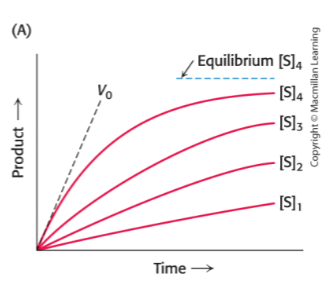
What is this chart displaying?
At low [S], the rate rises linearly with substrate concentration
At higher [S], the rate levels off and approaches maximum
Why is it most useful to focus on the intial rate of enzyme kinetics?
The rate of the reaction (the slope of the tangent line in the figure) decreases over time
Only at the beginning of the reaction is the exact concentration of substrate known
The reverse reaction is negligible at this point

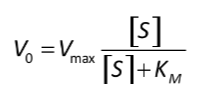
Michaelis-Menten equation
Describes how enzyme activity varies with substrate concentration
Michaelis constant (KM)
A measure of enzyme efficiency
Unique to each enzyme
Idependent of enzyme concentration
Depends on the particular substrate
Depends on environmental conditions (pH, temp, ionic strength)
Describes the properties of the enzyme-substrate interaction
Varies for enzymes that can use different substrates
Provides a measurement of the substrate concentration required for significant catalysis to take place

Maximum Velocity (Vmax)
Can be attained only when all of the total enzyme (ET) is bound to substrate (S)
Directly dependent on enzyme concentration

At very low substrate concentrations (when S is much less than KM), what happens to the velocity?
It is directly proportional to [S] concentration
![<p>It is directly proportional to [S] concentration</p>](https://assets.knowt.com/user-attachments/1b1e9275-127f-4a8e-af05-3ff6403a43ab.png)
At very high substrate concentrations (when S is much greater than KM), what happens to the velocity?
Velocity is maximimal and independent of [S] concentration
![<p>Velocity is maximimal and independent of [S] concentration</p>](https://assets.knowt.com/user-attachments/23000cf3-f5ec-4988-af08-679da9f9ecd4.png)
What happens when an enzyme is operating at Vmax?
All of the available enzyme is bound to substrate
The additiojn of more substrate does not affect the velocity of the reaction
The enzyme is displaying zero-order kinetics
The enzyme is said to be saturated
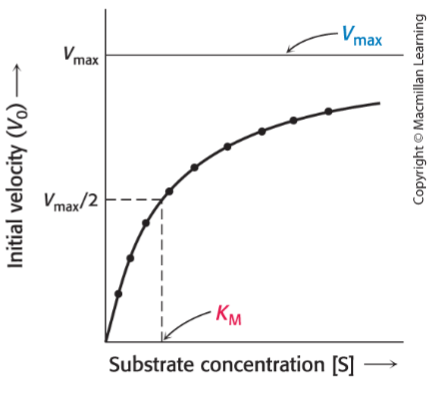
When V0 = Vmax/2, what does this mean for KM?
It its equal to the substrate concentration at which the rx velocity is half its maximal value
Michaelis-Menten enzymes
Simple, monomeric, and unregulated enzymes free to evolve to become as fast and as efficient as possible
Governed by mass action
Mass action
Enzymes in which, if a substrate is present, they will catalyse
Lineweaver-Burk plot
Also called a double-reciprocal plot
Plots out 1/V0 vs 1/[S]
Can determine KM and Vmax
![<p>Also called a double-reciprocal plot</p><ul><li><p>Plots out 1/V<sub>0 </sub>vs 1/[S]</p></li><li><p>Can determine K<sub>M</sub> and V<sub>max</sub></p></li></ul><p></p>](https://assets.knowt.com/user-attachments/61e8d80e-71b1-4ee5-a3f8-29ab52722b6f.png)

What does the slope of a Lineweaver-Burk plot represent?
KM/Vmax

What does the y-intercept of a Lineweaver-Burk plot represent?
-1/Vmax

What does the x-intercept of a Lineweaver-Burk plot represent?
-1/KM
Elasticity
Refers to an enzyme’s activity being sensitive to changes in environmental conditons
Ability for the enzyme to adapt
At substrate values below KM, what is an enzymes elasticity?
It will be very sensitive to changes in substrate concentration and display little activity
At substrate values well above KM, what is an enzymes elasticity?
It will have greater catalytic activity but be insensitive to changes in substrate concentration
Max activity
At substrate values approximately KM, what is an enzymes elasticity?
It will have significant activity (1/2 Vmax) but still sensitive to changes in substrate concentration
Turnover number (kcat) and what other property can reveal it
The number of substrate molecules that an enzyme can convert into product per unit time when fully saturated
Vmax reveals this number if the concentration of active sites [E]T is known
kcat = Vmax/[E]T
Specificity Constant
The rate constant for the interaction of substrate and enzyme when [S] is much less than KM
A measure of catalytic efficiency
Takes into account both the rate of catalysis with a particular substrate and the nature of the enzyme-substrate interaction
![<p>The rate constant for the interaction of substrate and enzyme when [S] is much less than K<sub>M</sub></p><ul><li><p>A measure of catalytic efficiency</p><ul><li><p>Takes into account both the rate of catalysis with a particular substrate and the nature of the enzyme-substrate interaction</p></li></ul></li></ul><p></p>](https://assets.knowt.com/user-attachments/256bec15-38eb-4408-a9e0-b2525a6b729f.png)
Bisubstrate reactions
Start with two substrates and yield two products

Sequential reactions
A type of bisubstrate reaction where all substrates must bind to the enzyme before any product is released
Forms a ternary complex (enzyme + both substrates)
Binding may be ordered (substrates bind the enzyme in a defined sequence) or random

Double-Displacement Reactions
A type of bisubstrate reaction where one or more products are released before all substrates bind the enzyme
Defining feature is a substituted enzyme intermediate in which the enzyme is temporarily modified
The substrates and products appear to bounce on and off the enzyme like a ping-pong ball bounces on and off a table

Allosteric enzymes typically catalyze the ___ step of metabolic pathways
Committed
Feedback inhibition
For allosteric enzymes, where the pathway itself is regulated by the pathway’s own products
Feedback inhibitors
Bear no strucutral resemblance to the substrate or the product of the enzyme they inhibit
Usually do not bind at the active site, but rather at a distinct regulatory site on the allosteric enzyme
Hence their name “allosteric”: they are regulated by molecules binding elswhere


In this chart, what products are inhibiting what enzymes?
F is inhibiting e1
I is inhibiting e10
K is inhibiting e1 and e10

In this chart, what products are stimulating what enzymes?
F is stimulating e10
I is stimulating e1

What, overall, is this chart conveying?
The process iof allosteric enzyme regulation
F and I make K.
If more F is made than I:
F can inhibit e1, stopping the eventual creation of F
F can stimulate e10, increasing up the eventual creation of I
Both help put F and I into equal balance with one another so neither is wasted
What shape do allosteric enzymes make on a graph? Why?
Sigmoidal
Due to the fact that they respond to substrate as well as regulators, unlike Michaelis-Menten whom responds solely to substrate
A sharp rise in V0 occurs in the middle of the curve rather than immediately

Concerted Model for Allosteric Enzymes (allostery)
Allosteric enzymes usually have multiple active sites on different polypeptide chains
Two states: relaxed (R) and tense (T); T is significantly less active but more stable
Equilibrium: Without substrate or signal molecules, R and T are in equilibrium and T is predominants.
Symmetry: all subunits must be in the same state (all T or all R, no hybrids)
Substrate preference: S binds more readily to R than T

Allosteric Constant (L0)
Associated with the concerted model for allostery, the T/R ratio
Normally in the hundreds for a typical allosteric enzyme
Threshold Effect
The activity of allosteric enzymes is more sensitive to changes in subtrate concentration than are Michaelis-Menten enzymes with the same Vmax
Allosteric enzymes transition from a less active state to a more active state within a narrow range of substrate concentration
Like an on/off switch, cooperativity ensures most of the enzyme is either on (R) or off (T)

Positive Effectors
Bind to the R form at a regulatory site of an allosteric enzyme and stabilize it
Increase concentration of R
Makes R and S interaction more likely
Lowers the threshold concentration of substrate needed for activity
Blue in the picture

Negative Effectors
Bind to the T form of an allosteric enzyme and stabilize it
Increased concentration of T, decreasing the likelihood of an R binding to an S
Raise the threshold concentration of substrate needed for activity
Red in the picture
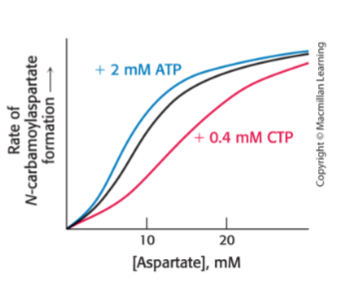
Heterotropic effects
The effects of regulatory molecules on allosteric enzymes are referred to as heterotropic effects because the binding of one molecule (the effector) has an effect on a different molecule (the substrate)
Shift the sigmoidal curve to the left (activators) or right (inhibitors)

Homotropic effects
If the effects are due to molecules of the same kind, like substrates binding to different subunits, these effects referred to as homotropic effects because they are due to the binding of more than one of the same molecules
Sequential Model for Allosteric Enzymes (allostery)
More readily accommodates negative cooperativity, where the binding of one substrate decreases the affinity of other sites
Which model do allosteric enzymes follow?
A mixture of sequential and concerted
Ensemble Studies
Most experiments use an enzyme preparation in a solution; even a few microliters hold millions of enzymes
Assumes all enzyme molecules are the same or very similar
Generates a single value representing the averge enzyme activity for a heterogeneous assembly
Single-Molecule Experiments
Examine one enzyme molecule at a time. Yield great information:
Existence of rare or transient structures
Fleeting events in a reaction sequence
Mechanical forces affecting or generated by an enzyme