Soils Exam 2 - Lectures 14, 15, and 16
 Call Kai
 Learn
 Practice Test
 Spaced Repetition
 Match
 Flashcards
 Knowt Play
1/15

There's no tags or description
Looks like no tags are added yet.
16 Terms
2 units for CEC
centimoles of positive charge per kilogram soil (cmolc/kg)
“milliequivalent” (meq)
both are the same number, just different units.
calculating soil CEC
Step 1 — know the charge and weight of each ion
Step 2 — convert each ion from grams of soil to cmolc/kg of soil
YOU MUST KNOW:
• How much soil was extracted
• Atomic weight and charge on each ion measured (these do not change – from the periodic table)
• Only NONACID cations are used (disregard H or Al!)
calculating the equivalent weight of ions
molar mass of the ion (periodic table) / charge of the ion
What are characteristics of soil colloids?
• Extremely small size (only can see with an electron microscope)
• Large external surface area per unit of mass
• Have both negative and positive surface charges
• These charges lead to adsorption of ions and water
4 types of soil colloids
1. Layer silicate clays – crystalline silicate clays
2. Iron and aluminum oxide clays (the minerals gibbsite and
3. Allophane – non-crystalline silicate clays (volcanic)
4. Humus (organic matter – well decomposed)
isomorphic substitution
when cations of a similar size substitute for the Al and Si in the sheets – this occurs during weathering; this is the part of CEC we call Permanent Charge.
Which ions can sub for which in each layer?
• Si, Al and Fe3+ are the only ions that can substitute in the tetrahedral sheet.
• Octahedral sheet: Al, Fe3+, Mg, Fe2+
• Exchange sites: Al, Fe3+, Mg, Fe2+, Zn, Na, Ca, K
• Both sheets: O and OH
basic properties/possible uses (if given), arrangement of Si tetrahedrals/Al octahedrals of kaolinite, smectite, vermiculite, illite and chlorite

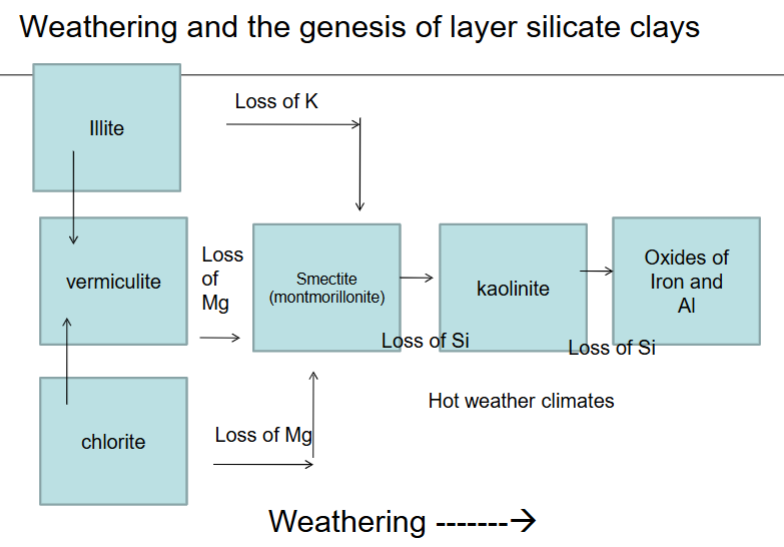
weathering (the degree of) and the genesis of layer silicate clays and Fe/Al oxides
‘Low,’ ‘Medium’ and ‘High’ ranges of CEC of layer silicate clays, humus, allophane and Al/Fe oxides
low: Al/Fe oxides, kaolinite
medium: illite, chlorite, allophane
high: humus, vermiculite, smectite
Which colloids have a pH dependent charge?
humus, kaolinite, allophane and Fe/Al oxides
How does pH dependent charge develop?
• We get it from the presence of OH-’s or other groups that accept or release H+ ions to create negative or positive charges.
• These charges are a function (depend upon) the pH of the soil.
• Thus, these are called pH-dependent charge.
Which colloids have AEC?
kaolinite, allophane, and Al/Fe oxides
equation for which a changing pH affects in Al compounds
-- Al – OH (Al with attached OH)
when pH increases…OH- added
-- Al – OH + OH- -→ Al-O- + H2O
equation for which a changing pH affects in OM
-CO-OH + OH- → - CO – O- + H2O
Al/Fe oxides and their formulas
Goethite — (FeOOH)
Hematite — (Fe2O3)
Gibbsite — (AlOH)3